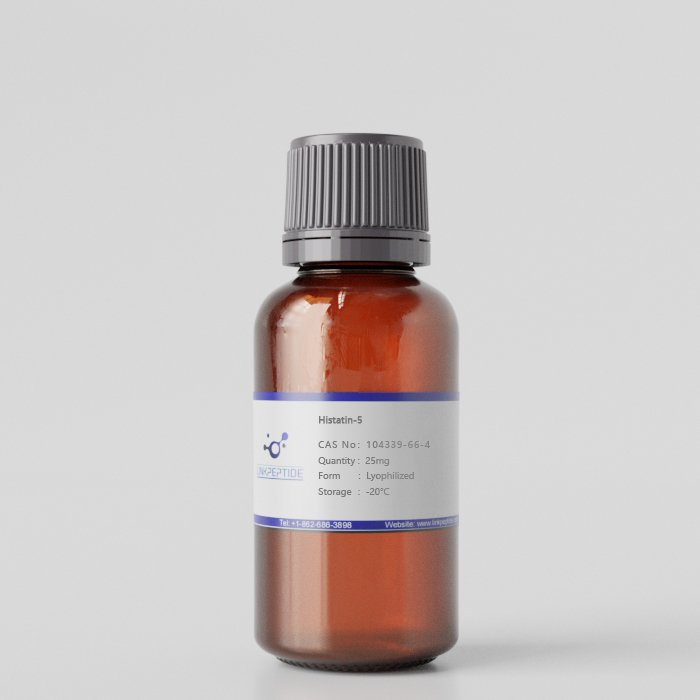
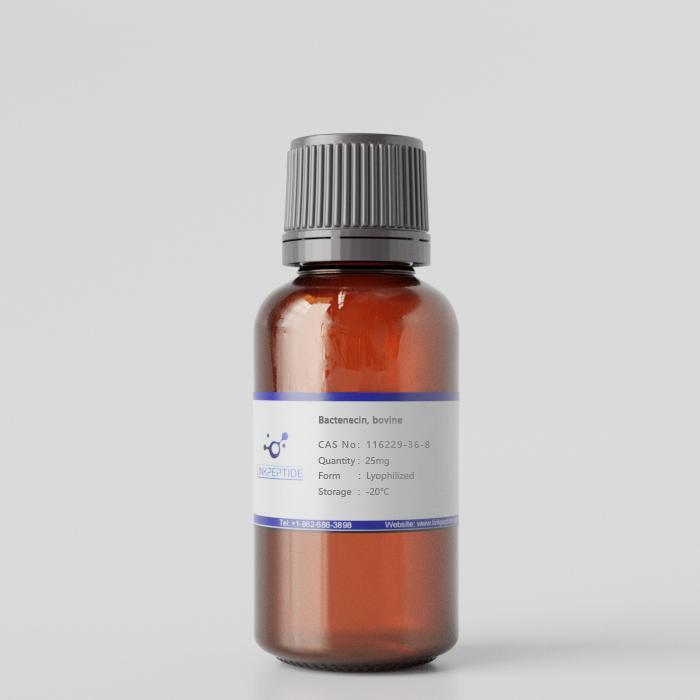
Product Name: Histatin-5
Sequence One Letter Code: DSHAKRHHGYKRKFHEKHHSHRGY
Sequence Three Letter Code: H-Asp-Ser-His-Ala-Lys-Arg-His-His-Gly-Tyr-Lys-Arg-Lys-Phe-His-Glu-Lys-His-His-Ser-His-Arg-Gly-Tyr-OH
Cas No: 104339-66-4
Chemical Formula:C133H195N51O33
Molecular Weight: 3036.5
Purity: 95%
Form: Lyophilized
Storage Conditions: - 20 °C
Research Area: Infection Disease Research
SMILES: CC(C(=O)NC(CCCCN)C(=O)NC(CCCNC(=N)N)C(=O)NC(CC1=CNC=N1)C(=O)NC(CC2=CNC=N2)C(=O)NCC(=O)NC(CC3=CC=C(C=C3)O)C(=O)NC(CCCCN)C(=O)NC(CCCNC(=N)N)C(=O)NC(CCCCN)C(=O)NC(CC4=CC=CC=C4)C(=O)NC(CC5=CNC=N5)C(=O)NC(CCC(=O)O)C(=O)NC(CCCCN)C(=O)NC(CC6=CNC=N6)C(=O)NC(CC7=CNC=N7)C(=O)NC(CO)C(=O)NC(CC8=CNC=N8)C(=O)NC(CCCNC(=N)N)C(=O)NCC(=O)NC(CC9=CC=C(C=C9)O)C(=O)O)NC(=O)C(CC1=CNC=N1)NC(=O)C(CO)NC(=O)C(CC(=O)O)N
IUPAC: 4-[[2-[[2-[[6-amino-2-[[2-[[6-amino-2-[[2-[[2-[[2-[[2-[[2-[[6-amino-2-[2-[[2-[[2-[(2-amino-3-carboxypropanoyl)amino]-3-hydroxypropanoyl]amino]-3-(1H-imidazol-4-yl)propanoyl]amino]propanoylamino]hexanoyl]amino]-5-carbamimidamidopentanoyl]amino]-3-(1H-imidazol-4-yl)propanoyl]amino]-3-(1H-imidazol-4-yl)propanoyl]amino]acetyl]amino]-3-(4-hydroxyphenyl)propanoyl]amino]hexanoyl]amino]-5-carbamimidamidopentanoyl]amino]hexanoyl]amino]-3-phenylpropanoyl]amino]-3-(1H-imidazol-4-yl)propanoyl]amino]-5-[[6-amino-1-[[1-[[1-[[1-[[1-[[5-carbamimidamido-1-[[2-[[1-carboxy-2-(4-hydroxyphenyl)ethyl]amino]-2-oxoethyl]amino]-1-oxopentan-2-yl]amino]-3-(1H-imidazol-4-yl)-1-oxopropan-2-yl]amino]-3-hydroxy-1-oxopropan-2-yl]amino]-3-(1H-imidazol-4-yl)-1-oxopropan-2-yl]amino]-3-(1H-imidazol-4-yl)-1-oxopropan-2-yl]amino]-1-oxohexan-2-yl]amino]-5-oxopentanoic acid
INCHIKEY: KSXBMTJGDUPBBN-UHFFFAOYSA-N
INCHI:
InChI=1S/C133H195N51O33/c1-71(164-120(206)96(46-76-54-146-65-158-76)181-128(214)103(62-185)183-110(196)84(138)52-108(193)194)109(195)167-86(18-5-9-35-134)113(199)172-91(24-15-41-154-133(143)144)118(204)178-99(49-79-57-149-68-161-79)125(211)176-95(45-75-53-145-64-157-75)112(198)156-60-105(189)165-93(43-73-25-29-82(187)30-26-73)121(207)173-87(19-6-10-36-135)114(200)171-90(23-14-40-153-132(141)142)115(201)169-88(20-7-11-37-136)116(202)175-94(42-72-16-3-2-4-17-72)122(208)179-97(47-77-55-147-66-159-77)124(210)174-92(33-34-107(191)192)119(205)170-89(21-8-12-38-137)117(203)177-100(50-80-58-150-69-162-80)126(212)180-101(51-81-59-151-70-163-81)127(213)184-104(63-186)129(215)182-98(48-78-56-148-67-160-78)123(209)168-85(22-13-39-152-131(139)140)111(197)155-61-106(190)166-102(130(216)217)44-74-27-31-83(188)32-28-74/h2-4,16-17,25-32,53-59,64-71,84-104,185-188H,5-15,18-24,33-52,60-63,134-138H2,1H3,(H,145,157)(H,146,158)(H,147,159)(H,148,160)(H,149,161)(H,150,162)(H,151,163)(H,155,197)(H,156,198)(H,164,206)(H,165,189)(H,166,190)(H,167,195)(H,168,209)(H,169,201)(H,170,205)(H,171,200)(H,172,199)(H,173,207)(H,174,210)(H,175,202)(H,176,211)(H,177,203)(H,178,204)(H,179,208)(H,180,212)(H,181,214)(H,182,215)(H,183,196)(H,184,213)(H,191,192)(H,193,194)(H,216,217)(H4,139,140,152)(H4,141,142,153)(H4,143,144,154)
Source / Species: human
Conjugation: Unconjugated
Code Nacres: NA.26
Application: Histatin-5 is a human cationic salivary peptide belonging to the histatin family of antimicrobial peptides and is a key component of oral innate immunity. It exhibits potent fungicidal activity, particularly against Candida species, through membrane disruption and intracellular targeting mechanisms. Produced by salivary glands, Histatin-5 contributes to mucosal defense and epithelial homeostasis. Beyond its antimicrobial properties, it has been investigated for roles in wound healing and epithelial regeneration. This peptide is broadly utilized in oral biology, microbiology, and immunology research to study antifungal mechanisms, host–pathogen interactions, and peptide-based therapeutic strategies.
Current Research: Histatin-5 is a human cationic salivary peptide and a prominent member of the histatin family of antimicrobial peptides (AMPs). Secreted primarily by the parotid and submandibular glands, Histatin-5 is a critical effector of oral innate immunity, contributing to antimicrobial surveillance, mucosal protection, and epithelial integrity within the oral cavity. Among salivary AMPs, it is particularly distinguished for its potent fungicidal activity against Candida species, including Candida albicans, a major opportunistic fungal pathogen. Molecular and Functional Characteristics Histatin-5 is rich in histidine residues, conferring a net positive charge at physiological pH. This cationic property facilitates electrostatic interactions with negatively charged microbial cell surfaces. Unlike many AMPs that act solely via membrane lysis, Histatin-5 employs a multi-step antifungal mechanism: Cell surface binding to fungal cell wall components Translocation across the membrane Intracellular targeting, including disruption of mitochondrial function and induction of ionic imbalance ATP efflux and oxidative stress, culminating in fungal cell death This mechanism distinguishes Histatin-5 from classical pore-forming peptides and makes it a valuable model for studying non-lytic antimicrobial pathways. Role in Oral Mucosal Defense Within saliva, Histatin-5 acts synergistically with other antimicrobial factors such as defensins, lysozyme, and lactoferrin. Its activity helps maintain microbial homeostasis and prevent fungal overgrowth under normal physiological conditions. Reduced salivary Histatin-5 levels have been associated with increased susceptibility to oral candidiasis, particularly in immunocompromised individuals. Beyond direct antimicrobial effects, Histatin-5 contributes to epithelial barrier maintenance. It interacts with host cells to support mucosal resilience and may influence inflammatory signaling pathways relevant to host–pathogen dynamics. Emerging Roles in Wound Healing and Regeneration In addition to antifungal activity, Histatin-5 has demonstrated pro-migratory and wound-healing properties in epithelial cell models. Studies show that it can promote re-epithelialization by enhancing cell migration and supporting tissue repair processes. These findings have stimulated interest in Histatin-derived peptides as candidates for topical therapeutics, including applications in oral mucosal injury, periodontal disease, and potentially broader epithelial repair contexts. Research Applications Histatin-5 is widely used in the following areas: 1. Antifungal Mechanism Studies Membrane interaction assays Fungal viability and ATP release assays Reactive oxygen species (ROS) analysis Mitochondrial dysfunction studies 2. Host–Pathogen Interaction Research Candida albicans adhesion and invasion models Biofilm inhibition and disruption studies Saliva–microbiome interaction investigations 3. Oral Biology and Immunology Salivary defense mechanism characterization Innate immune peptide signaling pathways Inflammatory modulation in epithelial cells 4. Peptide Therapeutic Development Design of stabilized histatin analogs Evaluation of antifungal peptide derivatives Biomaterial coatings for antifungal protection Experimental Considerations Histatin-5 activity can be influenced by ionic strength, pH, and proteolytic degradation in biological matrices. When designing experiments, buffer composition and peptide stability should be carefully controlled. Dose–response evaluation is recommended, particularly in fungal killing assays or epithelial migration studies.
Get a Quote
 LinkPeptide