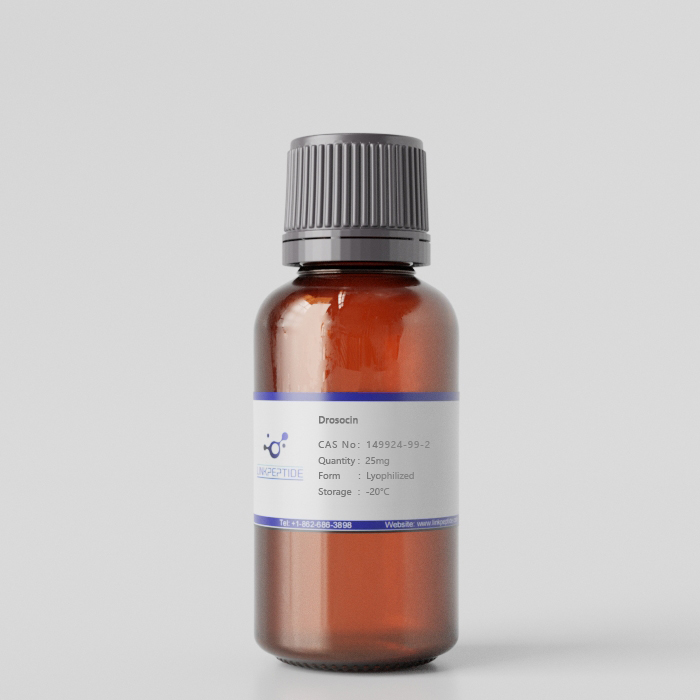
Product Name: Drosocin
Sequence One Letter Code: GKPRPYSPRPTSHPRPIRV
Sequence Three Letter Code: H-Gly-Lys-Pro-Arg-Pro-Tyr-Ser-Pro-Arg-Pro-Thr-Ser-His-Pro-Arg-Pro-Ile-Arg-Val-OH
Cas No: 149924-99-2
Chemical Formula:C98H160N34O24
Molecular Weight: 2198.6
Purity: 95%
Form: Lyophilized
Storage Conditions: - 20 °C
Research Area: Bacterial
SMILES: CC[C@H](C)[C@@H](C(=O)N[C@@H](CCCNC(=N)N)C(=O)N[C@@H](C(C)C)C(=O)O)NC(=O)[C@@H]1CCCN1C(=O)[C@H](CCCNC(=N)N)NC(=O)[C@@H]2CCCN2C(=O)[C@H](CC3=CN=CN3)NC(=O)[C@H](CO)NC(=O)[C@H]([C@@H](C)O)NC(=O)[C@@H]4CCCN4C(=O)[C@H](CCCNC(=N)N)NC(=O)[C@@H]5CCCN5C(=O)[C@H](CO)NC(=O)[C@H](CC6=CC=C(C=C6)O)NC(=O)[C@@H]7CCCN7C(=O)[C@H](CCCNC(=N)N)NC(=O)[C@@H]8CCCN8C(=O)[C@H](CCCCN)NC(=O)CN
IUPAC: (2S)-2-[[(2S)-2-[[(2S,3S)-2-[[(2S)-1-[(2S)-2-[[(2S)-1-[(2S)-2-[[(2S)-2-[[(2S,3R)-2-[[(2S)-1-[(2S)-2-[[(2S)-1-[(2S)-2-[[(2S)-2-[[(2S)-1-[(2S)-2-[[(2S)-1-[(2S)-6-amino-2-[(2-aminoacetyl)amino]hexanoyl]pyrrolidine-2-carbonyl]amino]-5-carbamimidamidopentanoyl]pyrrolidine-2-carbonyl]amino]-3-(4-hydroxyphenyl)propanoyl]amino]-3-hydroxypropanoyl]pyrrolidine-2-carbonyl]amino]-5-carbamimidamidopentanoyl]pyrrolidine-2-carbonyl]amino]-3-hydroxybutanoyl]amino]-3-hydroxypropanoyl]amino]-3-(1H-imidazol-5-yl)propanoyl]pyrrolidine-2-carbonyl]amino]-5-carbamimidamidopentanoyl]pyrrolidine-2-carbonyl]amino]-3-methylpentanoyl]amino]-5-carbamimidamidopentanoyl]amino]-3-methylbutanoic acid
INCHIKEY: NRRWQFGMQBIGRJ-AXGRSTHOSA-N
INCHI:
InChI=1S/C98H160N34O24/c1-6-53(4)75(86(147)116-58(20-9-35-110-95(101)102)77(138)124-74(52(2)3)94(155)156)125-84(145)71-28-17-41-129(71)90(151)61(22-11-37-112-97(105)106)118-81(142)68-25-15-43-131(68)92(153)64(46-56-48-109-51-114-56)121-79(140)65(49-133)122-87(148)76(54(5)135)126-85(146)72-29-18-42-130(72)91(152)62(23-12-38-113-98(107)108)119-82(143)69-26-16-44-132(69)93(154)66(50-134)123-78(139)63(45-55-30-32-57(136)33-31-55)120-83(144)70-27-14-40-128(70)89(150)60(21-10-36-111-96(103)104)117-80(141)67-24-13-39-127(67)88(149)59(19-7-8-34-99)115-73(137)47-100/h30-33,48,51-54,58-72,74-76,133-136H,6-29,34-47,49-50,99-100H2,1-5H3,(H,109,114)(H,115,137)(H,116,147)(H,117,141)(H,118,142)(H,119,143)(H,120,144)(H,121,140)(H,122,148)(H,123,139)(H,124,138)(H,125,145)(H,126,146)(H,155,156)(H4,101,102,110)(H4,103,104,111)(H4,105,106,112)(H4,107,108,113)/t53-,54+,58-,59-,60-,61-,62-,63-,64-,65-,66-,67-,68-,69-,70-,71-,72-,74-,75-,76-/m0/s1
Source / Species: Drosophila
Conjugation: Unconjugated
Code Nacres: NA.26
Application: Drosocin is a 19-amino acid cationic antimicrobial peptide originally isolated from Drosophila melanogaster and involved in insect innate immunity. In its native form, drosocin contains a disaccharide modification that enhances antibacterial potency. This synthetic version preserves the native amino acid sequence but lacks glycosylation, resulting in reduced yet measurable antimicrobial activity. Drosocin primarily targets Gram-negative bacteria and exerts its effects by interfering with essential bacterial physiological processes. It serves as an important model for studying structure–activity relationships and the functional contribution of glycosylation to antimicrobial efficacy. Researchers use drosocin to investigate insect host-defense mechanisms, peptide–pathogen interactions, and evolutionary aspects of innate immunity. This peptide supports microbiological studies and mechanistic research aimed at understanding how post-translational modifications influence antimicrobial peptide function.
Current Research: Drosocin is a 19-amino acid cationic antimicrobial peptide originally isolated from Drosophila melanogaster and functions as an effector molecule in insect innate immunity. It belongs to the class of proline-rich antimicrobial peptides (PrAMPs), which differ mechanistically from membrane-lytic peptides by targeting intracellular bacterial processes. In its native form, drosocin contains an O-linked disaccharide modification on a threonine residue, a post-translational modification that enhances antibacterial potency. The synthetic version preserves the primary amino acid sequence but lacks glycosylation, resulting in reduced yet measurable antimicrobial activity. This distinction makes drosocin a valuable model for investigating structure–activity relationships and the functional role of glycosylation in antimicrobial efficacy. Unlike amphipathic α-helical peptides that disrupt membranes directly, drosocin primarily targets Gram-negative bacteria through a non-lytic mechanism. Proline-rich antimicrobial peptides typically penetrate bacterial cells via inner membrane transport systems, such as the SbmA transporter in Escherichia coli. Once internalized, drosocin interferes with essential bacterial physiological processes, including protein synthesis. Studies suggest that PrAMPs bind to bacterial ribosomal components, inhibiting translation and ultimately leading to growth arrest or cell death. The absence of significant membrane disruption distinguishes drosocin from classical membrane-active peptides and highlights its specific intracellular mode of action. The glycosylation present in native drosocin contributes to enhanced antibacterial potency and stability. The disaccharide modification influences peptide conformation, solubility, and interaction with bacterial targets. By comparing glycosylated and non-glycosylated forms, researchers can dissect how post-translational modifications modulate uptake efficiency, target affinity, and resistance susceptibility. The synthetic non-glycosylated peptide provides a controlled baseline for evaluating the contribution of the carbohydrate moiety to biological function. Drosocin is particularly active against Gram-negative organisms, including E. coli and related enteric bacteria. Its activity spectrum and mechanism make it a useful probe for studying bacterial stress responses and resistance mechanisms. Because PrAMPs rely on specific uptake pathways, mutations in transporter proteins can reduce susceptibility, providing insight into evolutionary adaptation and host–pathogen interactions. Experimental systems using drosocin help clarify how bacteria regulate membrane transport and ribosomal protection in response to antimicrobial pressure. In insect immunity research, drosocin serves as a model effector molecule induced by activation of immune pathways such as the Imd pathway in Drosophila. Studying its expression and activity contributes to understanding how invertebrates deploy rapid, sequence-specific antimicrobial responses without adaptive immunity. Comparative analysis with mammalian antimicrobial peptides further illuminates conserved and divergent strategies in innate defense. The peptide is also widely used in structure–activity relationship (SAR) studies. Systematic substitution of residues, truncation experiments, or synthetic glycosylation variants allow investigation of sequence determinants required for ribosomal binding and antibacterial activity. These analyses inform broader efforts to design peptide-based antibiotics that exploit intracellular targets rather than membrane disruption, potentially reducing toxicity to host cells. From a translational perspective, proline-rich peptides like drosocin offer templates for developing novel anti-infective agents. Because their mechanism involves inhibition of bacterial protein synthesis through unique binding modes, they may circumvent resistance pathways associated with conventional antibiotics. Understanding the influence of glycosylation on stability and potency also guides strategies for optimizing pharmacokinetic properties. In summary, drosocin is a 19-residue proline-rich antimicrobial peptide central to insect innate immunity. The synthetic non-glycosylated form retains sequence identity but exhibits reduced potency compared to the native glycosylated peptide, enabling focused investigation of glycosylation-dependent activity. By serving as a model for intracellular antimicrobial mechanisms, transporter-mediated uptake, and evolutionary host defense strategies, drosocin supports microbiological research and development of next-generation peptide therapeutics.
Get a Quote
 LinkPeptide