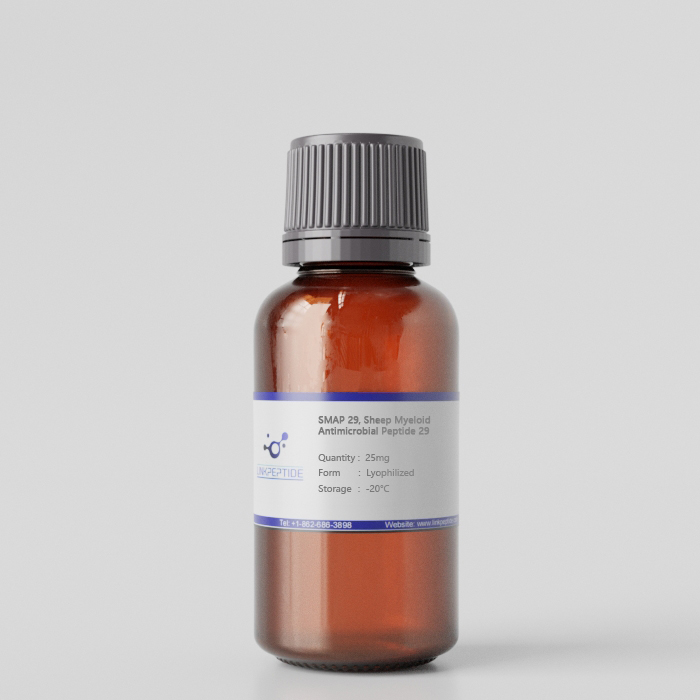
Product Name: SMAP 29, Sheep Myeloid Antimicrobial Peptide 29
Sequence One Letter Code: RGLRRLGRKIAHGVKKYGPTVLRIIRIAG
Sequence Three Letter Code: H-Arg-Gly-Leu-Arg-Arg-Leu-Gly-Arg-Lys-Ile-Ala-His-Gly-Val-Lys-Lys-Tyr-Gly-Pro-Thr-Val-Leu-Arg-Ile-Ile-Arg-Ile-Ala-Gly-OH
Chemical Formula:C146H260N52O32
Molecular Weight: 3256
Purity: 95%
Form: Lyophilized
Storage Conditions: - 20 °C
Research Area: Bacterial
Source / Species: sheep
Conjugation: Unconjugated
Code Nacres: NA.26
Application: SMAP 29 (Sheep Myeloid Antimicrobial Peptide 29) is a 29–amino acid cathelicidin-derived peptide with potent broad-spectrum antimicrobial activity. It demonstrates strong efficacy against Gram-negative bacteria, including Pseudomonas species, as well as multidrug-resistant pathogens. SMAP 29 remains active under both low- and high-ionic-strength conditions, highlighting its stability in physiologically relevant environments. Mechanistically, it disrupts bacterial membrane integrity, leading to rapid morphological damage and cell death. Its amphipathic structure supports membrane-targeting activity consistent with host-defense peptides. Due to its potency and robustness, SMAP 29 is widely employed in studies of innate immunity, antimicrobial peptide engineering, and membrane–peptide interactions. It also serves as a template for developing peptide-based anti-infective therapeutics. The peptide is particularly valuable in evaluating resistance mechanisms and exploring structure–activity relationships in antimicrobial design.
Current Research: SMAP 29 (Sheep Myeloid Antimicrobial Peptide 29) continues to attract significant attention in antimicrobial and innate immunity research, particularly in the context of rising multidrug resistance. As a member of the cathelicidin family, SMAP 29 is derived from the C-terminal region of a sheep myeloid precursor protein and exhibits potent, broad-spectrum antimicrobial activity. Recent investigations emphasize its strong efficacy against Gram-negative pathogens, including Pseudomonas aeruginosa, Acinetobacter baumannii, and other clinically problematic species, as well as activity against select Gram-positive bacteria. Current research has focused extensively on elucidating its mechanism of action. Biophysical and imaging studies demonstrate that SMAP 29 adopts an amphipathic α-helical structure upon interaction with lipid membranes. This conformational transition facilitates electrostatic binding to negatively charged bacterial membranes, followed by membrane permeabilization, pore formation, and rapid cytoplasmic leakage. Advanced microscopy and membrane-mimetic model systems confirm extensive surface disruption and blebbing consistent with membrane-targeting host-defense peptides. Importantly, its activity under both low- and high-ionic-strength conditions distinguishes it from many antimicrobial peptides whose efficacy diminishes in physiological salt concentrations. Structure–activity relationship (SAR) studies represent a major area of ongoing investigation. Researchers are dissecting the contribution of charge distribution, hydrophobic moment, and helix stability to antimicrobial potency and selectivity. Truncated analogs and residue substitutions have been engineered to reduce cytotoxicity toward mammalian cells while maintaining bactericidal activity. These optimization strategies aim to improve therapeutic indices and minimize hemolytic effects, a common challenge in peptide-based drug development. SMAP 29 is also widely used to study bacterial resistance mechanisms. Unlike conventional antibiotics that target specific intracellular pathways, membrane-disrupting peptides impose a multifaceted stress that reduces the likelihood of rapid resistance development. Nonetheless, adaptive responses such as lipid A modification, altered membrane charge, and efflux pump upregulation have been observed under selective pressure. Investigations using SMAP 29 help clarify how bacterial membranes remodel in response to cationic peptides and how combination therapies might suppress adaptive resistance. Beyond direct antimicrobial effects, emerging research suggests immunomodulatory functions. Like other cathelicidins, SMAP 29 may influence cytokine production, chemotaxis, and innate immune signaling pathways. Studies are examining its potential to modulate inflammatory responses in infection models, particularly in pulmonary and wound-healing contexts where both microbial clearance and inflammation control are critical. Translational research is actively exploring SMAP 29 as a template for next-generation anti-infective agents. Nanoparticle delivery systems, peptide conjugates, and surface coatings incorporating SMAP 29–derived sequences are under evaluation for applications ranging from implant-associated infection prevention to topical therapeutics. Its stability across physiologically relevant ionic conditions enhances its suitability for such applications. Collectively, SMAP 29 serves as both a mechanistic probe and a development scaffold in antimicrobial research. Ongoing studies continue to refine understanding of membrane-targeting peptides, optimize therapeutic properties, and address the urgent need for novel strategies to combat antibiotic-resistant pathogens.
Get a Quote
 LinkPeptide