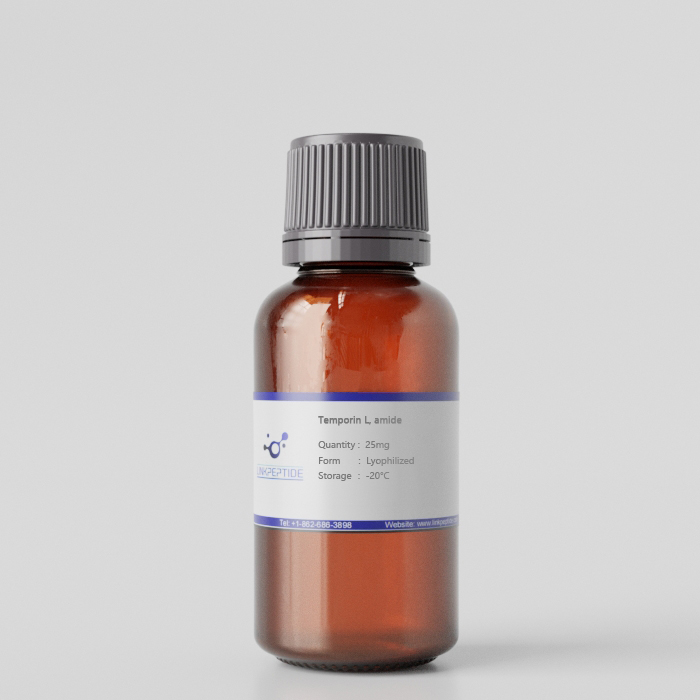
Product Name: Temporin L, amide
Sequence One Letter Code: FVQWFSKFLGRIL-NH2
Sequence Three Letter Code: H-Phe-Val-Gln-Trp-Phe-Ser-Lys-Phe-Leu-Gly-Arg-Ile-Leu-NH2
Chemical Formula:C83H122N20O15
Molecular Weight: 1640.1
Purity: 95%
Form: Lyophilized
Storage Conditions: - 20 °C
Research Area: Bacterial
Source / Species: frog
Conjugation: Unconjugated
Code Nacres: NA.26
Application: Temporin L is a hydrophobic antimicrobial peptide amide originally isolated from the frog Rana temporaria. It exerts bactericidal activity by inserting into the hydrophobic core of lipid bilayers, leading to membrane destabilization and cell lysis. The peptide displays broad-spectrum activity against both Gram-positive and Gram-negative bacteria, including Bacillus megaterium and Escherichia coli. Temporin L also enhances the antimicrobial efficacy of related temporins by preventing their oligomerization with lipopolysaccharide, thereby facilitating access to bacterial membranes. Owing to its membrane-targeting mechanism and synergistic potential, Temporin L is widely used in antimicrobial research, studies of peptide–lipid interactions, and investigations into innate immune defense mechanisms.
Current Research: Antimicrobial peptides (AMPs) are essential components of innate immunity across many species, providing rapid defense against invading pathogens. These small, cationic peptides typically kill microorganisms by disrupting cellular membranes, a mechanism that reduces the likelihood of resistance compared with conventional antibiotics. Among the best-characterized amphibian AMPs is Temporin L, a hydrophobic peptide originally isolated from the skin secretions of the European red frog Rana temporaria. Due to its potent bactericidal activity and well-defined membrane-disrupting mechanism, Temporin L has become an important model peptide in antimicrobial and membrane biology research. Discovery and Biological Role in Amphibian Immunity Amphibians rely heavily on antimicrobial peptides as part of their first-line defense against microbial infection. Their skin glands secrete complex mixtures of peptides that protect the animal from bacteria, fungi, and other pathogens present in aquatic and terrestrial environments. Temporins are a family of short peptides found in the skin secretions of Rana temporaria. Among them, Temporin L is one of the most potent members, displaying strong antimicrobial activity despite its relatively short sequence length. The peptide’s amphipathic and hydrophobic nature enables it to interact efficiently with microbial membranes, a property that underlies its bactericidal activity. Because amphibian AMPs often exhibit rapid and broad-spectrum antimicrobial effects, they have attracted significant interest as templates for developing new antimicrobial strategies and as experimental tools for studying peptide–membrane interactions. Structural Characteristics and Membrane Interaction Temporin L is a hydrophobic antimicrobial peptide amide, a structural feature that enhances its interaction with lipid bilayers. Like many AMPs, the peptide adopts an amphipathic conformation when associated with membranes, allowing hydrophobic residues to insert into lipid regions while polar residues interact with membrane surfaces. This structural arrangement promotes strong affinity for bacterial membranes, which typically contain negatively charged phospholipids. Once associated with the membrane, Temporin L can penetrate the lipid bilayer and destabilize its structural integrity. Biophysical studies have shown that the peptide inserts into the hydrophobic core of lipid bilayers, disrupting membrane organization and ultimately leading to increased permeability. This disruption compromises the barrier function of the bacterial membrane and results in cell lysis. Broad-Spectrum Antibacterial Activity One of the defining characteristics of Temporin L is its broad-spectrum antimicrobial activity. The peptide has demonstrated strong bactericidal effects against both Gram-positive and Gram-negative bacteria. Experimental studies have reported activity against organisms such as Bacillus megaterium and Escherichia coli, highlighting its ability to target diverse bacterial membranes. This broad activity is largely attributed to the membrane-targeting mechanism common to many AMPs. Unlike antibiotics that act on specific metabolic pathways or enzymes, Temporin L directly disrupts the structural integrity of the microbial membrane. Because this target is fundamental to cell survival and difficult for bacteria to modify without compromising viability, AMPs often show reduced susceptibility to traditional resistance mechanisms. For this reason, Temporin L is frequently used as a model peptide in research focused on antimicrobial mechanisms and membrane disruption. Synergistic Interactions with Other Temporins Another notable feature of Temporin L is its ability to enhance the antimicrobial activity of related temporin peptides. Studies have shown that interactions between different temporins can produce synergistic effects, improving overall antimicrobial efficacy. In particular, Temporin L has been found to prevent certain temporin peptides from forming inactive oligomeric complexes with lipopolysaccharide (LPS), a key component of Gram-negative bacterial outer membranes. By inhibiting this oligomerization process, Temporin L helps maintain the availability of active temporin molecules capable of interacting with bacterial membranes. This cooperative behavior increases the ability of temporin peptides to penetrate bacterial barriers and reach their membrane targets. The phenomenon provides an interesting example of how peptide mixtures within innate immune systems can work together to enhance antimicrobial defense. Applications in Antimicrobial and Membrane Biology Research Due to its well-characterized activity and strong membrane interactions, Temporin L is widely used in antimicrobial research and biophysical studies of peptide–lipid interactions. Researchers frequently employ this peptide to investigate how amphipathic peptides associate with membranes, induce pore formation, or destabilize lipid bilayers. In model membrane systems, Temporin L is used to examine processes such as membrane permeabilization, lipid phase disruption, and peptide-induced bilayer destabilization. Techniques including fluorescence spectroscopy, circular dichroism, and lipid vesicle assays have provided insights into how the peptide interacts with membranes at the molecular level. The peptide also serves as a useful reference compound for evaluating the antimicrobial properties of newly designed peptide analogs or synthetic AMP derivatives. Insights into Innate Immune Defense Mechanisms Research on Temporin L has contributed significantly to understanding the broader principles of innate immune defense. Amphibian antimicrobial peptides illustrate how organisms employ rapid, nonspecific mechanisms to control microbial threats before adaptive immune responses are activated. By studying peptides like Temporin L, scientists can better understand how short amphipathic peptides recognize microbial membranes, disrupt lipid organization, and cooperate with related peptides to enhance antimicrobial activity. These insights not only advance basic immunology but also inform efforts to develop peptide-inspired antimicrobial agents. Conclusion Temporin L represents a powerful example of a naturally occurring antimicrobial peptide with strong membrane-disrupting activity. Originally isolated from the skin secretions of Rana temporaria, this hydrophobic peptide exerts broad-spectrum bactericidal effects by inserting into lipid bilayers and destabilizing microbial membranes. Beyond its intrinsic antimicrobial activity, Temporin L also enhances the function of related temporins by preventing inactive oligomer formation with lipopolysaccharides, thereby promoting effective membrane targeting. Its well-defined mechanism and synergistic properties make it an important research tool for studying antimicrobial peptides, peptide–lipid interactions, and innate immune defense strategies.
Get a Quote
 LinkPeptide