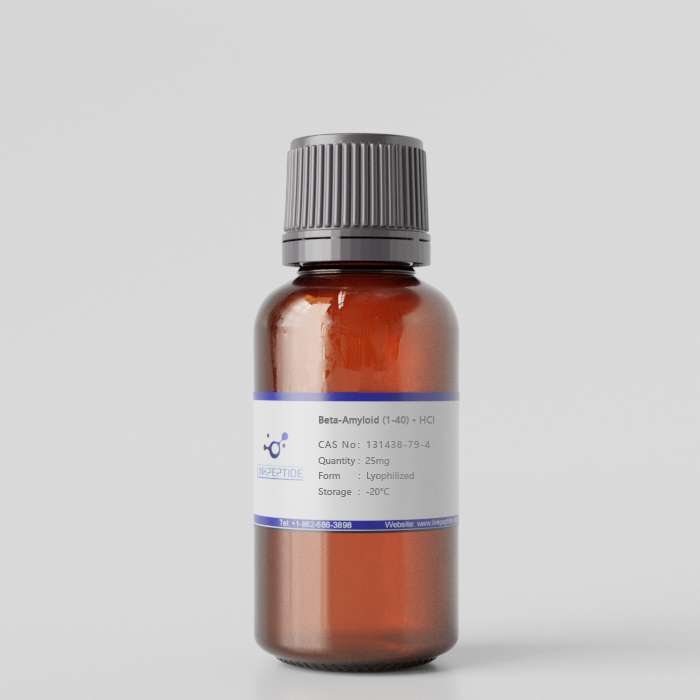
Product Name: Beta-Amyloid (1-40) • HCl
Sequence One Letter Code: DAEFRHDSGYEVHHQKLVFFAEDVGSNKGAIIGLMVGGVV • HCl
Sequence Three Letter Code: H-Asp-Ala-Glu-Phe-Arg-His-Asp-Ser-Gly-Tyr-Glu-Val-His-His-Gln-Lys-Leu-Val-Phe-Phe-Ala-Glu-Asp-Val-Gly-Ser-Asn-Lys-Gly-Ala-Ile-Ile-Gly-Leu-Met-Val-Gly-Gly-Val-Val-OH • HCl
Cas No: 131438-79-4
Chemical Formula:C194H295N53O58S
Molecular Weight: 4329.9•36.5
Purity: 95%
Form: Lyophilized
Storage Conditions: - 20 °C
Research Area: Alzheimer's Disease
SMILES: CC[C@H](C)[C@@H](C(=O)N[C@@H]([C@@H](C)CC)C(=O)NCC(=O)N[C@@H](CC(C)C)C(=O)N[C@@H](CCSC)C(=O)N[C@@H](C(C)C)C(=O)NCC(=O)NCC(=O)N[C@@H](C(C)C)C(=O)N[C@@H](C(C)C)C(=O)O)NC(=O)[C@H](C)NC(=O)CNC(=O)[C@H](CCCCN)NC(=O)[C@H](CC(=O)N)NC(=O)[C@H](CO)NC(=O)CNC(=O)[C@H](C(C)C)NC(=O)[C@H](CC(=O)O)NC(=O)[C@H](CCC(=O)O)NC(=O)[C@H](C)NC(=O)[C@H](CC1=CC=CC=C1)NC(=O)[C@H](CC2=CC=CC=C2)NC(=O)[C@H](C(C)C)NC(=O)[C@H](CC(C)C)NC(=O)[C@H](CCCCN)NC(=O)[C@H](CCC(=O)N)NC(=O)[C@H](CC3=CNC=N3)NC(=O)[C@H](CC4=CNC=N4)NC(=O)[C@H](C(C)C)NC(=O)[C@H](CCC(=O)O)NC(=O)[C@H](CC5=CC=C(C=C5)O)NC(=O)CNC(=O)[C@H](CO)NC(=O)[C@H](CC(=O)O)NC(=O)[C@H](CC6=CNC=N6)NC(=O)[C@H](CCCNC(=N)N)NC(=O)[C@H](CC7=CC=CC=C7)NC(=O)[C@H](CCC(=O)O)NC(=O)[C@H](C)NC(=O)[C@H](CC(=O)O)N
IUPAC: (4S)-5-[[(2S)-1-[[(2S)-1-[[(2S)-1-[[(2S)-1-[[(2S)-1-[[2-[[(2S)-1-[[(2S)-1-[[(2S)-1-[[(2S)-1-[[(2S)-1-[[(2S)-5-amino-1-[[(2S)-6-amino-1-[[(2S)-1-[[(2S)-1-[[(2S)-1-[[(2S)-1-[[(2S)-1-[[(2S)-1-[[(2S)-1-[[(2S)-1-[[2-[[(2S)-1-[[(2S)-4-amino-1-[[(2S)-6-amino-1-[[2-[[(2S)-1-[[(2S,3S)-1-[[(2S,3S)-1-[[2-[[(2S)-1-[[(2S)-1-[[(2S)-1-[[2-[[2-[[(2S)-1-[[(1S)-1-carboxy-2-methylpropyl]amino]-3-methyl-1-oxobutan-2-yl]amino]-2-oxoethyl]amino]-2-oxoethyl]amino]-3-methyl-1-oxobutan-2-yl]amino]-4-methylsulfanyl-1-oxobutan-2-yl]amino]-4-methyl-1-oxopentan-2-yl]amino]-2-oxoethyl]amino]-3-methyl-1-oxopentan-2-yl]amino]-3-methyl-1-oxopentan-2-yl]amino]-1-oxopropan-2-yl]amino]-2-oxoethyl]amino]-1-oxohexan-2-yl]amino]-1,4-dioxobutan-2-yl]amino]-3-hydroxy-1-oxopropan-2-yl]amino]-2-oxoethyl]amino]-3-methyl-1-oxobutan-2-yl]amino]-3-carboxy-1-oxopropan-2-yl]amino]-4-carboxy-1-oxobutan-2-yl]amino]-1-oxopropan-2-yl]amino]-1-oxo-3-phenylpropan-2-yl]amino]-1-oxo-3-phenylpropan-2-yl]amino]-3-methyl-1-oxobutan-2-yl]amino]-4-methyl-1-oxopentan-2-yl]amino]-1-oxohexan-2-yl]amino]-1,5-dioxopentan-2-yl]amino]-3-(1H-imidazol-4-yl)-1-oxopropan-2-yl]amino]-3-(1H-imidazol-4-yl)-1-oxopropan-2-yl]amino]-3-methyl-1-oxobutan-2-yl]amino]-4-carboxy-1-oxobutan-2-yl]amino]-3-(4-hydroxyphenyl)-1-oxopropan-2-yl]amino]-2-oxoethyl]amino]-3-hydroxy-1-oxopropan-2-yl]amino]-3-carboxy-1-oxopropan-2-yl]amino]-3-(1H-imidazol-4-yl)-1-oxopropan-2-yl]amino]-5-carbamimidamido-1-oxopentan-2-yl]amino]-1-oxo-3-phenylpropan-2-yl]amino]-4-[[(2S)-2-[[(2S)-2-amino-3-carboxypropanoyl]amino]propanoyl]amino]-5-oxopentanoic acid
INCHIKEY: FEWOUVRMGWFWIH-ILZZQXMPSA-N
INCHI:
InChI=1S/C194H295N53O58S/c1-25-102(19)158(188(299)211-87-143(256)218-124(67-94(3)4)174(285)228-123(62-66-306-24)172(283)241-152(96(7)8)186(297)209-83-140(253)206-84-145(258)240-154(98(11)12)191(302)245-157(101(17)18)193(304)305)247-192(303)159(103(20)26-2)246-162(273)104(21)215-141(254)85-207-164(275)116(47-36-38-63-195)223-181(292)133(77-139(199)252)234-185(296)137(90-249)220-144(257)88-210-187(298)153(97(9)10)242-184(295)135(79-151(269)270)235-170(281)121(56-60-147(261)262)222-161(272)106(23)217-173(284)127(69-107-41-30-27-31-42-107)231-177(288)129(71-109-45-34-29-35-46-109)237-189(300)156(100(15)16)244-183(294)125(68-95(5)6)229-166(277)117(48-37-39-64-196)224-168(279)119(54-58-138(198)251)226-178(289)130(73-111-80-202-91-212-111)233-180(291)132(75-113-82-204-93-214-113)238-190(301)155(99(13)14)243-171(282)122(57-61-148(263)264)227-175(286)126(72-110-50-52-114(250)53-51-110)219-142(255)86-208-165(276)136(89-248)239-182(293)134(78-150(267)268)236-179(290)131(74-112-81-203-92-213-112)232-167(278)118(49-40-65-205-194(200)201)225-176(287)128(70-108-43-32-28-33-44-108)230-169(280)120(55-59-146(259)260)221-160(271)105(22)216-163(274)115(197)76-149(265)266/h27-35,41-46,50-53,80-82,91-106,115-137,152-159,248-250H,25-26,36-40,47-49,54-79,83-90,195-197H2,1-24H3,(H2,198,251)(H2,199,252)(H,202,212)(H,203,213)(H,204,214)(H,206,253)(H,207,275)(H,208,276)(H,209,297)(H,210,298)(H,211,299)(H,215,254)(H,216,274)(H,217,284)(H,218,256)(H,219,255)(H,220,257)(H,221,271)(H,222,272)(H,223,292)(H,224,279)(H,225,287)(H,226,289)(H,227,286)(H,228,285)(H,229,277)(H,230,280)(H,231,288)(H,232,278)(H,233,291)(H,234,296)(H,235,281)(H,236,290)(H,237,300)(H,238,301)(H,239,293)(H,240,258)(H,241,283)(H,242,295)(H,243,282)(H,244,294)(H,245,302)(H,246,273)(H,247,303)(H,259,260)(H,261,262)(H,263,264)(H,265,266)(H,267,268)(H,269,270)(H,304,305)(H4,200,201,205)/t102-,103-,104-,105-,106-,115-,116-,117-,118-,119-,120-,121-,122-,123-,124-,125-,126-,127-,128-,129-,130-,131-,132-,133-,134-,135-,136-,137-,152-,153-,154-,155-,156-,157-,158-,159-/m0/s1
Source / Species: human
Conjugation: Unconjugated
Code Nacres: NA.26
Application: Beta-Amyloid (1–40) is a peptide derived from amyloid precursor protein and a major component of amyloid deposits associated with neurodegenerative disorders. In aqueous environments, it adopts β-sheet structures and self-assembles into fibrillar aggregates with neurotoxic properties. These aggregates impair neuronal function and reduce cellular metabolic activity, contributing to neurodegeneration. Compared to Aβ (1–42), this isoform is more abundant but less aggregation-prone, making it useful for controlled studies of amyloid formation. Beta-Amyloid (1–40) is widely used in research to investigate peptide aggregation, cytotoxicity, and mechanisms of neuroinflammation, providing a well-characterized model for studying protein misfolding and Alzheimer’s disease pathology.
Current Research: β-Amyloid (1–40), commonly referred to as Aβ (1–40), is a 40-amino-acid peptide generated through proteolytic processing of amyloid precursor protein (APP). It is one of the most abundant amyloid-β isoforms found in the human brain and a प्रमुख component of amyloid deposits associated with neurodegenerative disorders, particularly Alzheimer’s disease (AD). While less aggregation-prone than Aβ (1–42), Aβ (1–40) remains a critical model for studying protein misfolding, aggregation dynamics, and amyloid-associated toxicity. Structural Properties and Aggregation Behavior In aqueous environments, Aβ (1–40) can transition from a predominantly unstructured monomer into β-sheet–rich conformations, which promote self-association. This process leads to the formation of: Soluble oligomers Protofibrils Mature fibrillar aggregates Although Aβ (1–40) aggregates more slowly than Aβ (1–42), it still forms stable fibrils with characteristic β-sheet architecture. Its comparatively lower aggregation propensity makes it particularly useful for controlled kinetic studies, where gradual assembly allows detailed observation of intermediate states. Role in Neurodegeneration Aβ (1–40) contributes to neurodegenerative processes through its ability to form aggregates that disrupt cellular function. These aggregates are associated with: Impaired neuronal signaling and synaptic function Reduced cellular metabolic activity Induction of oxidative stress and mitochondrial dysfunction Activation of inflammatory pathways in glial cells While Aβ (1–42) is more strongly linked to plaque formation in neuronal tissue, Aβ (1–40) is especially prominent in vascular amyloid deposition, including cerebral amyloid angiopathy (CAA), where it contributes to vascular dysfunction and blood–brain barrier impairment. Comparison with Aβ (1–42) Aβ (1–40) and Aβ (1–42) differ by only two amino acids at the C-terminus, yet this difference significantly affects their biochemical behavior: Aβ (1–40): More abundant, slower aggregation, more suitable for controlled studies Aβ (1–42): More hydrophobic, aggregates rapidly, forms highly toxic oligomers Because of these differences, Aβ (1–40) is often used in experimental systems where reproducibility and controlled aggregation kinetics are required. Applications in Amyloid and Neurodegeneration Research Aβ (1–40) is widely used as a model peptide in studies investigating the molecular mechanisms of amyloid formation and toxicity. Common research applications include: Aggregation and fibrillization assays to study peptide assembly kinetics Biophysical studies of β-sheet formation and structural transitions Cell-based assays evaluating amyloid-induced cytotoxicity Neuroinflammation studies involving microglial and astrocyte activation Screening of compounds that inhibit aggregation or promote peptide clearance Its well-characterized behavior makes it a standard reference in amyloid research. Mechanisms of Cytotoxicity Aβ (1–40) aggregates can disrupt cellular homeostasis through several mechanisms: Membrane interaction and permeability changes Disruption of calcium signaling Generation of reactive oxygen species (ROS) Activation of inflammatory signaling pathways These effects contribute to neuronal dysfunction and are central to understanding the progression of Alzheimer’s disease. Role in Protein Misfolding Studies Beyond its relevance to AD, Aβ (1–40) serves as a model system for studying protein misfolding and aggregation, processes that are common across many neurodegenerative diseases. Its predictable aggregation pathway and structural transitions make it ideal for investigating: Nucleation-dependent polymerization mechanisms Formation of toxic oligomeric intermediates Stability and morphology of amyloid fibrils A Foundational Tool for Alzheimer’s Disease Research β-Amyloid (1–40) remains a cornerstone reagent in the study of amyloid biology and neurodegeneration. Its abundance, defined aggregation properties, and relevance to both neuronal and vascular pathology make it indispensable for exploring the molecular basis of Alzheimer’s disease. By enabling detailed investigation of aggregation kinetics, cytotoxicity, and inflammatory responses, Aβ (1–40) continues to support advances in understanding protein misfolding disorders and the development of therapeutic strategies targeting amyloid pathology.
Get a Quote
 LinkPeptide