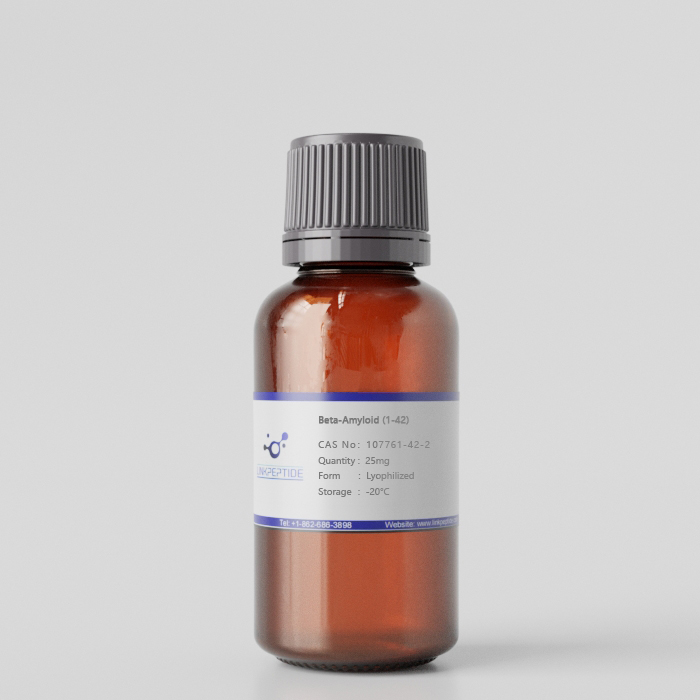
Product Name: Beta-Amyloid (1-42)
Sequence One Letter Code: DAEFRHDSGYEVHHQKLVFFAEDVGSNKGAIIGLMVGGVVIA
Sequence Three Letter Code: H-Asp-Ala-Glu-Phe-Arg-His-Asp-Ser-Gly-Tyr-Glu-Val-His-His-Gln-Lys-Leu-Val-Phe-Phe-Ala-Glu-Asp-Val-Gly-Ser-Asn-Lys-Gly-Ala-Ile-Ile-Gly-Leu-Met-Val-Gly-Gly-Val-Val-Ile-Ala-OH
Cas No: 107761-42-2
Chemical Formula:C203H311N55O60S
Molecular Weight: 4514
Purity: 95%
Form: Lyophilized
Storage Conditions: - 20 °C
Research Area: Alzheimer's Disease
SMILES: CC[C@H](C)[C@@H](C(=O)N[C@@H]([C@@H](C)CC)C(=O)NCC(=O)N[C@@H](CC(C)C)C(=O)N[C@@H](CCSC)C(=O)N[C@@H](C(C)C)C(=O)NCC(=O)NCC(=O)N[C@@H](C(C)C)C(=O)N[C@@H](C(C)C)C(=O)N[C@@H]([C@@H](C)CC)C(=O)N[C@@H](C)C(=O)O)NC(=O)[C@H](C)NC(=O)CNC(=O)[C@H](CCCCN)NC(=O)[C@H](CC(=O)N)NC(=O)[C@H](CO)NC(=O)CNC(=O)[C@H](C(C)C)NC(=O)[C@H](CC(=O)O)NC(=O)[C@H](CCC(=O)O)NC(=O)[C@H](C)NC(=O)[C@H](CC1=CC=CC=C1)NC(=O)[C@H](CC2=CC=CC=C2)NC(=O)[C@H](C(C)C)NC(=O)[C@H](CC(C)C)NC(=O)[C@H](CCCCN)NC(=O)[C@H](CCC(=O)N)NC(=O)[C@H](CC3=CNC=N3)NC(=O)[C@H](CC4=CNC=N4)NC(=O)[C@H](C(C)C)NC(=O)[C@H](CCC(=O)O)NC(=O)[C@H](CC5=CC=C(C=C5)O)NC(=O)CNC(=O)[C@H](CO)NC(=O)[C@H](CC(=O)O)NC(=O)[C@H](CC6=CNC=N6)NC(=O)[C@H](CCCNC(=N)N)NC(=O)[C@H](CC7=CC=CC=C7)NC(=O)[C@H](CCC(=O)O)NC(=O)[C@H](C)NC(=O)[C@H](CC(=O)O)N
IUPAC: (4S)-5-[[(2S)-1-[[(2S)-1-[[(2S)-1-[[(2S)-1-[[(2S)-1-[[2-[[(2S)-1-[[(2S)-1-[[(2S)-1-[[(2S)-1-[[(2S)-1-[[(2S)-5-amino-1-[[(2S)-6-amino-1-[[(2S)-1-[[(2S)-1-[[(2S)-1-[[(2S)-1-[[(2S)-1-[[(2S)-1-[[(2S)-1-[[(2S)-1-[[2-[[(2S)-1-[[(2S)-4-amino-1-[[(2S)-6-amino-1-[[2-[[(2S)-1-[[(2S,3S)-1-[[(2S,3S)-1-[[2-[[(2S)-1-[[(2S)-1-[[(2S)-1-[[2-[[2-[[(2S)-1-[[(2S)-1-[[(2S,3S)-1-[[(1S)-1-carboxyethyl]amino]-3-methyl-1-oxopentan-2-yl]amino]-3-methyl-1-oxobutan-2-yl]amino]-3-methyl-1-oxobutan-2-yl]amino]-2-oxoethyl]amino]-2-oxoethyl]amino]-3-methyl-1-oxobutan-2-yl]amino]-4-methylsulfanyl-1-oxobutan-2-yl]amino]-4-methyl-1-oxopentan-2-yl]amino]-2-oxoethyl]amino]-3-methyl-1-oxopentan-2-yl]amino]-3-methyl-1-oxopentan-2-yl]amino]-1-oxopropan-2-yl]amino]-2-oxoethyl]amino]-1-oxohexan-2-yl]amino]-1,4-dioxobutan-2-yl]amino]-3-hydroxy-1-oxopropan-2-yl]amino]-2-oxoethyl]amino]-3-methyl-1-oxobutan-2-yl]amino]-3-carboxy-1-oxopropan-2-yl]amino]-4-carboxy-1-oxobutan-2-yl]amino]-1-oxopropan-2-yl]amino]-1-oxo-3-phenylpropan-2-yl]amino]-1-oxo-3-phenylpropan-2-yl]amino]-3-methyl-1-oxobutan-2-yl]amino]-4-methyl-1-oxopentan-2-yl]amino]-1-oxohexan-2-yl]amino]-1,5-dioxopentan-2-yl]amino]-3-(1H-imidazol-4-yl)-1-oxopropan-2-yl]amino]-3-(1H-imidazol-4-yl)-1-oxopropan-2-yl]amino]-3-methyl-1-oxobutan-2-yl]amino]-4-carboxy-1-oxobutan-2-yl]amino]-3-(4-hydroxyphenyl)-1-oxopropan-2-yl]amino]-2-oxoethyl]amino]-3-hydroxy-1-oxopropan-2-yl]amino]-3-carboxy-1-oxopropan-2-yl]amino]-3-(1H-imidazol-4-yl)-1-oxopropan-2-yl]amino]-5-carbamimidamido-1-oxopentan-2-yl]amino]-1-oxo-3-phenylpropan-2-yl]amino]-4-[[(2S)-2-[[(2S)-2-amino-3-carboxypropanoyl]amino]propanoyl]amino]-5-oxopentanoic acid
INCHIKEY: DZHSAHHDTRWUTF-SIQRNXPUSA-N
INCHI:
InChI=1S/C203H311N55O60S/c1-28-106(20)164(195(310)220-91-149(267)228-130(71-98(4)5)181(296)238-129(66-70-319-27)179(294)251-158(100(8)9)193(308)218-87-146(264)215-88-151(269)250-160(102(12)13)198(313)255-163(105(18)19)199(314)258-165(107(21)29-2)200(315)227-112(26)202(317)318)257-201(316)166(108(22)30-3)256-169(284)109(23)224-147(265)89-216-171(286)122(51-40-42-67-204)233-188(303)139(81-145(208)263)244-192(307)143(94-260)230-150(268)92-219-194(309)159(101(10)11)252-191(306)141(83-157(280)281)245-177(292)127(60-64-153(272)273)232-168(283)111(25)226-180(295)133(73-113-45-34-31-35-46-113)241-184(299)135(75-115-49-38-33-39-50-115)247-196(311)162(104(16)17)254-190(305)131(72-99(6)7)239-173(288)123(52-41-43-68-205)234-175(290)125(58-62-144(207)262)236-185(300)136(77-117-84-211-95-221-117)243-187(302)138(79-119-86-213-97-223-119)248-197(312)161(103(14)15)253-178(293)128(61-65-154(274)275)237-182(297)132(76-116-54-56-120(261)57-55-116)229-148(266)90-217-172(287)142(93-259)249-189(304)140(82-156(278)279)246-186(301)137(78-118-85-212-96-222-118)242-174(289)124(53-44-69-214-203(209)210)235-183(298)134(74-114-47-36-32-37-48-114)240-176(291)126(59-63-152(270)271)231-167(282)110(24)225-170(285)121(206)80-155(276)277/h31-39,45-50,54-57,84-86,95-112,121-143,158-166,259-261H,28-30,40-44,51-53,58-83,87-94,204-206H2,1-27H3,(H2,207,262)(H2,208,263)(H,211,221)(H,212,222)(H,213,223)(H,215,264)(H,216,286)(H,217,287)(H,218,308)(H,219,309)(H,220,310)(H,224,265)(H,225,285)(H,226,295)(H,227,315)(H,228,267)(H,229,266)(H,230,268)(H,231,282)(H,232,283)(H,233,303)(H,234,290)(H,235,298)(H,236,300)(H,237,297)(H,238,296)(H,239,288)(H,240,291)(H,241,299)(H,242,289)(H,243,302)(H,244,307)(H,245,292)(H,246,301)(H,247,311)(H,248,312)(H,249,304)(H,250,269)(H,251,294)(H,252,306)(H,253,293)(H,254,305)(H,255,313)(H,256,284)(H,257,316)(H,258,314)(H,270,271)(H,272,273)(H,274,275)(H,276,277)(H,278,279)(H,280,281)(H,317,318)(H4,209,210,214)/t106-,107-,108-,109-,110-,111-,112-,121-,122-,123-,124-,125-,126-,127-,128-,129-,130-,131-,132-,133-,134-,135-,136-,137-,138-,139-,140-,141-,142-,143-,158-,159-,160-,161-,162-,163-,164-,165-,166-/m0/s1
Source / Species: human
Conjugation: Unconjugated
Code Nacres: NA.26
Application: Beta-Amyloid (1–42) is a highly aggregation-prone peptide and a principal component of amyloid plaques in Alzheimer’s disease. Compared to Aβ (1–40), its extended C-terminus increases hydrophobicity and promotes the formation of toxic oligomers and fibrils. Aβ (1–42) is strongly associated with neuronal deposition and disease progression. It is widely used in neurodegeneration research to study amyloid aggregation, fibrillization kinetics, and mechanisms of synaptic toxicity. This peptide also supports investigations into therapeutic strategies targeting amyloid formation and clearance. Its well-characterized aggregation behavior makes it a key model for understanding molecular processes underlying Alzheimer’s disease pathology.
Current Research: β-Amyloid (1–42), commonly referred to as Aβ (1–42), is a 42-amino-acid peptide derived from the proteolytic processing of amyloid precursor protein (APP). It is one of the most extensively studied molecules in neurodegenerative research due to its pivotal role in Alzheimer’s disease (AD) pathology. Compared to shorter isoforms such as Aβ (1–40), Aβ (1–42) exhibits greater hydrophobicity and aggregation propensity, making it a primary component of amyloid plaques in the brain. Because of its well-characterized biochemical properties and disease relevance, Aβ (1–42) is widely used as a model system for studying protein aggregation, neurotoxicity, and therapeutic intervention strategies. Structural Features and Aggregation Propensity The defining characteristic of Aβ (1–42) is its extended C-terminal region, which includes two additional hydrophobic residues compared to Aβ (1–40). This extension significantly enhances: Hydrophobic interactions between peptide molecules Self-association into oligomers and fibrils Stability of aggregated structures As a result, Aβ (1–42) has a strong tendency to undergo rapid aggregation, forming a range of assemblies including soluble oligomers, protofibrils, and insoluble fibrils. Among these species, soluble oligomers are considered particularly neurotoxic and are thought to play a key role in early disease progression. Role in Alzheimer’s Disease Pathology Aβ (1–42) is a major constituent of extracellular amyloid plaques, one of the hallmark pathological features of Alzheimer’s disease. It is more prone to deposition in neuronal tissue compared to Aβ (1–40), and its accumulation is closely linked to: Synaptic dysfunction and loss Neuronal toxicity and cell death Neuroinflammation and oxidative stress Elevated levels of Aβ (1–42), or an increased ratio of Aβ (1–42) to Aβ (1–40), are associated with disease onset and progression, making it a critical biomarker and research target in AD. Mechanisms of Aggregation and Fibrillization Aβ (1–42) aggregation follows a nucleation-dependent polymerization process, involving: Monomer assembly into small oligomers Formation of intermediate protofibrils Growth into mature fibrils and plaque structures This process is influenced by environmental factors such as pH, ionic strength, and the presence of lipids or metal ions. Studying these aggregation dynamics is essential for understanding how toxic species form and propagate in the brain. Applications in Neurodegeneration Research Aβ (1–42) is widely used in experimental systems to model key aspects of Alzheimer’s disease. Its aggregation behavior and biological effects make it suitable for a variety of research applications, including: Aggregation and fibrillization assays to study peptide assembly kinetics Structural studies of amyloid fibrils and oligomeric intermediates Cellular toxicity assays evaluating neuronal responses to Aβ exposure Investigation of synaptic dysfunction and signaling disruption Screening of compounds that inhibit aggregation or promote clearance These applications provide critical insights into the molecular mechanisms underlying neurodegeneration. Synaptic Toxicity and Cellular Effects One of the most important aspects of Aβ (1–42) research is its role in synaptic impairment. Soluble oligomeric forms of the peptide can interfere with synaptic signaling by: Disrupting receptor function and neurotransmission Altering calcium homeostasis Inducing oxidative stress and mitochondrial dysfunction These effects contribute to the cognitive decline observed in Alzheimer’s disease and highlight the importance of targeting early-stage aggregation processes. Therapeutic Research and Drug Development Because of its central role in disease pathology, Aβ (1–42) is a major focus in the development of Alzheimer’s disease therapeutics. Research efforts often aim to: Inhibit peptide aggregation Stabilize non-toxic forms of Aβ Enhance clearance of amyloid deposits Block interactions between Aβ and cellular targets Aβ (1–42)-based assays are commonly used to evaluate the efficacy of candidate drugs and to explore new strategies for modifying disease progression. A Key Model for Protein Aggregation Studies Beyond Alzheimer’s disease, Aβ (1–42) serves as a model system for studying protein misfolding and aggregation, processes that are relevant to many neurodegenerative disorders. Its well-characterized aggregation kinetics and structural transitions make it an ideal platform for investigating fundamental principles of amyloid formation. A Foundational Tool in Alzheimer’s Disease Research β-Amyloid (1–42) remains one of the most important peptides in neuroscience research. Its strong association with plaque formation, synaptic toxicity, and disease progression makes it indispensable for studying the molecular basis of Alzheimer’s disease. Through its use in aggregation studies, cellular models, and therapeutic development, Aβ (1–42) continues to drive advances in understanding neurodegeneration, amyloid biology, and strategies for combating Alzheimer’s disease.
Get a Quote
 LinkPeptide

![[Nphe1]Nociceptin(1-13)NH2](https://www.linkpeptide.com/wp-content/uploads/2024/10/Nphe1Nociceptin1-13NH2-jpg-3.webp "[Nphe1]Nociceptin(1-13)NH2")