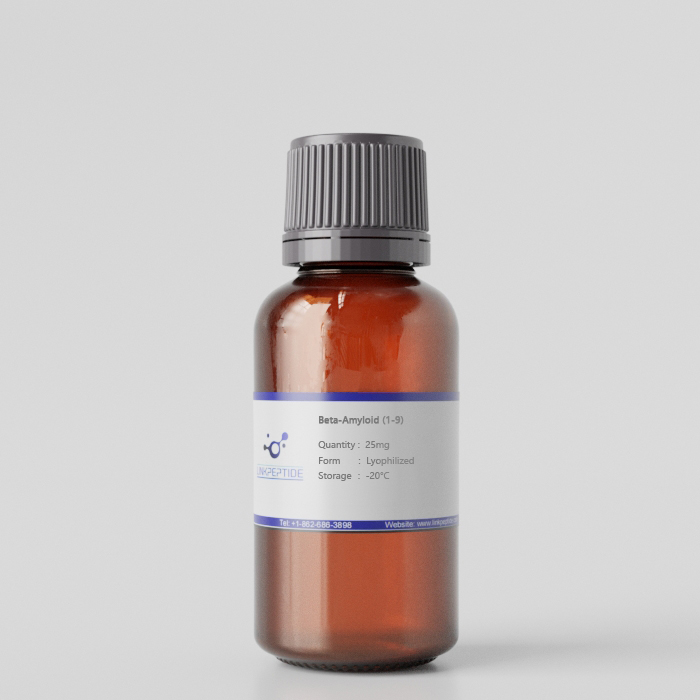
Product Name: Beta-Amyloid (1-9)
Sequence One Letter Code: DAEFRHDSG
Sequence Three Letter Code: H-Asp-Ala-Glu-Phe-Arg-His-Asp-Ser-Gly-OH
Chemical Formula:C42H60N14O17
Molecular Weight: 1033.1
Purity: 95%
Form: Lyophilized
Storage Conditions: - 20 °C
Research Area: Alzheimer's Disease
Source / Species: human
Conjugation: Unconjugated
Code Nacres: NA.26
Application: β-Amyloid (1–9) is a short N-terminal fragment of the amyloid-β peptide that contains a defined B-cell epitope while lacking known T-cell epitopes. This property has made the fragment particularly useful in immunological studies and vaccine design strategies aimed at eliciting antibody responses while minimizing the risk of autoimmune T-cell activation. Despite its short length, the N-terminal region contributes to important structural and antigenic properties of amyloid peptides. The fragment is widely used in epitope mapping, immunogenicity testing, and antibody recognition studies. It also supports research investigating amyloid structure and early molecular interactions associated with Alzheimer’s disease. Because of its defined immunological characteristics, β-Amyloid (1–9) is frequently used in studies exploring therapeutic vaccination and immune-based strategies targeting amyloid pathology.
Current Research: Introduction to Amyloid-β Immunology Amyloid-β (Aβ) peptides are key molecular components involved in the pathology of Alzheimer’s disease. These peptides originate from proteolytic processing of the amyloid precursor protein (APP) and can accumulate in the brain as oligomers and plaques. In addition to their role in neurodegeneration, amyloid peptides have become important targets for immunological approaches aimed at preventing or reducing amyloid accumulation. Understanding how the immune system recognizes amyloid peptides is essential for developing antibody-based therapies and vaccination strategies. Short synthetic fragments derived from the amyloid-β sequence are widely used in immunological studies to identify antigenic regions and evaluate immune responses. Among these fragments, β-Amyloid (1–9) represents a well-defined N-terminal epitope with unique immunological properties. Structural Characteristics of the β-Amyloid (1–9) Fragment The β-Amyloid (1–9) peptide corresponds to the first nine amino acids of the amyloid-β sequence. Although relatively short, this N-terminal region contains important structural and antigenic features that contribute to the molecular recognition of amyloid peptides by antibodies. Unlike longer amyloid fragments, the 1–9 region lacks the hydrophobic sequences responsible for rapid aggregation and fibril formation. This characteristic improves the peptide’s solubility and stability in experimental systems, making it easier to use in biochemical and immunological assays. Despite its short length, the N-terminal domain plays an important role in defining the antigenic properties of amyloid-β peptides and participates in early molecular interactions associated with amyloid formation. B-Cell Epitope Without T-Cell Activation One of the most notable features of β-Amyloid (1–9) is that it contains a defined B-cell epitope while lacking known T-cell epitopes. This distinction is particularly important in immunological research. B-cell epitopes are peptide regions recognized by antibodies, allowing the immune system to produce targeted antibody responses. In contrast, T-cell epitopes can activate T-cell–mediated immune responses, which in some cases may lead to inflammation or autoimmune reactions. Because the β-Amyloid (1–9) fragment primarily stimulates antibody recognition without strongly activating T-cells, it has become a valuable model in vaccine design strategies. Researchers can use this fragment to explore approaches that generate protective antibody responses while minimizing the risk of harmful immune activation. Applications in Epitope Mapping and Antibody Studies The β-Amyloid (1–9) peptide is widely used in epitope mapping experiments, where researchers identify specific regions of proteins that are recognized by antibodies. By isolating the N-terminal sequence, scientists can examine how antibodies interact with this particular epitope and determine its role in immune recognition. Synthetic peptides representing this fragment are frequently used in assays evaluating antibody binding, specificity, and immunogenicity. These studies help researchers understand how antibodies detect amyloid peptides and how epitope structure influences immune responses. Such investigations are important for developing diagnostic antibodies and therapeutic antibodies targeting amyloid-β. Relevance to Alzheimer’s Disease Research Beyond immunological studies, the β-Amyloid (1–9) fragment also supports research into the structural and molecular properties of amyloid peptides. The N-terminal region contributes to early peptide interactions that influence aggregation behavior and molecular recognition. By studying this fragment independently from the rest of the amyloid sequence, researchers can examine how individual regions of the peptide contribute to overall amyloid structure. These insights are useful for understanding how amyloid peptides assemble and how their structural features affect biological activity. Such studies contribute to a broader understanding of the molecular mechanisms underlying amyloid accumulation in Alzheimer’s disease. Applications in Vaccine and Therapeutic Strategy Development Because of its defined immunological characteristics, β-Amyloid (1–9) has become a valuable tool in research exploring therapeutic vaccination strategies targeting amyloid pathology. Peptide-based vaccine approaches aim to stimulate antibody production against amyloid peptides while avoiding excessive immune activation. The ability of the 1–9 fragment to function as a B-cell epitope without triggering strong T-cell responses makes it particularly attractive for designing immune-based therapies. Researchers can use the peptide to evaluate vaccine candidates and investigate immune responses in experimental models. These efforts are part of a broader strategy to develop treatments that reduce amyloid accumulation and potentially slow the progression of neurodegenerative disease. Conclusion The β-Amyloid (1–9) peptide is a short N-terminal fragment of amyloid-β that contains a defined B-cell epitope while lacking known T-cell epitopes. This unique immunological profile makes it highly useful for studying antibody recognition and for designing immune-based strategies targeting amyloid peptides. Widely applied in epitope mapping, immunogenicity testing, and antibody interaction studies, the peptide also supports research investigating amyloid structure and early molecular interactions. Through its applications in Alzheimer’s disease research and vaccine development, β-Amyloid (1–9) remains an important tool for understanding immune responses to amyloid pathology and for exploring potential therapeutic interventions.
Get a Quote
 LinkPeptide

![[Nphe1]Nociceptin(1-13)NH2](https://www.linkpeptide.com/wp-content/uploads/2024/10/Nphe1Nociceptin1-13NH2-jpg-3.webp "[Nphe1]Nociceptin(1-13)NH2")
![SCYLLATOXIN [Tyr2]-](https://www.linkpeptide.com/wp-content/uploads/2024/10/SCYLLATOXIN-Tyr2-jpg-2.webp "SCYLLATOXIN [Tyr2]-")