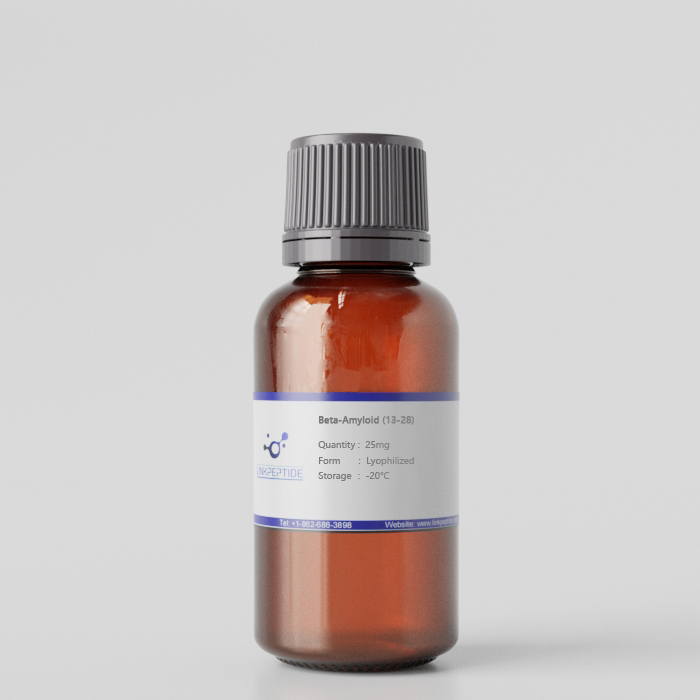
Product Name: Beta-Amyloid (13-28)
Sequence One Letter Code: HHQKLVFFAEDVGSNK
Sequence Three Letter Code: H-His-His-Gln-Lys-Leu-Val-Phe-Phe-Ala-Glu-Asp-Val-Gly-Ser-Asn-Lys-OH
Chemical Formula:C84H126N24O24
Molecular Weight: 1856.2
Purity: 95%
Form: Lyophilized
Storage Conditions: - 20 °C
Research Area: Alzheimer's Disease
Source / Species: human
Conjugation: Unconjugated
Code Nacres: NA.26
Application: This peptide corresponds to residues 13–28 of the β-amyloid sequence, a central region that contributes to peptide aggregation and fibril formation associated with Alzheimer’s disease. Although shorter than the full-length amyloid-β peptide, this fragment retains key structural and physicochemical features that drive self-assembly and intermolecular interactions. As a result, it is widely used to investigate the mechanisms and kinetics of amyloid aggregation in vitro. The peptide supports studies of peptide folding, oligomer formation, and fibril growth, as well as screening approaches aimed at identifying aggregation inhibitors. It is particularly useful for biophysical experiments and mechanistic research exploring amyloid assembly pathways relevant to neurodegenerative disease pathology.
Current Research: Amyloid aggregation is a defining molecular feature of several neurodegenerative disorders, most notably Alzheimer’s disease (AD). The accumulation of amyloid-β (Aβ) peptides into soluble oligomers and insoluble fibrillar plaques is widely associated with neuronal dysfunction and progressive cognitive decline. To better understand the molecular events underlying amyloid formation, researchers often use defined peptide fragments that reproduce critical aggregation properties of the full-length protein. One such fragment is the Aβ (13–28) peptide, corresponding to residues 13–28 of the amyloid-β sequence. Despite its shorter length, this fragment retains key structural elements that drive peptide self-assembly and aggregation, making it a valuable tool for mechanistic and biophysical studies of amyloid formation. Amyloid-β and Alzheimer’s Disease Amyloid-β peptides are derived from the amyloid precursor protein (APP) through sequential cleavage by β-secretase and γ-secretase enzymes. The resulting peptides, typically Aβ40 or Aβ42, can adopt conformations that promote aggregation. During the progression of Alzheimer’s disease, these peptides assemble into a range of structures, including soluble oligomers, protofibrils, and mature amyloid fibrils. Among these forms, soluble oligomers are thought to be particularly neurotoxic because they disrupt synaptic signaling and neuronal communication. Over time, these aggregates accumulate into the extracellular plaques that are a hallmark of Alzheimer’s pathology. Because the full-length Aβ peptide contains multiple regions involved in aggregation, researchers often isolate specific segments to study the molecular determinants of peptide self-association. The central hydrophobic region, which includes residues 13–28, plays a particularly important role in driving aggregation. Structural Features of the Aβ (13–28) Fragment The Aβ (13–28) peptide encompasses part of the central domain of the amyloid-β sequence. This region contains residues that promote hydrophobic interactions, β-sheet formation, and intermolecular association, all of which contribute to aggregation behavior. Even though it is shorter than the full-length peptide, the fragment preserves key physicochemical properties that facilitate self-assembly into ordered structures. These properties allow the peptide to mimic important aspects of amyloid aggregation pathways, making it useful for simplified experimental systems. Because of its reduced size and well-defined sequence, the Aβ (13–28) fragment is easier to handle experimentally while still capturing the essential interactions responsible for amyloid formation. Studying Peptide Self-Assembly and Aggregation One of the primary uses of the Aβ (13–28) peptide is in in vitro studies of peptide aggregation kinetics. Researchers use this fragment to examine how individual peptides interact and assemble into higher-order structures. Aggregation typically proceeds through multiple stages. Initially, monomeric peptides interact to form small oligomeric assemblies. These oligomers can then grow into protofibrils, which eventually mature into long fibrillar structures characterized by cross-β-sheet architecture. By monitoring the behavior of Aβ fragments under controlled experimental conditions, scientists can investigate the nucleation and growth phases of amyloid assembly, providing insight into the molecular events that lead to fibril formation. Applications in Biophysical Research The Aβ (13–28) peptide is particularly well suited for biophysical experiments aimed at characterizing amyloid structure and dynamics. Techniques such as circular dichroism spectroscopy, nuclear magnetic resonance, fluorescence assays, and electron microscopy are commonly used to analyze peptide folding and aggregation behavior. These studies help researchers understand how peptide structure changes during the transition from soluble monomers to aggregated fibrils. They also provide insight into how environmental conditions—such as pH, ionic strength, and temperature—affect aggregation pathways. Because the peptide captures the essential features of amyloid self-association, it provides a simplified model system for exploring the molecular basis of amyloid formation. Screening for Aggregation Inhibitors Another important application of the Aβ (13–28) fragment is in screening assays designed to identify molecules that inhibit amyloid aggregation. Compounds that interfere with peptide self-assembly may have potential relevance for therapeutic strategies aimed at preventing or slowing amyloid plaque formation. Using shorter peptide fragments allows researchers to perform high-throughput screening experiments that evaluate how candidate compounds affect aggregation kinetics or fibril formation. These studies can reveal molecules that stabilize monomeric peptides, disrupt oligomer formation, or prevent fibril growth. Such experimental systems are valuable for identifying compounds that influence amyloid assembly pathways. A Model System for Amyloid Mechanism Studies Defined amyloid fragments like Aβ (13–28) provide researchers with simplified experimental systems that retain key structural determinants of aggregation. By focusing on this central region of the amyloid sequence, scientists can investigate the molecular interactions that drive peptide self-assembly and fibril formation. Through its use in aggregation kinetics experiments, structural analyses, and inhibitor screening, the Aβ (13–28) peptide continues to support research aimed at understanding the mechanisms of amyloid formation and the molecular processes associated with neurodegenerative disease pathology.
Get a Quote
 LinkPeptide