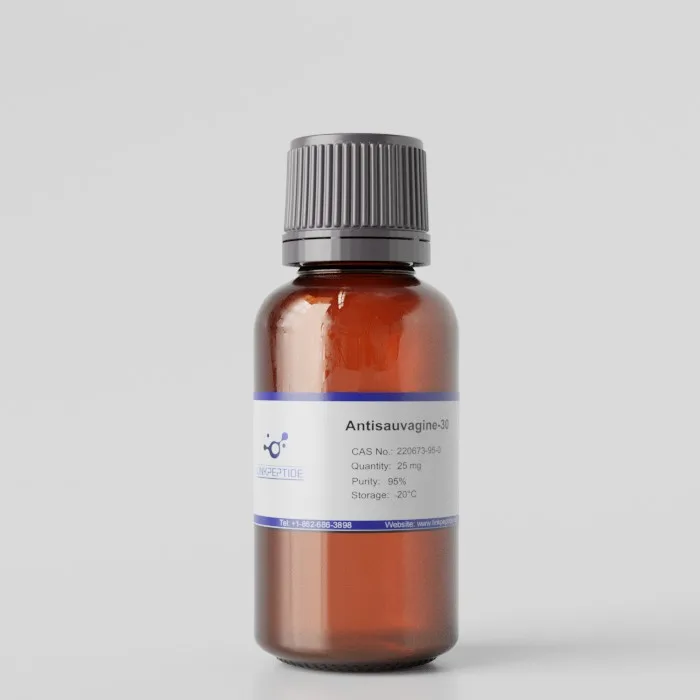
Product Name: Antisauvagine-30
CAS No: 220673-95-0
Purity: 95%
Molar Mass: 3651.2
Chemical Formula: C161H273N47O47S
Synonyms: aSvg-30
Storage: Store at -20 degrees Celsius
Sequence: FHLLRKMXEXEKQEKEKQQAANNRLLLDXX
Application:
Antisauvagine-30 is a synthetic peptide that functions as a selective antagonist of the corticotropin-releasing factor receptor 2 (CRFR2). By blocking this receptor, Antisauvagine-30 inhibits the effects of urocortins, which are involved in the stress response, cardiovascular regulation, and appetite control. This peptide is used in pharmaceutical research to explore the role of CRFR2 in stress-related disorders, such as anxiety and depression, as well as metabolic and cardiovascular diseases. Its specificity for CRFR2 makes it a valuable tool for dissecting the physiological and pathological functions of the CRF system.
Current Research:
Antisauvagine-30 is a potent and selective antagonist of the corticotropin-releasing factor receptor type 2 (CRF₂), widely used in neuropharmacological studies. It exhibits high affinity for CRF₂ receptors (Kₐ ≈ 1.4 nM) while displaying significantly reduced activity against CRF₁ receptors. This selectivity has made it a valuable tool for investigating the role of CRF₂ receptors in stress-related behaviors and physiological processes.
CRF₂ receptors are integral to regulating stress responses, anxiety, and fear conditioning. Studies employing Antisauvagine-30 have demonstrated its ability to block CRF₂-mediated effects, such as stress-enhanced fear conditioning and hippocampal ERK1/2 activation, underscoring its role in memory modulation and stress response pathways. These findings suggest its therapeutic potential in treating anxiety disorders, depression, and post-traumatic stress disorder (PTSD).
Despite its utility, Antisauvagine-30’s specificity has been questioned, particularly at higher doses, where potential off-target interactions with CRF₁ receptors may occur. Some studies indicate that its anxiolytic-like effects might not be entirely mediated by CRF₂ antagonism, highlighting the need for cautious interpretation of results. Alternative CRF₂-selective antagonists, such as Astressin 2-B, have been explored to address these limitations and provide more precise tools for CRF receptor research.
Current research continues to leverage Antisauvagine-30 to dissect the complex signaling mechanisms of CRF₂ receptors. Advances in understanding its pharmacological effects and limitations are critical for refining strategies in targeting CRF₂ pathways for therapeutic purposes. As research evolves, Antisauvagine-30 remains a cornerstone in the exploration of stress and anxiety-related neuropharmacology.
Reference:
Get a Quote
 LinkPeptide