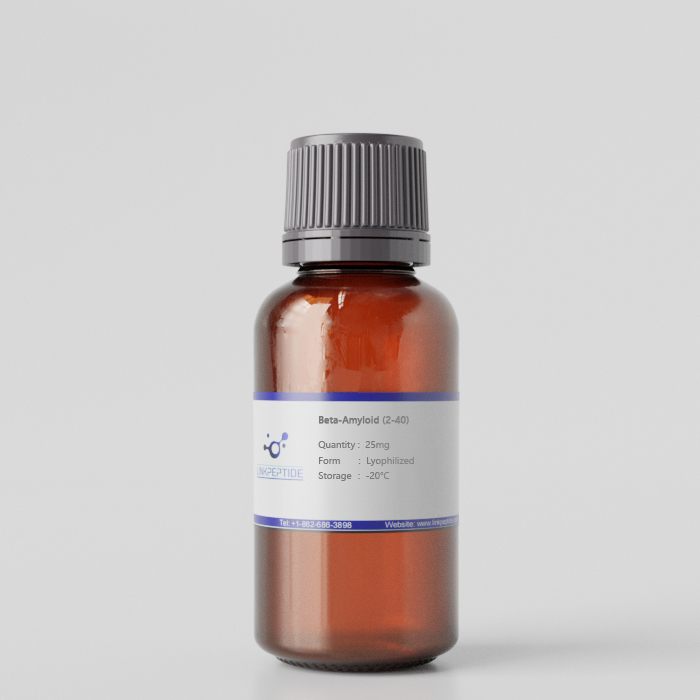
Product Name: Beta-Amyloid (2-40)
Sequence One Letter Code: AEFRHDSGYEVHHQKLVFFAEDVGSNKGAIIGLMVGGVV
Sequence Three Letter Code: H-Ala-Glu-Phe-Arg-His-Asp-Ser-Gly-Tyr-Glu-Val-His-His-Gln-Lys-Leu-Val-Phe-Phe-Ala-Glu-Asp-Val-Gly-Ser-Asn-Lys-Gly-Ala-Ile-Ile-Gly-Leu-Met-Val-Gly-Gly-Val-Val-OH
Chemical Formula:C190H290N52O55S
Molecular Weight: 4215.1
Purity: 95%
Form: Lyophilized
Storage Conditions: - 20 °C
Research Area: Alzheimer's Disease
Source / Species: human
Conjugation: Unconjugated
Code Nacres: NA.26
Application: Beta-Amyloid (2–40) is an N-terminally truncated variant of the amyloid-β peptide generated through alternative processing of amyloid precursor protein. Unlike the full-length Aβ1–40 isoform, this peptide lacks the initial N-terminal residue, a modification that alters its biochemical characteristics and biological activity. N-terminal truncation influences aggregation behavior, conformational dynamics, and interactions with immune cells. Studies have shown that truncated Aβ species can modulate innate immune responses, including stimulation of phagocytic activity in primary human monocytes. Although generally less aggregation-prone than corresponding Aβ(x–42) peptides, Aβ2–40 provides an important comparative tool for analyzing amyloid heterogeneity. This peptide is widely used in Alzheimer’s disease research to examine structure–function relationships, aggregation kinetics, and neuroimmune interactions, supporting investigations into the pathological diversity of amyloid species and their contributions to neuroinflammation and disease progression.
Current Research: Beta-Amyloid (2–40) is an N-terminally truncated isoform of the amyloid-β (Aβ) peptide generated through alternative proteolytic processing of amyloid precursor protein (APP). Unlike the canonical Aβ1–40 species, Aβ2–40 lacks the first N-terminal residue, a seemingly minor modification that can significantly influence peptide conformation, aggregation behavior, and biological interactions. As interest grows in the heterogeneity of amyloid species present in Alzheimer’s disease (AD) pathology, truncated variants such as Aβ2–40 are receiving increasing attention for their distinct structural and functional properties. In the context of amyloid aggregation, N-terminal truncation alters charge distribution and hydrogen bonding potential, which in turn affects nucleation kinetics and fibril assembly pathways. Although Aβ2–40 is generally less aggregation-prone than longer, more hydrophobic isoforms such as Aβ(x–42), it can still form β-sheet–rich assemblies under physiological conditions. Comparative studies demonstrate that even small sequence differences at the N-terminus can shift conformational ensembles, influence oligomer stability, and modify fibril morphology. These differences are particularly relevant when evaluating how diverse Aβ species coexist and potentially interact within amyloid plaques. Recent research emphasizes that Alzheimer’s disease pathology is not driven by a single Aβ isoform, but rather by a complex mixture of full-length and truncated peptides. N-terminally modified variants—including Aβ2–40—have been detected in brain tissue and cerebrospinal fluid, suggesting they contribute to the biochemical landscape of amyloid deposition. Their presence complicates the traditional view centered exclusively on Aβ1–40 and Aβ1–42, reinforcing the importance of studying truncated forms independently. Beyond aggregation, Aβ2–40 exhibits distinct biological activities in neuroimmune contexts. The N-terminus of amyloid-β plays a role in receptor recognition and interactions with innate immune cells. Truncation can modulate binding to pattern recognition receptors, alter microglial activation profiles, and influence cytokine release patterns. Experimental evidence indicates that certain truncated Aβ species stimulate phagocytic responses in primary human monocytes, suggesting that they may differentially regulate innate immune activity compared with full-length peptides. These findings align with growing recognition that neuroinflammation is a central component of AD progression. From a structural perspective, Aβ2–40 serves as a valuable model for examining how minimal sequence alterations affect peptide folding landscapes. Techniques such as circular dichroism spectroscopy, nuclear magnetic resonance, and electron microscopy are commonly used to compare conformational transitions between Aβ2–40 and Aβ1–40. These analyses reveal shifts in secondary structure propensity and aggregation kinetics, providing insight into the molecular determinants governing amyloid stability and toxicity. The peptide is also widely employed in kinetic aggregation assays to evaluate nucleation rates, fibril elongation efficiency, and the impact of environmental variables such as pH, ionic strength, and metal ion presence. Because it differs from Aβ1–40 by only a single residue, Aβ2–40 offers a controlled system for isolating the contribution of the N-terminal region to aggregation thermodynamics and intermolecular packing. In therapeutic research, understanding the behavior of truncated Aβ species is increasingly important for antibody design and small-molecule inhibitor development. Immunotherapies targeting amyloid-β must account for structural diversity among isoforms to achieve broad efficacy. Studying Aβ2–40 helps clarify epitope accessibility, conformational variation, and immune recognition patterns that may influence treatment outcomes. Overall, Beta-Amyloid (2–40) represents a critical comparative tool in modern Alzheimer’s disease research. Its distinct structural and immunomodulatory characteristics contribute to a more nuanced understanding of amyloid heterogeneity, neuroimmune interactions, and disease progression. By enabling detailed analysis of sequence-dependent aggregation and biological function, Aβ2–40 supports ongoing efforts to unravel the complex molecular landscape underlying amyloid pathology and neuroinflammation.
Get a Quote
 LinkPeptide

![[Nphe1]Nociceptin(1-13)NH2](https://www.linkpeptide.com/wp-content/uploads/2024/10/Nphe1Nociceptin1-13NH2-jpg-3.webp "[Nphe1]Nociceptin(1-13)NH2")