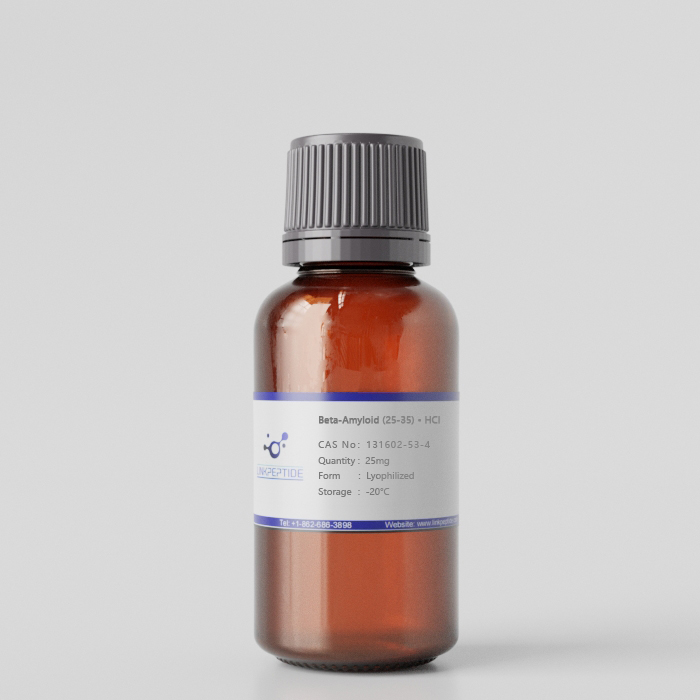
Product Name: Beta-Amyloid (25-35) • HCl
Sequence One Letter Code: GSNKGAIIGLM • HCl
Sequence Three Letter Code: H-Gly-Ser-Asn-Lys-Gly-Ala-Ile-Ile-Gly-Leu-Met-OH • HCl
Cas No: 131602-53-4
Chemical Formula:C45H81N13O14S
Molecular Weight: 1060.3•36.5
Purity: 95%
Form: Lyophilized
Storage Conditions: - 20 °C
Research Area: Neurological Disease Research
SMILES: CCC(C)C(C(=O)NC(C(C)CC)C(=O)NCC(=O)NC(CC(C)C)C(=O)NC(CCSC)C(=O)O)NC(=O)C(C)NC(=O)CNC(=O)C(CCCCN)NC(=O)C(CC(=O)N)NC(=O)C(CO)NC(=O)CN
IUPAC: 2-[[2-[[2-[[2-[[2-[2-[[2-[[6-amino-2-[[4-amino-2-[[2-[(2-aminoacetyl)amino]-3-hydroxypropanoyl]amino]-4-oxobutanoyl]amino]hexanoyl]amino]acetyl]amino]propanoylamino]-3-methylpentanoyl]amino]-3-methylpentanoyl]amino]acetyl]amino]-4-methylpentanoyl]amino]-4-methylsulfanylbutanoic acid
INCHIKEY: WIHBNMPFWRHGDF-UHFFFAOYSA-N
INCHI:
InChI=1S/C45H81N13O14S/c1-9-24(5)36(43(69)50-21-35(63)52-29(17-23(3)4)40(66)55-28(45(71)72)14-16-73-8)58-44(70)37(25(6)10-2)57-38(64)26(7)51-34(62)20-49-39(65)27(13-11-12-15-46)54-41(67)30(18-32(48)60)56-42(68)31(22-59)53-33(61)19-47/h23-31,36-37,59H,9-22,46-47H2,1-8H3,(H2,48,60)(H,49,65)(H,50,69)(H,51,62)(H,52,63)(H,53,61)(H,54,67)(H,55,66)(H,56,68)(H,57,64)(H,58,70)(H,71,72)
Source / Species: human
Conjugation: Unconjugated
Code Nacres: NA.26
Application: Beta-Amyloid (25–35) · HCl is a synthetic peptide fragment encompassing residues 25–35 of the β-amyloid sequence, supplied as the hydrochloride salt to improve solubility and handling. This region represents a core neurotoxic domain that rapidly adopts β-sheet conformation under physiological conditions and readily self-assembles into fibrillar aggregates. The peptide induces oxidative stress, mitochondrial dysfunction, and reduced metabolic activity in neuronal and non-neuronal cell models. Due to its reproducible aggregation kinetics and robust cytotoxic profile, Aβ(25–35) is widely used as a minimal model for studying amyloid fibrillogenesis and toxicity mechanisms. It supports investigations of cellular stress responses, apoptosis pathways, and screening of aggregation inhibitors or neuroprotective compounds relevant to Alzheimer’s disease research.
Current Research: Beta-Amyloid (25–35) · HCl is a synthetic peptide fragment corresponding to residues 25–35 of the β-amyloid (Aβ) sequence. Supplied as the hydrochloride salt to improve solubility and handling, this 11–amino acid fragment represents one of the most widely used minimal models for studying amyloid aggregation and neurotoxicity. Despite its short length, Aβ(25–35) retains the core structural and biophysical features responsible for β-sheet formation and cytotoxic activity observed in full-length Aβ peptides. Structural and Aggregation Properties Residues 25–35 lie within the hydrophobic C-terminal region of the Aβ sequence, a domain strongly associated with fibrillogenesis and membrane interaction. Aβ(25–35) rapidly adopts β-sheet–rich conformations under physiological conditions and self-assembles into oligomers and fibrillar aggregates. Its aggregation kinetics are reproducible and relatively rapid compared to longer Aβ species, facilitating time-course studies and standardized experimental conditions. The peptide’s ability to form ordered β-sheet structures can be monitored using established techniques such as circular dichroism spectroscopy, Thioflavin T fluorescence assays, and electron microscopy. These features make Aβ(25–35) particularly suitable for mechanistic investigations of amyloid assembly. Cellular Toxicity and Mechanisms of Action Aβ(25–35) induces robust cytotoxic effects in neuronal and non-neuronal cell models. Reported cellular responses include: Increased reactive oxygen species (ROS) production Mitochondrial membrane depolarization Disruption of calcium homeostasis Activation of apoptotic signaling pathways Reduced metabolic activity The peptide interacts with cellular membranes, leading to altered permeability and oxidative stress. Mitochondrial impairment is a key downstream consequence, contributing to ATP depletion and apoptotic cascades. These effects mirror important aspects of amyloid-associated neuronal injury observed in Alzheimer’s disease (AD). Model for Amyloid Fibrillogenesis Because of its defined aggregation behavior and consistent toxicity profile, Aβ(25–35) serves as a simplified model for studying amyloid fibrillogenesis. It allows researchers to dissect nucleation, oligomer formation, and fibril elongation processes without the structural complexity of full-length Aβ1–40 or Aβ1–42. This minimal system is particularly valuable for: Comparative aggregation studies Evaluation of environmental influences on fibril formation Analysis of peptide–lipid interactions Investigation of aggregation-modulating compounds Applications in Neurodegeneration Research Aβ(25–35) · HCl is widely applied in Alzheimer’s disease research and broader neurodegeneration studies. Experimental uses include: In vitro neuronal toxicity assays Oxidative stress and mitochondrial function measurements Calcium signaling and membrane integrity studies Apoptosis pathway analysis Screening of anti-aggregation and neuroprotective agents Its reproducible toxicity enables consistent evaluation of candidate compounds aimed at reducing amyloid-induced cellular damage. Experimental Advantages Minimal amyloidogenic core sequence Rapid and reproducible β-sheet formation Robust and well-characterized cytotoxic profile Improved solubility as hydrochloride salt Compatible with biochemical, cellular, and pharmacological assays The hydrochloride formulation enhances peptide solubility and facilitates accurate preparation of stock solutions for aggregation and toxicity studies. Research Significance Beta-Amyloid (25–35) · HCl provides a streamlined and experimentally tractable model for exploring amyloid aggregation and neurotoxicity mechanisms. By capturing a core toxic domain of the full-length Aβ peptide, it supports mechanistic investigation of oxidative stress, mitochondrial dysfunction, membrane disruption, and apoptosis relevant to Alzheimer’s disease pathology. Its defined properties and consistent performance make it a foundational reagent in amyloid biology and neuroprotective compound screening research.
Get a Quote
 LinkPeptide

![[Nphe1]Nociceptin(1-13)NH2](https://www.linkpeptide.com/wp-content/uploads/2024/10/Nphe1Nociceptin1-13NH2-jpg-3.webp "[Nphe1]Nociceptin(1-13)NH2")