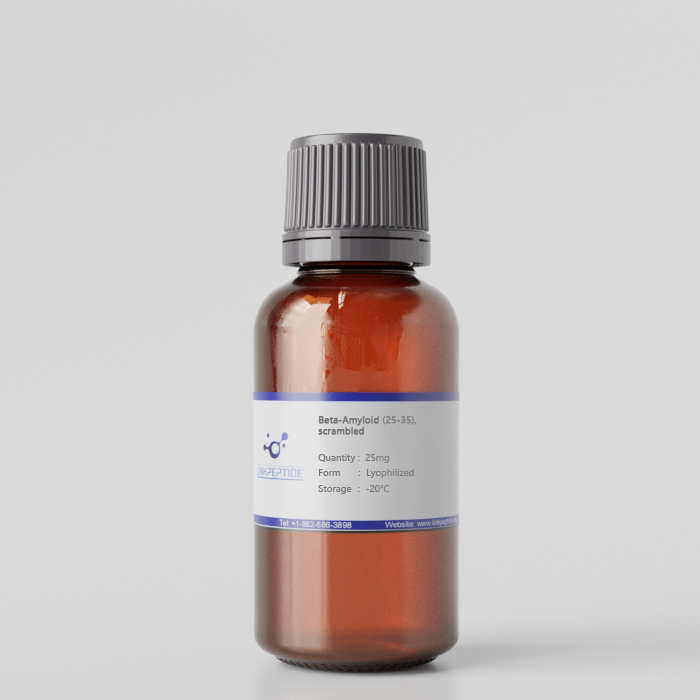
Product Name: Beta-Amyloid (25-35), scrambled
Sequence One Letter Code: MAKGINGISGL
Sequence Three Letter Code: H-Met-Ala-Lys-Gly-Ile-Asn-Gly-Ile-Ser-Gly-Leu-OH
Chemical Formula:C45H81N13O14S1
Molecular Weight: 1060.4
Purity: 95%
Form: Lyophilized
Storage Conditions: - 20 °C
Research Area: Alzheimer's Disease
Source / Species: human
Conjugation: Unconjugated
Code Nacres: NA.26
Application: This scrambled β-amyloid (25–35) peptide serves as a negative control for experiments using the native β-amyloid (25–35) fragment. The peptide maintains the same amino acid composition as the native sequence but rearranges the residue order, eliminating the structural features responsible for amyloid-specific biological effects. This design allows researchers to distinguish sequence-dependent activity from nonspecific peptide interactions in biochemical and cellular assays. The scrambled control is commonly paired with the native peptide in studies of amyloid aggregation, cytotoxicity, and neuronal responses. By providing an appropriate experimental control, the peptide supports rigorous interpretation of results in Alzheimer’s disease research. It is widely used in aggregation assays, neurotoxicity studies, and investigations examining the molecular mechanisms of amyloid-mediated cellular effects.
Current Research: Introduction to Control Peptides in Amyloid Research Amyloid-β peptides are widely studied for their role in Alzheimer’s disease and other neurodegenerative disorders. Among the various fragments derived from the amyloid-β sequence, β-amyloid (25–35) is one of the most commonly used short peptides for modeling amyloid toxicity and aggregation in experimental systems. This fragment retains many of the biological properties of the full-length amyloid peptide, including its ability to aggregate and induce cellular stress. To accurately interpret experimental results, researchers often use carefully designed control peptides alongside the active amyloid fragment. One widely used control reagent is the scrambled β-amyloid (25–35) peptide, which serves as a negative control in biochemical and cellular assays involving the native β-amyloid (25–35) sequence. Design and Structural Characteristics of the Scrambled Peptide The scrambled β-amyloid (25–35) peptide is constructed to retain the same amino acid composition as the native peptide while rearranging the sequence order. This design ensures that the peptide contains identical residues and overall chemical properties, but lacks the specific sequence pattern required for amyloid-specific structural formation. In the native β-amyloid (25–35) fragment, the precise order of amino acids contributes to the peptide’s ability to adopt conformations that promote aggregation and biological activity. By scrambling the residue arrangement, the control peptide eliminates these sequence-dependent structural features while maintaining similar physicochemical characteristics such as length, charge distribution, and amino acid content. As a result, the scrambled peptide typically does not reproduce the aggregation behavior or cytotoxic effects associated with the native amyloid fragment. Importance of Negative Controls in Amyloid Experiments Experimental studies investigating amyloid toxicity, aggregation, and cellular responses require rigorous controls to ensure that observed biological effects are specifically related to amyloid structure rather than nonspecific peptide interactions. The scrambled β-amyloid (25–35) peptide fulfills this role by providing a sequence-independent control. Because the scrambled peptide has the same amino acid composition as the active fragment, differences in experimental outcomes can be attributed primarily to the sequence-specific structural features of the native peptide. This approach helps researchers distinguish genuine amyloid-related activity from effects caused by peptide concentration, charge interactions, or nonspecific cellular stress. Including such controls strengthens the reliability of experimental conclusions and ensures accurate interpretation of data in amyloid-related studies. Applications in Amyloid Aggregation Studies The scrambled β-amyloid (25–35) peptide is frequently used in amyloid aggregation experiments to evaluate whether observed aggregation behavior depends on the specific sequence of the amyloid fragment. In these studies, the native peptide typically forms oligomers or fibrillar structures under appropriate experimental conditions. In contrast, the scrambled peptide generally exhibits reduced aggregation potential or forms structurally different assemblies. By comparing the behavior of the native and scrambled peptides, researchers can identify the sequence elements responsible for amyloid formation and determine how peptide structure influences aggregation dynamics. Such comparisons are particularly useful in experiments examining the early stages of amyloid assembly and the molecular mechanisms that drive fibril formation. Use in Neurotoxicity and Cellular Response Studies Another major application of the scrambled peptide is in neurotoxicity assays designed to investigate how amyloid peptides affect neuronal cells. The native β-amyloid (25–35) fragment is known to induce cellular stress, disrupt membrane integrity, and trigger signaling pathways associated with neurodegeneration. By treating cells with both the native and scrambled peptides, researchers can determine whether the observed cellular effects are specifically caused by amyloid structure. If toxicity occurs only with the native peptide and not with the scrambled control, this provides strong evidence that the response is related to amyloid-specific interactions rather than nonspecific peptide exposure. These studies are commonly performed in neuronal cell cultures and other experimental systems used to model Alzheimer’s disease–related neurotoxicity. Supporting Alzheimer’s Disease Research The scrambled β-amyloid (25–35) peptide plays an important role in Alzheimer’s disease research by enabling careful experimental design and validation. As scientists investigate the mechanisms through which amyloid peptides influence neuronal function and viability, appropriate control reagents are essential for distinguishing true amyloid-driven effects from unrelated experimental variables. Using the scrambled control peptide alongside the native amyloid fragment allows researchers to confirm that observed changes in aggregation, signaling pathways, or cell viability arise from the structural properties of amyloid-β. This approach contributes to more reliable data and improves the interpretability of experiments focused on amyloid biology and neurodegenerative disease mechanisms. Conclusion The scrambled β-amyloid (25–35) peptide serves as an essential negative control in studies involving the native β-amyloid (25–35) fragment. By maintaining identical amino acid composition while altering the sequence order, the peptide removes the structural determinants responsible for amyloid-specific biological activity. This design allows researchers to distinguish sequence-dependent effects from nonspecific peptide interactions in biochemical and cellular assays. Widely used in aggregation experiments, neurotoxicity studies, and Alzheimer’s disease research, the scrambled peptide helps ensure accurate interpretation of results and supports rigorous investigation of amyloid-mediated cellular mechanisms.
Get a Quote
 LinkPeptide

![[Phe1Ψ(CH2-NH)Gly2]Nociceptin(1-13)NH2](https://www.linkpeptide.com/wp-content/uploads/2024/10/Phe1¶aCH2-NHGly2Nociceptin1-13NH2-jpg.webp "[Phe1Ψ(CH2-NH)Gly2]Nociceptin(1-13)NH2")
![SCYLLATOXIN [Tyr2]-](https://www.linkpeptide.com/wp-content/uploads/2024/10/SCYLLATOXIN-Tyr2-jpg-2.webp "SCYLLATOXIN [Tyr2]-")