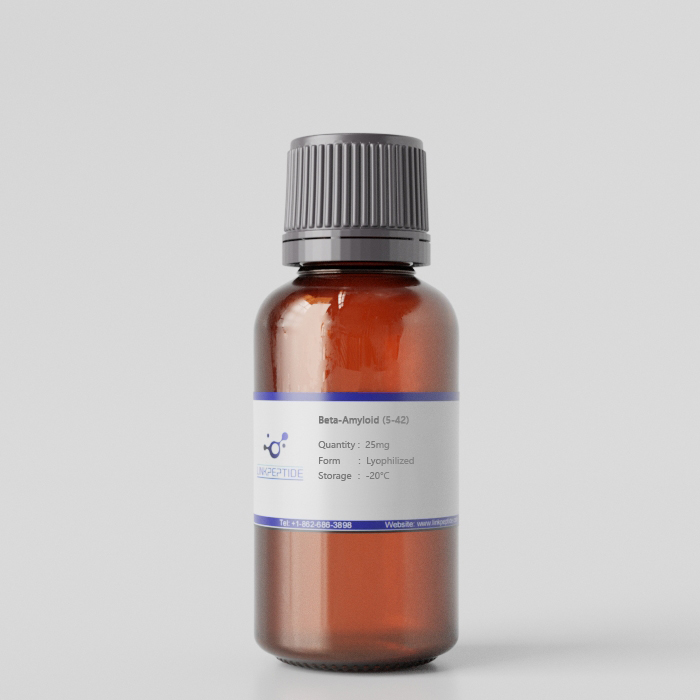
Product Name: Beta-Amyloid (5-42)
Sequence One Letter Code: RHDSGYEVHHQKLVFFAEDVGSNKGAIIGLMVGGVVIA
Sequence Three Letter Code: H-Arg-His-Asp-Ser-Gly-Tyr-Glu-Val-His-His-Gln-Lys-Leu-Val-Phe-Phe-Ala-Glu-Asp-Val-Gly-Ser-Asn-Lys-Gly-Ala-Ile-Ile-Gly-Leu-Met-Val-Gly-Gly-Val-Val-Ile-Ala-OH
Chemical Formula:C182H285N51O52S
Molecular Weight: 4051.9
Purity: 95%
Form: Lyophilized
Storage Conditions: - 20 °C
Research Area: Neurological Disease Research
Source / Species: human
Conjugation: Unconjugated
Code Nacres: NA.26
Application: Beta-Amyloid (5–42) is an N-terminally truncated amyloid-β peptide generated during amyloid precursor protein processing. This variant exhibits biochemical and aggregation properties distinct from full-length peptides, contributing to amyloid heterogeneity observed in pathological conditions. Truncated forms such as Aβ (5–42) are associated with altered aggregation kinetics, stability, and biological activity, and may play roles in disease progression. This peptide is widely used in neurodegeneration research to study amyloid diversity, peptide processing mechanisms, and structure–function relationships. It provides a useful model for investigating non-canonical amyloid species and their contribution to aggregation and toxicity.
Current Research: β-Amyloid (5–42) is an N-terminally truncated amyloid-β peptide derived from amyloid precursor protein (APP) processing. Unlike full-length isoforms such as Aβ (1–40) and Aβ (1–42), this variant lacks the first four amino acids, resulting in distinct structural and biochemical properties. Truncated amyloid species like Aβ (5–42) contribute to the molecular heterogeneity of amyloid deposits observed in neurodegenerative diseases, particularly Alzheimer’s disease (AD). Origin and Amyloid Heterogeneity Amyloid-β peptides are generated through sequential cleavage of APP by secretases. While canonical pathways produce full-length peptides, alternative processing and post-cleavage modifications can generate truncated forms such as Aβ (5–42). These truncated variants: Coexist with full-length Aβ species in amyloid deposits Contribute to the complex composition of plaques Reflect diverse proteolytic and degradation pathways The presence of multiple Aβ species highlights the importance of studying amyloid heterogeneity in disease mechanisms. Structural and Aggregation Properties The absence of the N-terminal residues alters the peptide’s physicochemical behavior. Compared to full-length Aβ (1–42), Aβ (5–42) exhibits: Modified aggregation kinetics Changes in peptide stability and solubility Altered conformational preferences and β-sheet formation These differences can influence how the peptide assembles into oligomers, protofibrils, and fibrillar aggregates, potentially affecting the formation and morphology of amyloid structures. Role in Aggregation and Toxicity Truncated amyloid species are increasingly recognized for their potential role in modulating aggregation pathways and toxicity. Aβ (5–42) may: Act as a seed or co-aggregating species with other Aβ variants Influence the rate and pathway of fibril formation Contribute to the generation of structurally distinct oligomeric intermediates Such properties suggest that truncated peptides may not merely be byproducts but active participants in disease-associated aggregation processes. Applications in Neurodegeneration Research β-Amyloid (5–42) is widely used in research to investigate non-canonical amyloid species and their functional implications. Its unique characteristics make it valuable for dissecting aspects of amyloid biology that are not captured by full-length peptides alone. Common applications include: Comparative aggregation studies with Aβ (1–40) and Aβ (1–42) Analysis of structure–function relationships in truncated peptides Investigation of amyloid processing and degradation pathways Studies of mixed-species aggregation and cross-seeding effects Evaluation of peptide stability and conformational dynamics These approaches help clarify how different Aβ variants contribute to disease. Insights into Amyloid Processing Mechanisms The existence of Aβ (5–42) provides insight into alternative processing routes and proteolytic events involved in APP metabolism. Studying this peptide helps researchers understand: Enzymatic pathways generating truncated Aβ species Post-translational modifications and peptide trimming processes Balance between amyloidogenic and non-canonical pathways Such knowledge is essential for building a comprehensive picture of amyloid generation and turnover. Relevance to Alzheimer’s Disease Pathology Amyloid plaques in Alzheimer’s disease are composed of a mixture of peptide species, including truncated forms like Aβ (5–42). These variants may: Alter plaque composition and structure Influence aggregation dynamics and stability Contribute to variability in toxicity and disease progression Understanding their role is critical for interpreting the complex pathology of amyloid deposition. A Model for Non-Canonical Amyloid Species β-Amyloid (5–42) serves as an important model for studying non-canonical and truncated amyloid peptides. By examining how structural modifications affect aggregation and function, researchers can gain deeper insight into the diversity of amyloid species and their biological impact. Its use continues to advance research into amyloid processing, aggregation mechanisms, and the molecular basis of neurodegenerative disease, supporting efforts to better understand and ultimately target complex amyloid pathologies.
Get a Quote
 LinkPeptide

![[Phe1Ψ(CH2-NH)Gly2]Nociceptin(1-13)NH2](https://www.linkpeptide.com/wp-content/uploads/2024/10/Phe1¶aCH2-NHGly2Nociceptin1-13NH2-jpg.webp "[Phe1Ψ(CH2-NH)Gly2]Nociceptin(1-13)NH2")