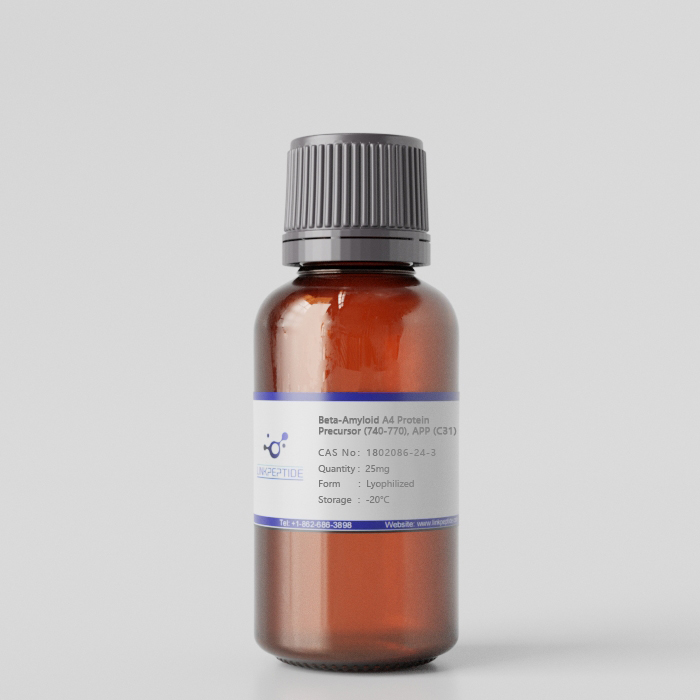
Product Name: Beta-Amyloid A4 Protein Precursor (740-770), APP (C31)
Sequence One Letter Code: AAVTPEERHLSKMQQNGYENPTYKFFEQMQN
Sequence Three Letter Code: H-Ala-Ala-Val-Thr-Pro-Glu-Glu-Arg-His-Leu-Ser-Lys-Met-Gln-Gln-Asn-Gly-Tyr-Glu-Asn-Pro-Thr-Tyr-Lys-Phe-Phe-Glu-Gln-Met-Gln-Asn-OH
Cas No: 1802086-24-3
Chemical Formula:C162H243N45O52S2
Molecular Weight: 3717.3
Purity: 95%
Form: Lyophilized
Storage Conditions: - 20 °C
Research Area: Alzheimer's Disease
Source / Species: human
Conjugation: Unconjugated
Code Nacres: NA.26
Application: APP (C31) is a 31-amino acid peptide corresponding to the C-terminal fragment of amyloid precursor protein generated by caspase-mediated cleavage. Formation of the C31 fragment has been associated with neuronal apoptosis and neurotoxicity in Alzheimer’s disease models. APP (C31) localizes to lipid rafts and interacts with APP-BP1, a binding partner of the APP intracellular domain, implicating it in apoptosis signaling pathways. The peptide is widely used to investigate caspase-dependent APP processing, lipid raft–associated signaling, and mechanisms linking APP cleavage to programmed cell death. It supports mechanistic studies of neurodegeneration and apoptotic signaling relevant to Alzheimer’s disease pathology.
Current Research: Amyloid precursor protein (APP) is a type I transmembrane glycoprotein extensively studied in the context of Alzheimer’s disease (AD). While much attention has focused on amyloid-β (Aβ) peptides generated by β- and γ-secretase cleavage, alternative proteolytic processing pathways also produce biologically active fragments. One such fragment, APP (C31), is a 31-amino acid peptide derived from the extreme C-terminus of APP following caspase-mediated cleavage at Asp664 (APP695 numbering). Accumulating evidence implicates C31 formation in neuronal apoptosis and neurotoxicity, positioning it as a mechanistic link between APP processing and programmed cell death. Caspase activation is a hallmark of apoptosis and is observed in vulnerable neuronal populations in AD. Cleavage of APP by executioner caspases generates two principal products: a truncated APP lacking the C-terminal 31 residues and the liberated C31 peptide. Experimental studies in neuronal culture systems have demonstrated that expression of C31 alone is sufficient to induce apoptotic phenotypes, including mitochondrial dysfunction, cytochrome c release, and activation of downstream caspase cascades. These findings suggest that C31 is not merely a byproduct of proteolysis but may function as a pro-apoptotic signaling effector. Subcellular localization studies indicate that APP (C31) associates with lipid raft microdomains within the plasma membrane. Lipid rafts are cholesterol- and sphingolipid-enriched regions that compartmentalize signaling molecules and facilitate assembly of receptor complexes. Localization of C31 to these microdomains suggests a role in organizing or modulating signaling pathways linked to cell survival and apoptosis. Because lipid rafts are also implicated in APP trafficking and amyloidogenic processing, C31 may contribute to a feedback mechanism integrating proteolytic cleavage with downstream signaling events. A key molecular interaction partner of APP (C31) is APP-binding protein 1 (APP-BP1), which also interacts with the APP intracellular domain (AICD). APP-BP1 participates in cell cycle regulation through its involvement in the NEDD8 conjugation pathway, influencing cullin-RING ubiquitin ligase activity and protein turnover. Interaction between C31 and APP-BP1 has been associated with aberrant cell cycle re-entry in post-mitotic neurons—a pathological event frequently observed in AD brains. Such inappropriate cell cycle activation can precipitate apoptosis, providing a mechanistic framework linking caspase cleavage of APP to neuronal death. The APP (C31) peptide is widely used in experimental systems to dissect caspase-dependent APP processing pathways. By introducing synthetic C31 or expressing C31 constructs in neuronal cell models, researchers can isolate its effects from other APP-derived fragments. This approach enables precise evaluation of mitochondrial membrane potential changes, reactive oxygen species generation, and activation of pro-apoptotic signaling pathways such as JNK and p53. Comparisons between wild-type APP and caspase-resistant APP mutants further clarify the contribution of C31 generation to neurodegenerative phenotypes. In addition to apoptosis signaling, C31 is studied in the context of cross-talk between amyloidogenic processing and cell death pathways. Evidence suggests that Aβ toxicity can enhance caspase activation, which in turn increases C31 production, potentially amplifying neuronal injury. This feed-forward model highlights the importance of understanding how distinct APP cleavage products converge to drive neurodegeneration. The peptide also supports investigations into membrane microdomain–associated signaling mechanisms. Because lipid rafts concentrate kinases, adaptors, and death receptors, C31-mediated recruitment or modulation of these components may influence downstream apoptotic cascades. Biochemical fractionation and imaging studies employing APP (C31) facilitate analysis of its spatial distribution and interaction networks within neuronal membranes. In summary, APP (C31) is a caspase-generated C-terminal fragment of APP implicated in apoptosis and neurotoxicity in Alzheimer’s disease models. Through its localization to lipid rafts and interaction with APP-BP1, C31 links proteolytic processing of APP to cell cycle dysregulation and programmed cell death pathways. As a focused molecular tool, APP (C31) enables mechanistic investigation of caspase-dependent APP cleavage, apoptotic signaling, and the broader relationship between APP processing and neurodegenerative pathology.
Get a Quote
 LinkPeptide

![[Nphe1]Nociceptin(1-13)NH2](https://www.linkpeptide.com/wp-content/uploads/2024/10/Nphe1Nociceptin1-13NH2-jpg-3.webp "[Nphe1]Nociceptin(1-13)NH2")