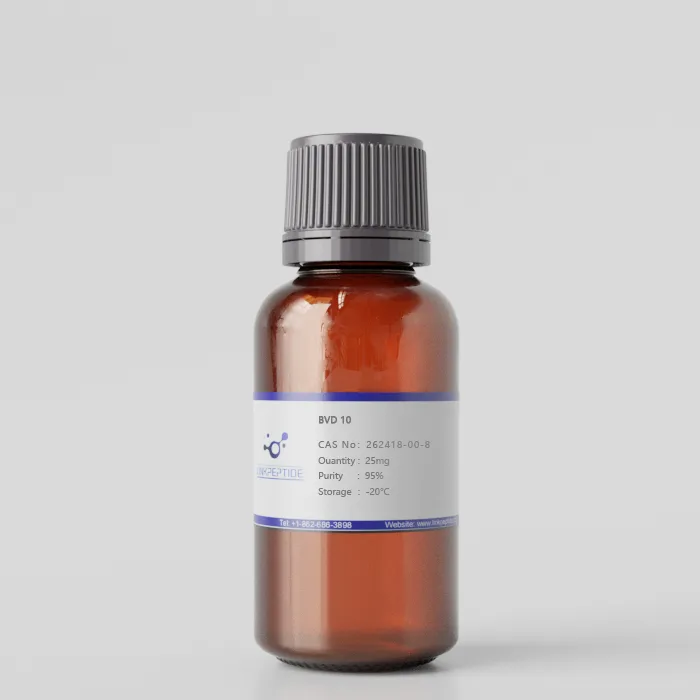
Product Name:BVD 10
CAS No:262418-00-8
Purity:95%
Molar Mass:1221.46
Chemical Formula:C58H92N16O13
Storage:Store at -20 degrees Celsius
Sequence:INPIYRLRY
Target:NPY Y1 receptor antagonist
Application:
BVD 10 is a synthetic peptide that functions as an inhibitor of the protein-protein interactions between Bcl-2 family members, specifically targeting the Bcl-2 homology domain 3 (BH3) interactions. Bcl-2 proteins are key regulators of apoptosis, and their interactions play a critical role in determining cell survival or death. BVD 10 disrupts these interactions, promoting apoptosis in cells that are otherwise resistant to cell death, such as cancer cells. This peptide is widely used in research focused on understanding the mechanisms of apoptosis, particularly in the context of cancer, and in exploring potential therapeutic strategies that target Bcl-2 family proteins to induce cell death in cancerous cells.
Current Research:
BVD 10 (CAS: 262418-00-8) is a synthetic nonapeptide that functions as a highly selective antagonist of the neuropeptide Y (NPY) Y₁ receptor. Its amino acid sequence is H-Ile-Asn-Pro-Ile-Tyr-Arg-Leu-Arg-Tyr-OMe, with a methyl ester modification at the C-terminal tyrosine residue.
Receptor Binding Affinity
BVD 10 exhibits the following inhibition constant (Kᵢ) values for NPY receptor subtypes:
Y₁ Receptor: 25.7 nM
Y₂ Receptor: 1420 nM
Y₄ Receptor: 2403 nM
Y₅ Receptor: 7100 nM
These values indicate a high affinity for the Y₁ receptor and significantly lower affinities for other NPY receptor subtypes, underscoring its selectivity. Notably, BVD 10 lacks agonist activity at the Y₄ receptor.
Biological Activity
As an NPY Y₁ receptor antagonist, BVD 10 inhibits the binding of endogenous NPY to the Y₁ receptor, thereby modulating physiological processes such as:
Regulation of Food Intake: NPY is a potent stimulator of appetite; antagonism of the Y₁ receptor can reduce food intake.
Cardiovascular Function: NPY influences blood pressure and heart rate; Y₁ receptor antagonism may affect these parameters.
Anxiety and Stress Responses: NPY plays a role in modulating stress; Y₁ receptor antagonists can alter anxiety-related behaviors.
Research Applications
BVD 10 serves as a valuable tool in neuropharmacological research, particularly in:
Elucidating NPY Y₁ Receptor Functions: Investigating the specific roles of Y₁ receptors in various physiological and pathological conditions.
Developing Therapeutic Agents: Serving as a lead compound for designing drugs targeting Y₁ receptors in disorders such as obesity, hypertension, and anxiety.
Handling and Storage
For optimal stability, BVD 10 should be stored at -20°C, protected from light and moisture. It is soluble in water up to 1 mg/mL, facilitating its use in various experimental setups.
Conclusion
BVD 10 is a potent and selective NPY Y₁ receptor antagonist with significant applications in research focused on NPY-related physiological processes and potential therapeutic interventions.
Reference:
Get a Quote
 LinkPeptide

![[Nphe1]Nociceptin(1-13)NH2](https://www.linkpeptide.com/wp-content/uploads/2024/10/Nphe1Nociceptin1-13NH2-jpg-3.webp "[Nphe1]Nociceptin(1-13)NH2")