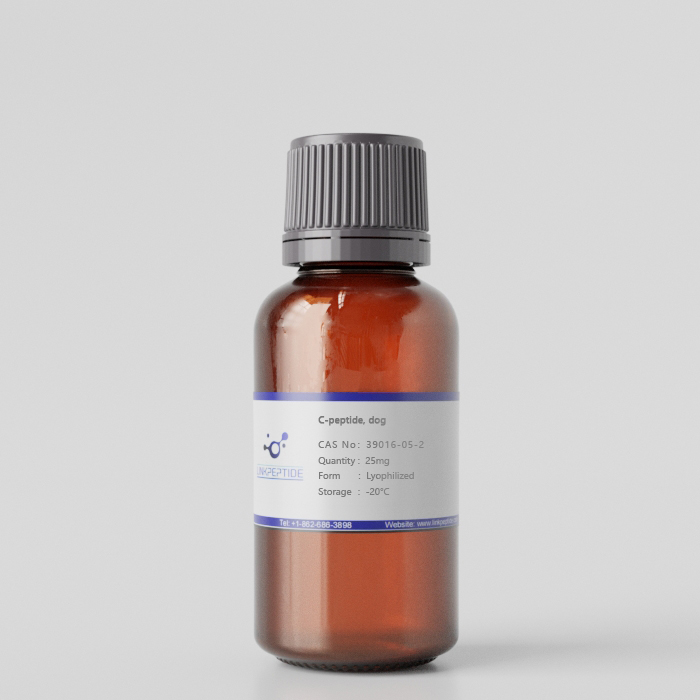
Product Name: C-peptide, dog
Sequence One Letter Code: EVEDLQVRDVELAGAPGEGGLQPLALEGALQ
Sequence Three Letter Code: H-Glu-Val-Glu-Asp-Leu-Gln-Val-Arg-Asp-Val-Glu-Leu-Ala-Gly-Ala-Pro-Gly-Glu-Gly-Gly-Leu-Gln-Pro-Leu-Ala-Leu-Glu-Gly-Ala-Leu-Gln-OH
Cas No: 39016-05-2
Chemical Formula:C137H225N37O49
Molecular Weight: 3174.8
Purity: 95%
Form: Lyophilized
Storage Conditions: - 20 °C
Research Area: Diabetes and Metabolic Syndrome
SMILES: CC(C)CC(C(=O)NC(CCC(=O)N)C(=O)N1CCCC1C(=O)NC(CC(C)C)C(=O)NC(C)C(=O)NC(CC(C)C)C(=O)NC(CCC(=O)O)C(=O)NCC(=O)NC(C)C(=O)NC(CC(C)C)C(=O)NC(CCC(=O)N)C(=O)O)NC(=O)CNC(=O)CNC(=O)C(CCC(=O)O)NC(=O)CNC(=O)C2CCCN2C(=O)C(C)NC(=O)CNC(=O)C(C)NC(=O)C(CC(C)C)NC(=O)C(CCC(=O)O)NC(=O)C(C(C)C)NC(=O)C(CC(=O)O)NC(=O)C(CCCNC(=N)N)NC(=O)C(C(C)C)NC(=O)C(CCC(=O)N)NC(=O)C(CC(C)C)NC(=O)C(CC(=O)O)NC(=O)C(CCC(=O)O)NC(=O)C(C(C)C)NC(=O)C(CCC(=O)O)N
IUPAC: 4-amino-5-[[1-[[1-[[1-[[1-[[5-amino-1-[[1-[[1-[[1-[[1-[[1-[[1-[[1-[[2-[[1-[2-[[2-[[1-[[2-[[2-[[1-[[5-amino-1-[2-[[1-[[1-[[1-[[1-[[2-[[1-[[1-[(4-amino-1-carboxy-4-oxobutyl)amino]-4-methyl-1-oxopentan-2-yl]amino]-1-oxopropan-2-yl]amino]-2-oxoethyl]amino]-4-carboxy-1-oxobutan-2-yl]amino]-4-methyl-1-oxopentan-2-yl]amino]-1-oxopropan-2-yl]amino]-4-methyl-1-oxopentan-2-yl]carbamoyl]pyrrolidin-1-yl]-1,5-dioxopentan-2-yl]amino]-4-methyl-1-oxopentan-2-yl]amino]-2-oxoethyl]amino]-2-oxoethyl]amino]-4-carboxy-1-oxobutan-2-yl]amino]-2-oxoethyl]carbamoyl]pyrrolidin-1-yl]-1-oxopropan-2-yl]amino]-2-oxoethyl]amino]-1-oxopropan-2-yl]amino]-4-methyl-1-oxopentan-2-yl]amino]-4-carboxy-1-oxobutan-2-yl]amino]-3-methyl-1-oxobutan-2-yl]amino]-3-carboxy-1-oxopropan-2-yl]amino]-5-carbamimidamido-1-oxopentan-2-yl]amino]-3-methyl-1-oxobutan-2-yl]amino]-1,5-dioxopentan-2-yl]amino]-4-methyl-1-oxopentan-2-yl]amino]-3-carboxy-1-oxopropan-2-yl]amino]-4-carboxy-1-oxobutan-2-yl]amino]-3-methyl-1-oxobutan-2-yl]amino]-5-oxopentanoic acid
INCHIKEY: YNYDBXCGKFIALM-UHFFFAOYSA-N
INCHI:
InChI=1S/C137H225N37O49/c1-61(2)48-83(123(209)161-81(31-38-94(140)176)135(221)174-47-25-28-92(174)130(216)169-85(50-63(5)6)122(208)153-72(21)113(199)164-86(51-64(7)8)124(210)156-77(34-42-103(187)188)116(202)148-59-97(179)150-71(20)112(198)163-87(52-65(9)10)126(212)162-82(136(222)223)32-39-95(141)177)155-99(181)57-145-96(178)56-147-115(201)76(33-41-102(185)186)154-100(182)60-149-129(215)91-27-24-46-173(91)134(220)73(22)151-98(180)58-146-111(197)70(19)152-121(207)84(49-62(3)4)165-118(204)79(35-43-104(189)190)160-133(219)110(69(17)18)172-128(214)90(55-107(195)196)168-117(203)75(26-23-45-144-137(142)143)158-132(218)109(68(15)16)171-120(206)78(30-37-93(139)175)157-125(211)88(53-66(11)12)166-127(213)89(54-106(193)194)167-119(205)80(36-44-105(191)192)159-131(217)108(67(13)14)170-114(200)74(138)29-40-101(183)184/h61-92,108-110H,23-60,138H2,1-22H3,(H2,139,175)(H2,140,176)(H2,141,177)(H,145,178)(H,146,197)(H,147,201)(H,148,202)(H,149,215)(H,150,179)(H,151,180)(H,152,207)(H,153,208)(H,154,182)(H,155,181)(H,156,210)(H,157,211)(H,158,218)(H,159,217)(H,160,219)(H,161,209)(H,162,212)(H,163,198)(H,164,199)(H,165,204)(H,166,213)(H,167,205)(H,168,203)(H,169,216)(H,170,200)(H,171,206)(H,172,214)(H,183,184)(H,185,186)(H,187,188)(H,189,190)(H,191,192)(H,193,194)(H,195,196)(H,222,223)(H4,142,143,144)
Source / Species: dog
Conjugation: Unconjugated
Code Nacres: NA.26
Application: C-Peptide, dog is a synthetic peptide corresponding to the canine C-peptide released during proinsulin cleavage and co-secreted with insulin in equimolar amounts. Because C-peptide is not extracted by the liver and exhibits a longer half-life than insulin, circulating levels provide a reliable measure of endogenous insulin secretion. In veterinary endocrinology, plasma C-peptide concentrations are widely used to assess pancreatic β-cell function in diabetic dogs. Measurement during glucagon stimulation testing enables evaluation of residual insulin secretory capacity and disease progression. Variability in C-peptide responses may reflect differences in diabetes phenotype or the degree of β-cell destruction. This peptide supports comparative metabolic research, translational diabetes studies, and validation of immunoassays for canine samples. It is also applied in investigations exploring β-cell preservation strategies and endocrine pancreatic physiology in companion animal models.
Current Research: C-peptide, dog has become an important biomarker and research tool in contemporary veterinary endocrinology and comparative diabetes research. Derived from the connecting peptide of proinsulin, canine C-peptide is released in equimolar amounts with insulin during β-cell secretion. Unlike insulin, it is not subject to significant first-pass hepatic extraction and has a longer circulating half-life, making peripheral plasma concentrations a more stable and reliable indicator of endogenous insulin production. This kinetic advantage underpins its expanding role in both clinical assessment and experimental investigation. Current research in canine diabetes mellitus increasingly relies on C-peptide measurement to differentiate between insulin-deficient and insulin-resistant phenotypes. Although most diabetic dogs present with a condition resembling type 1 diabetes characterized by β-cell loss and insulin dependence, heterogeneity in residual β-cell function has been documented. Basal and stimulated C-peptide concentrations, particularly following glucagon or mixed-meal stimulation testing, are used to quantify remaining secretory capacity. Longitudinal monitoring allows investigators to assess disease progression and evaluate whether partial β-cell preservation occurs in early or atypical cases. Recent studies have also focused on refining immunoassays specific to canine C-peptide. Species-specific assay validation is critical because cross-reactivity with human reagents can compromise accuracy. Development of high-sensitivity ELISA and chemiluminescent platforms has improved detection thresholds, supporting research into early-stage disease and subclinical β-cell dysfunction. Analytical validation efforts emphasize precision, recovery, dilutional linearity, and interference testing to ensure translational reliability across laboratories. Beyond diagnostic stratification, canine C-peptide is increasingly applied in interventional research. Trials evaluating immunomodulatory therapies, stem cell approaches, and regenerative strategies in diabetic dogs use C-peptide as a primary endpoint for β-cell functional recovery. Because spontaneous diabetes in dogs shares immunopathological and clinical similarities with human type 1 diabetes, these companion animal models offer translational value. Measurement of endogenous C-peptide provides an objective biomarker for therapeutic efficacy in studies aiming to preserve or restore insulin secretion. Comparative endocrinology research has also expanded interest in C-peptide physiology beyond its historical classification as an inert byproduct. In human medicine, C-peptide has been implicated in microvascular blood flow regulation, endothelial function, and anti-inflammatory signaling. Parallel investigations in canine systems are exploring whether similar biological activity exists in dogs, particularly in the context of diabetic complications affecting renal, neural, and vascular tissues. While definitive mechanistic data remain limited, early findings suggest potential modulatory roles deserving further study. In metabolic research settings, canine C-peptide measurement supports detailed characterization of insulin secretory dynamics under varying nutritional, hormonal, and pharmacologic conditions. Studies assessing obesity-related insulin resistance, pancreatitis-associated endocrine dysfunction, and hyperadrenocorticism frequently incorporate C-peptide profiling to distinguish primary β-cell impairment from secondary metabolic effects. Integration with continuous glucose monitoring and insulin tolerance testing provides a comprehensive framework for evaluating pancreatic endocrine function. Genetic investigations are another emerging frontier. Research examining breed predisposition to diabetes is beginning to correlate genotypic risk factors with quantitative measures of β-cell reserve using C-peptide data. Such approaches may clarify whether certain breeds exhibit accelerated β-cell decline or distinct immunological mechanisms contributing to disease onset. Overall, C-peptide, dog remains central to modern veterinary diabetes research. Its biochemical stability, species specificity, and functional relevance make it indispensable for assessing endogenous insulin secretion, monitoring disease progression, validating therapeutic interventions, and advancing translational models of autoimmune and metabolic diabetes. As assay technologies and interventional strategies evolve, canine C-peptide measurement will continue to provide critical insight into β-cell biology and endocrine pancreatic physiology in companion animal medicine.
Get a Quote
 LinkPeptide