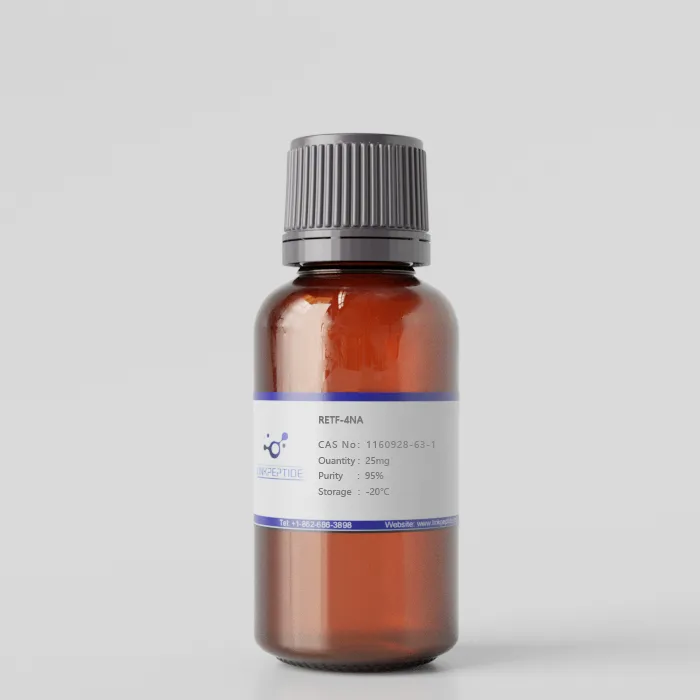
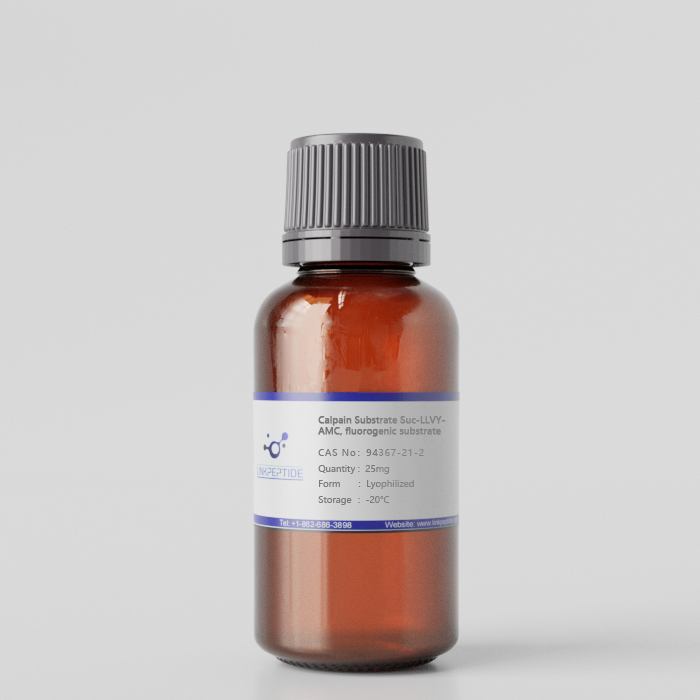
Product Name: Calpain Substrate Suc-LLVY-AMC, fluorogenic substrate
Sequence One Letter Code: Suc-LLVY-AMC
Sequence Three Letter Code: Suc-Leu-Leu-Val-Tyr-AMC
Cas No: 94367-21-2
Chemical Formula:C40H53N5O10
Molecular Weight: 763.9
Purity: 95%
Form: Lyophilized
Storage Conditions: - 20 °C Protected from light
Research Area: peptide substrate
SMILES: CC1=CC(=O)OC2=C1C=CC(=C2)NC(=O)[C@H](CC3=CC=C(C=C3)O)NC(=O)[C@H](C(C)C)NC(=O)[C@H](CC(C)C)NC(=O)[C@H](CC(C)C)NC(=O)CCC(=O)O
IUPAC: 4-[[(2S)-1-[[(2S)-1-[[(2S)-1-[[(2S)-3-(4-hydroxyphenyl)-1-[(4-methyl-2-oxochromen-7-yl)amino]-1-oxopropan-2-yl]amino]-3-methyl-1-oxobutan-2-yl]amino]-4-methyl-1-oxopentan-2-yl]amino]-4-methyl-1-oxopentan-2-yl]amino]-4-oxobutanoic acid
INCHIKEY: UVFAEQZFLBGVRM-MSMWPWNWSA-N
INCHI:
InChI=1S/C40H53N5O10/c1-21(2)16-29(42-33(47)14-15-34(48)49)38(52)43-30(17-22(3)4)39(53)45-36(23(5)6)40(54)44-31(19-25-8-11-27(46)12-9-25)37(51)41-26-10-13-28-24(7)18-35(50)55-32(28)20-26/h8-13,18,20-23,29-31,36,46H,14-17,19H2,1-7H3,(H,41,51)(H,42,47)(H,43,52)(H,44,54)(H,45,53)(H,48,49)/t29-,30-,31-,36-/m0/s1
Source / Species: Synthetic construct
Conjugation: Conjugated
Conjugation Type: Fluorescent dyes
Code Nacres: NA.26
Application: Suc-LLVY-AMC is a fluorogenic peptide substrate used to measure the activity of calpains and other chymotrypsin-like proteases, including the 20S proteasome. Proteolytic cleavage releases the fluorescent AMC moiety, enabling sensitive quantification through defined excitation and emission wavelengths. This substrate is widely employed in enzyme kinetics studies, inhibitor screening, and assays monitoring calcium-dependent proteolysis. It supports research into neurodegeneration, muscle disorders, metabolic disease, and proteasome-related cellular processes, as well as drug discovery programs targeting cysteine and proteasomal proteases.
Current Research: Suc-LLVY-AMC (succinyl-Leu-Leu-Val-Tyr-7-amido-4-methylcoumarin) is a widely used fluorogenic peptide substrate designed to quantify chymotrypsin-like protease activity. It is commonly applied in assays measuring calpain activity and the chymotrypsin-like activity of the 20S proteasome. Upon proteolytic cleavage at the C-terminal tyrosine residue, the AMC (7-amino-4-methylcoumarin) fluorophore is released, generating a measurable fluorescence signal. This property enables sensitive, real-time detection of protease activity under defined experimental conditions. The LLVY sequence represents a canonical recognition motif for chymotrypsin-like proteases that preferentially cleave after hydrophobic or aromatic residues. In Suc-LLVY-AMC, the N-terminal succinyl (Suc) group enhances solubility and mimics peptide backbone constraints, improving substrate stability and specificity. Cleavage between tyrosine and AMC liberates free AMC, which exhibits characteristic fluorescence when excited at approximately 350–380 nm and detected at 440–460 nm. This fluorescence increase is directly proportional to enzymatic activity, allowing quantitative kinetic analysis. Calpains are calcium-dependent cysteine proteases that regulate cytoskeletal remodeling, signal transduction, and apoptosis. Their activity is tightly controlled by intracellular calcium levels and endogenous inhibitors such as calpastatin. Dysregulated calpain activation has been implicated in neurodegenerative disorders, ischemic injury, muscular dystrophy, and metabolic dysfunction. Suc-LLVY-AMC is frequently employed in calpain assays to measure calcium-stimulated proteolysis and to evaluate calpain inhibitors. By varying calcium concentrations and inhibitor doses, researchers can determine enzymatic kinetics, activation thresholds, and inhibitor potency. The 20S proteasome, a central component of the ubiquitin–proteasome system, also exhibits chymotrypsin-like activity that efficiently cleaves the LLVY motif. Measurement of proteasomal activity using Suc-LLVY-AMC is a standard method in cell biology and pharmacology. The assay enables monitoring of proteasome function in cell lysates, purified enzyme preparations, or intact cells under permeabilized conditions. Inhibitors such as bortezomib or MG132 reduce AMC release, providing a quantitative readout of proteasomal inhibition. This is particularly relevant in cancer research, where proteasome inhibitors are established therapeutic agents. In enzyme kinetics studies, Suc-LLVY-AMC allows determination of parameters such as Km, Vmax, and catalytic efficiency. Because the fluorescence signal accumulates over time, reaction progress can be continuously monitored using microplate readers, supporting high-throughput formats. This makes the substrate suitable for screening chemical libraries for modulators of calpain or proteasome activity. In drug discovery programs targeting cysteine proteases or proteasomal subunits, the assay provides a rapid and reproducible evaluation platform. Beyond cancer research, Suc-LLVY-AMC is widely applied in studies of neurodegeneration. Proteasome dysfunction and aberrant calpain activation contribute to protein aggregation, synaptic loss, and neuronal death in conditions such as Alzheimer’s disease, Parkinson’s disease, and amyotrophic lateral sclerosis. Measuring proteolytic activity with fluorogenic substrates helps clarify how oxidative stress, mitochondrial impairment, or inflammatory signaling influence protein turnover and degradation pathways. In metabolic and muscle disorders, calpain-mediated proteolysis affects insulin signaling, sarcomere integrity, and muscle atrophy. Suc-LLVY-AMC assays support investigation of calcium-dependent proteolysis in these contexts, enabling quantification of enzyme activation under pathological conditions. Overall, Suc-LLVY-AMC is a versatile fluorogenic substrate for detecting chymotrypsin-like protease activity, including calpains and the 20S proteasome. Its sensitive fluorescence-based readout facilitates enzyme kinetics analysis, inhibitor screening, and mechanistic investigation of proteolytic pathways. As protease dysregulation is implicated in a broad range of diseases, this substrate remains an essential tool in both basic research and therapeutic development targeting cysteine and proteasomal proteases.
Get a Quote
 LinkPeptide

![CDK1 Substrate [HATPPKKKRK]](https://www.linkpeptide.com/wp-content/uploads/2026/05/CDK1-Substrate-HATPPKKKRK.jpg "CDK1 Substrate [HATPPKKKRK]")