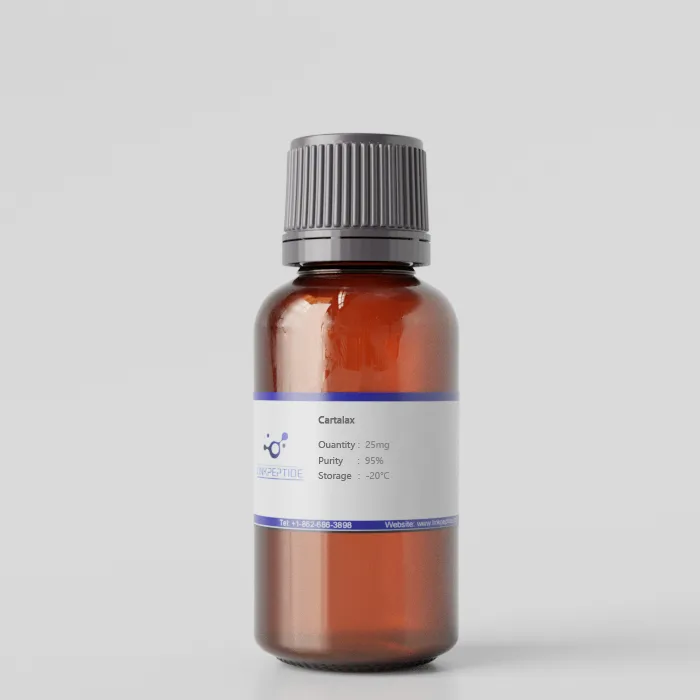
Product Name:Cartalax
Purity:95%
Chemical Formula:C12H19N3O8
Molar Mass:333.29
Synonyms:Ala-Glu-Asp; alanyl-glutamyl-aspartic acid; Cartalax; T-31 peptide
IUPAC Name:(2S)-2-[[(2S)-2-[[(2S)-2-aminopropanoyl]amino]-4-carboxybutanoyl]amino]butanedioic acid
SMILES:C[C@@H](C(=O)N[C@@H](CCC(=O)O)C(=O)N[C@@H](CC(=O)O)C(=O)O)N
InChIKey:KXEVYGKATAMXJJ-ACZMJKKPSA-N
InChI:InChI=1S/C12H19N3O8/c1-5(13)10(20)14-6(2-3-8(16)17)11(21)15-7(12(22)23)4-9(18)19/h5-7H,2-4,13H2,1H3,(H,14,20)(H,15,21)(H,16,17)(H,18,19)(H,22,23)/t5-,6-,7-/m0/s1
Storage:-20 degree Celsius
Sequence:AED
Application:Cartalax is a synthetic short peptide bioregulator composed of dipeptide Ala-Glu, designed to support cartilage and connective tissue regeneration in research settings. Developed from peptide research in tissue-specific repair, Cartalax selectively interacts with DNA sites in chondrocytes and modulates gene expression linked to cartilage integrity and matrix homeostasis. It has shown potential in models of osteoarthritis, degenerative joint disease, and connective tissue disorders. Cartalax is ideal for studies exploring molecular repair, aging musculoskeletal systems, and inflammation regulation.
Current Research:Introduction to Cartalax and Peptide Bioregulators Cartalax is part of a class of cytogenetic short peptides developed through Russian peptide research, particularly associated with the Saint Petersburg Institute of Bioregulation and Gerontology. As a synthetic dipeptide (Ala-Glu), Cartalax mimics naturally occurring regulatory peptides and exerts targeted effects on cartilage and connective tissue. Its mechanisms are primarily epigenetic—modulating gene expression by binding to specific DNA sequences in the nucleus, thereby influencing transcription of structural and regulatory proteins involved in cartilage homeostasis. Cartilage Regeneration and Joint Health The primary area of application for Cartalax is in cartilage repair and joint protection. In vitro studies suggest Cartalax stimulates the expression of aggrecan, collagen type II, and Sox9—markers of chondrocyte activity and cartilage matrix synthesis. These proteins are critical for maintaining the resilience and integrity of articular cartilage, particularly under degenerative stress such as osteoarthritis. Animal models of osteoarthritis and cartilage degeneration have shown promising outcomes following Cartalax administration. These include: Increased chondrocyte proliferation Reduced expression of inflammatory cytokines (e.g., IL-1β, TNF-α) Preservation of joint structure on histological examination Improved joint mobility and reduced cartilage erosion Such findings suggest that Cartalax may modulate both structural regeneration and inflammatory balance in joint tissues. Mechanism of Action: Epigenetic and Anti-Inflammatory Cartalax, like other cytogenetic peptides, is believed to work by binding to regulatory DNA sequences and altering gene expression in a tissue-specific manner. The dipeptide Ala-Glu appears to guide transcription toward restoration of physiological balance, particularly by enhancing the synthesis of structural proteins while suppressing catabolic pathways. In inflammatory models, Cartalax reduces the production of matrix metalloproteinases (MMPs), enzymes responsible for cartilage breakdown. This supports cartilage preservation under inflammatory conditions such as rheumatoid arthritis and age-related wear-and-tear. Additionally, the peptide enhances antioxidant defenses, reducing oxidative stress within joint tissues. Oxidative stress plays a crucial role in the chronic progression of degenerative joint disease, making this antioxidant effect a notable benefit. Applications in Aging and Musculoskeletal Research Cartalax is being increasingly studied in the context of gerontology and anti-aging medicine, particularly for its role in preserving musculoskeletal function in aging organisms. Age-related loss of cartilage elasticity and reduced regenerative capacity contribute significantly to disability in elderly populations. Cartalax has shown potential in slowing these age-associated changes by promoting anabolic gene expression and suppressing senescence-associated inflammatory responses. In rodent models, long-term administration of Cartalax has been linked to: Improved mobility and physical activity Lower biomarkers of tissue degeneration Enhanced collagen turnover in joints and ligaments These findings highlight Cartalax’s promise in extending healthspan and musculoskeletal function, not just treating pathology. Potential Synergy with Other Bioregulators Cartalax is often studied in combination with other tissue-specific peptides such as Vladonix (for thymus and immune support) or Chonluten (for respiratory tissues). In musculoskeletal protocols, it pairs well with peptides like Sigumir (targeted to connective tissue repair) and Ventfort (vascular tissue support). Together, these combinations may offer multi-system regenerative effects, improving systemic resilience and cellular renewal. Conclusion and Future Directions Cartalax represents a novel approach to joint and cartilage regeneration, distinct from traditional anti-inflammatory drugs or physical therapies. By directly modulating gene expression at the nuclear level, it offers a precision bioregulatory mechanism for restoring tissue integrity. Current research continues to explore optimal dosing strategies, delivery methods (oral, injectable, or transdermal), and long-term safety. Future clinical applications may include its role as an adjunct therapy for osteoarthritis, sports injuries, connective tissue diseases, and age-related cartilage degeneration. As part of the broader field of peptide bioregulation, Cartalax exemplifies how minimal peptide sequences can exert profound tissue-specific actions—ushering in a new era of targeted regenerative medicine research.
Reference:
Get a Quote
 LinkPeptide