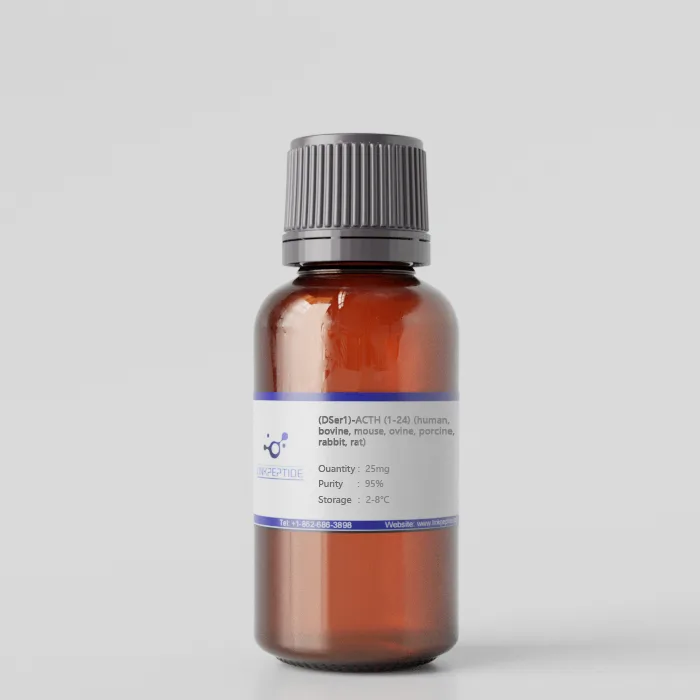
Product Name:(DSer1)-ACTH (1-24) (human, bovine, mouse, ovine, porcine, rabbit, rat)
Form:TFA salt
Purity:95%
Storage:2-8 degree Celsius
Molar Mass:2933.5
Chemical Formula:C136H210N40O31S1
Sequence:DSer-Tyr-Ser-Met-Glu-His-Phe-Arg-Trp-Gly-Lys-Pro-Val-Gly-Lys-Lys-Arg-Arg-Pro-Val-Lys-Val-Tyr-Pro
Application:(DSer1)-ACTH (1-24) (human, bovine, mouse, ovine, porcine, rabbit, rat) is a synthetic modified fragment of adrenocorticotropic hormone (ACTH) with D-serine substitution at position 1. This N-terminal ACTH analog retains melanocortin receptor activation properties, stimulating adrenal corticosteroid production via melanocortin 2 receptor (MC2R). The D-serine modification enhances peptide stability and receptor binding, making it valuable for comparative endocrine research across multiple species. This peptide is widely used in studies on HPA axis regulation, stress adaptation, and immune responses, with applications in adrenal dysfunction, neuroendocrine signaling, and peptide-based drug development for endocrine and metabolic disorders.
Current Research:
Introduction
(DSer¹)-ACTH (1-24) is a structurally modified ACTH analog, where D-serine replaces L-serine at position 1, potentially altering receptor binding dynamics, enzymatic resistance, and biological activity. Since ACTH (1-24) is the active domain responsible for adrenal stimulation, this modified version is studied for comparative receptor activation, peptide stability, and adrenal steroidogenesis across multiple species (human, bovine, mouse, ovine, porcine, rabbit, rat).
Endocrine and Adrenal Function Research
ACTH (1-24) is a widely used truncated form of ACTH (1-39), retaining full activity at the melanocortin 2 receptor (MC2R) in the adrenal cortex. The D-serine substitution at position 1 in (DSer¹)-ACTH (1-24) may:
Enhance receptor binding affinity, leading to potentially prolonged activation of MC2R.
Increase peptide stability, improving half-life and resistance to enzymatic degradation.
Modulate adrenal steroidogenesis, impacting glucocorticoid, mineralocorticoid, and androgen production.
This makes (DSer¹)-ACTH (1-24) a valuable tool for:
Adrenal insufficiency research, including Addison’s disease and congenital adrenal hyperplasia (CAH).
Comparative endocrinology studies, analyzing species-specific differences in MC2R activation and adrenal steroid output.
Peptide-based hormone therapy development, focusing on enhanced stability and receptor selectivity.
Neuroendocrine and Stress Regulation Research
ACTH peptides play an essential role in HPA axis function and stress adaptation. Research on (DSer¹)-ACTH (1-24) explores:
HPA axis modulation, particularly in stress models across different species.
Effects on neurotransmitter systems, including dopamine and serotonin, which influence mood, cognition, and stress responses.
Potential applications in neuropsychiatric research, particularly in stress-related disorders such as PTSD, anxiety, and depression.
By altering stress hormone release, this modified peptide could provide insights into species-specific adrenal responses to environmental stressors.
Immunomodulatory and Anti-Inflammatory Effects
Melanocortin peptides, including ACTH-derived analogs, have been implicated in immune regulation. Studies on (DSer¹)-ACTH (1-24) suggest:
Potential immune modulation through melanocortin receptor interactions (MC1R, MC3R, and MC5R).
Suppression of pro-inflammatory cytokines (e.g., TNF-α, IL-6, IL-1β), suggesting anti-inflammatory effects.
Possible therapeutic applications in autoimmune and inflammatory diseases, such as rheumatoid arthritis and multiple sclerosis.
These properties make it a candidate for investigating immune-endocrine interactions in species-specific immune responses.
Species-Specific Research and Applications
ACTH function varies across species, making comparative endocrinology an important research area. Studies using (DSer¹)-ACTH (1-24) across species (human, bovine, mouse, ovine, porcine, rabbit, rat) focus on:
Differences in MC2R activation, which influence glucocorticoid and adrenal response rates.
Variability in stress adaptation, studying species-dependent HPA axis activity and cortisol release patterns.
Application in veterinary and biomedical research, particularly in livestock stress physiology and laboratory animal models.
This peptide is valuable for translating findings from animal models to human endocrine and metabolic disorders.
Potential Research and Therapeutic Applications
Given its stabilized structure, receptor-binding properties, and immune-modulating effects, (DSer¹)-ACTH (1-24) is being explored for:
Improved peptide-based adrenal hormone therapy.
Stress physiology research, particularly for species-specific HPA axis responses.
Immunomodulatory applications, targeting neuroimmune conditions and inflammatory diseases.
Conclusion
(DSer¹)-ACTH (1-24) is a modified ACTH analog with potential applications in adrenal function research, stress adaptation studies, and immune regulation. The D-serine substitution enhances stability and receptor interactions, making it valuable for comparative endocrinology and therapeutic development across species. Ongoing research continues to refine its biological significance and clinical applications in endocrine disorders, neuroimmune conditions, and stress-related diseases.
Get a Quote
 LinkPeptide