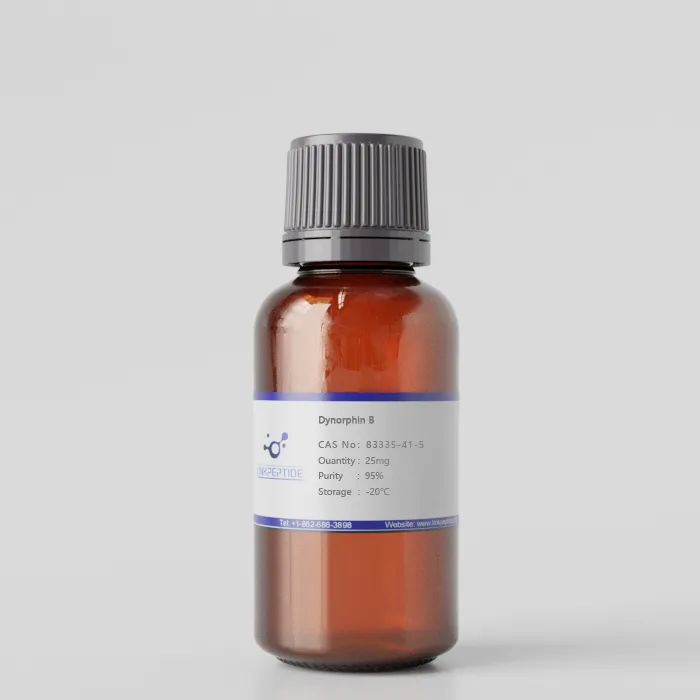
Product Name:Dynorphin B
CAS No:83335-41-5
Purity:95%
Molar Mass:1570.85
Chemical Formula:C74H115N21O17
Storage:Store at -20 degrees Celsius
Sequence:YGGFLRRQFKVVT
Target:kappa opioid
Application:
Dynorphin B is an endogenous opioid peptide that primarily acts on kappa-opioid receptors (KOR). It is derived from the precursor protein prodynorphin and plays a critical role in modulating pain, stress responses, and emotional states. Dynorphin B's activation of KOR can induce analgesia but is also associated with dysphoria, making it a subject of interest in pain management and mood disorder research. Additionally, it has been studied in addiction and neurodegenerative diseases due to its involvement in the brain's reward and stress pathways.
Current Research:
Dynorphin B, also known as rimorphin, is an endogenous opioid peptide derived from the precursor protein prodynorphin. Its amino acid sequence is Tyr-Gly-Gly-Phe-Leu-Arg-Arg-Gln-Phe-Lys-Val-Val-Thr.
Biosynthesis and Structure
Prodynorphin undergoes proteolytic cleavage to produce several active peptides, including dynorphin A, dynorphin B, and α-neo-endorphin. Dynorphin B is generated from the cleavage of leumorphin, a larger fragment of prodynorphin. Notably, dynorphin B shares an identical N-terminal sequence with dynorphin A but differs in its C-terminal region, which influences its receptor binding affinity and physiological effects.
Receptor Affinity and Physiological Roles
Dynorphin B primarily binds to κ-opioid receptors (KORs) in the central and peripheral nervous systems. Activation of KORs by dynorphin B modulates pain perception, stress responses, and emotional regulation. Additionally, dynorphin B has been implicated in the regulation of cardiovascular and respiratory functions.
Clinical Implications
Alterations in dynorphin B levels and KOR activity have been associated with various pathological conditions, including chronic pain, mood disorders, and substance abuse. Understanding the role of dynorphin B in these conditions may inform the development of targeted therapies aimed at modulating the dynorphin/KOR system.
Research Applications
Dynorphin B serves as a valuable tool in neuropharmacological research, aiding in the exploration of opioid receptor function and the development of novel analgesics with reduced abuse potential. Recent studies have investigated the structure–function relationships of dynorphin B variants to better understand their interactions with opioid receptors.
Conclusion
Dynorphin B is a critical component of the endogenous opioid system, influencing various physiological processes through its interaction with κ-opioid receptors. Ongoing research continues to elucidate its complex roles in health and disease, highlighting its potential as a therapeutic target.
Reference:
Get a Quote
 LinkPeptide