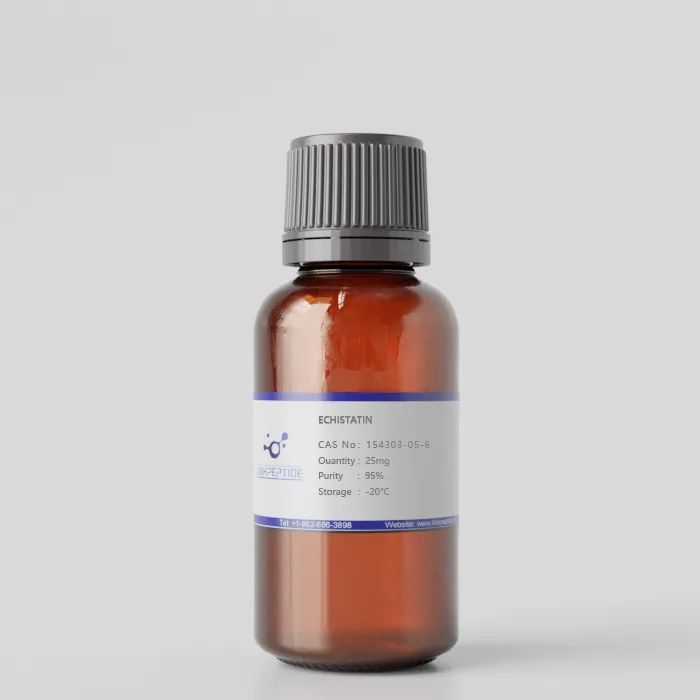
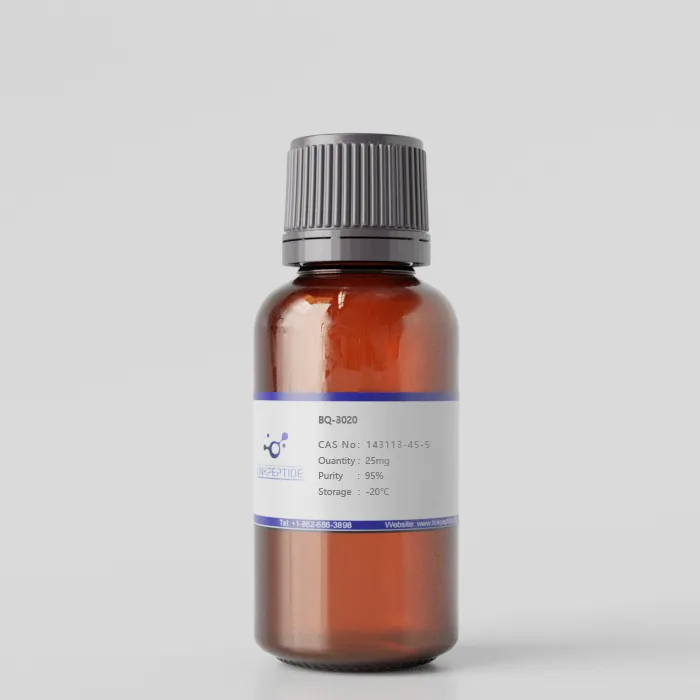
Product Name:ECHISTATIN
Synonyms:Echistatin α1 (9CI)
CAS No:154303-05-6
Purity:95%
Molar Mass:5417
Chemical Formula:C217H341N71O74S9
Storage:Room temperature
Sequence:ECESGPCCRN CKFLKEGTIC KRARGDDMDD YCNGKTCDCP RNPHKGPAT
Target:platelet aggregation
Application:
Echistatin is a potent disintegrin protein derived from the venom of the saw-scaled viper (Echis carinatus). It is widely utilized in research for its ability to inhibit integrin-mediated cell adhesion, particularly through binding to the αvβ3 and αIIbβ3 integrins. By interfering with integrin functions, Echistatin serves as a valuable tool in studying processes such as platelet aggregation, tumor metastasis, angiogenesis, and osteoporosis. Its strong affinity for integrins makes it an effective inhibitor in both in vitro and in vivo models, providing insights into the mechanisms of cell-matrix interactions and the development of therapeutic agents targeting integrin-related diseases.
Current Research:
Echistatin is a small disintegrin peptide derived from the venom of the saw-scaled viper (Echis carinatus). Renowned for its high affinity for integrins, particularly αvβ3 and αIIbβ3, Echistatin serves as a powerful tool for studying cell adhesion, migration, and signaling pathways.
This 49-amino acid peptide contains the RGD (Arg-Gly-Asp) motif, a critical sequence that mimics natural ligands of integrins. By binding to the integrin receptors, Echistatin effectively blocks interactions with extracellular matrix proteins like fibronectin, vitronectin, and fibrinogen. This mechanism underpins its utility in exploring processes such as angiogenesis, thrombosis, and cancer metastasis.
In angiogenesis research, Echistatin is widely used to inhibit endothelial cell migration and tube formation, providing insights into the role of integrins in vascular development. Its ability to disrupt integrin-mediated adhesion has also been leveraged in cancer studies to understand tumor invasion and metastasis, where integrins play a key role in facilitating cellular interactions with the tumor microenvironment.
In thrombosis research, Echistatin has been employed to investigate platelet aggregation mechanisms. By inhibiting the αIIbβ3 integrin, which is essential for platelet-fibrinogen binding, Echistatin offers a model for studying antithrombotic strategies.
Additionally, Echistatin's stability and specificity make it a valuable tool in high-throughput screening assays for integrin-targeted therapeutics. The peptide is instrumental in developing drugs aimed at modulating integrin activity for conditions like osteoporosis, cancer, and inflammatory diseases.
With its robust binding properties and extensive applications in biomedical research, Echistatin remains a cornerstone molecule for elucidating integrin-mediated biological processes and advancing therapeutic development. Its continued use is anticipated to yield transformative insights into integrin biology and its implications for human health.
Reference:
Get a Quote
 LinkPeptide