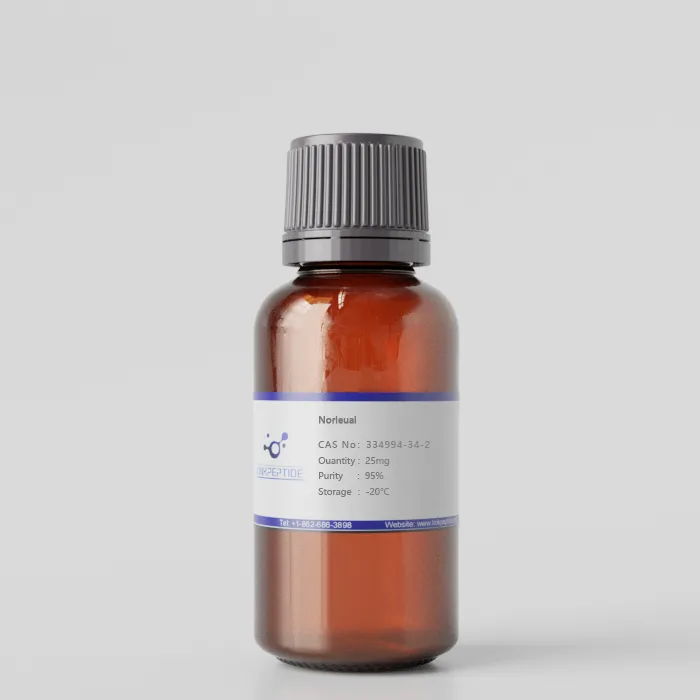
Product Name:TEPROTIDE
Form:free base
Purity:95%
Storage:2-8 degree Celsius
Cas No:35115-60-7
Molar Mass:1101.3
Chemical Formula:C53H76N14O12
IUPAC Name:(2S)-1-[(2S)-1-[(2S,3S)-2-[[(2S)-5-amino-2-[[(2S)-1-[(2S)-5-(diaminomethylideneamino)-2-[[(2S)-1-[(2S)-3-(1H-indol-3-yl)-2-[[(2S)-5-oxopyrrolidine-2-carbonyl]amino]propanoyl]pyrrolidine-2-carbonyl]amino]pentanoyl]pyrrolidine-2-carbonyl]amino]-5-oxopentanoyl]amino]-3-methylpentanoyl]pyrrolidine-2-carbonyl]pyrrolidine-2-carboxylic acid
SMILES: CC[C@H](C)[C@@H](C(=O)N1CCC[C@H]1C(=O)N2CCC[C@H]2C(=O)O)NC(=O)[C@H](CCC(=O)N)NC(=O)[C@@H]3CCCN3C(=O)[C@H](CCCN=C(N)N)NC(=O)[C@@H]4CCCN4C(=O)[C@H](CC5=CNC6=CC=CC=C65)NC(=O)[C@@H]7CCC(=O)N7
InChIKey:UUUHXMGGBIUAPW-CSCXCSGISA-N
InChI:InChI=1S/C53H76N14O12/c1-3-29(2)43(51(77)66-25-9-16-39(66)50(76)67-26-10-17-40(67)52(78)79)63-45(71)34(18-20-41(54)68)60-46(72)37-14-7-23-64(37)48(74)35(13-6-22-57-53(55)56)61-47(73)38-15-8-24-65(38)49(75)36(62-44(70)33-19-21-42(69)59-33)27-30-28-58-32-12-5-4-11-31(30)32/h4-5,11-12,28-29,33-40,43,58H,3,6-10,13-27H2,1-2H3,(H2,54,68)(H,59,69)(H,60,72)(H,61,73)(H,62,70)(H,63,71)(H,78,79)(H4,55,56,57)/t29-,33-,34-,35-,36-,37-,38-,39-,40-,43-/m0/s1
Sequence:Glp-Trp-Pro-Arg-Pro-Gln-Ile-Pro-Pro
Application:Teprotide is a bioactive nonapeptide derived from the venom of Bothrops jararaca (Brazilian pit viper), known as a natural angiotensin-converting enzyme (ACE) inhibitor. It effectively blocks the conversion of angiotensin I to angiotensin II, leading to vasodilation and reduced blood pressure. Teprotide served as a prototype for the development of synthetic ACE inhibitors like captopril, revolutionizing hypertension treatment. Research continues to explore its role in cardiovascular health, renal protection, and inflammation regulation. As a model compound, teprotide is used in studying hypertension mechanisms, vascular function, and peptide-based drug development for cardiovascular and metabolic diseases.
Current Research:
Teprotide was the first natural ACE inhibitor to be studied extensively for its ability to lower blood pressure and regulate vascular function. Isolated from Bothrops jararaca venom, teprotide’s discovery led to the development of captopril, the first synthetic ACE inhibitor approved for clinical use. Today, research continues to explore its potential in hypertension, cardiovascular diseases, kidney protection, and metabolic disorders.
Teprotide-derived peptides as alternative ACE inhibitors with improved stability and bioavailability.
Its impact on endothelial function, showing protective effects against oxidative stress and vascular inflammation.
Potential therapeutic applications in heart failure, where ACE inhibition reduces cardiac workload and fibrosis.
Recent work also suggests that teprotide may synergize with modern antihypertensive therapies, offering multi-targeted approaches to resistant hypertension.
Chronic kidney disease (CKD), where ACE inhibitors reduce glomerular hypertension and proteinuria.
Diabetic nephropathy, as it helps modulate inflammation and oxidative stress in kidney tissues.
Studies have shown that teprotide may have anti-fibrotic properties, reducing renal damage in hypertension-related kidney disorders.
Type 2 diabetes (T2D), where it may enhance insulin sensitivity by improving vascular function.
Neuroprotection, as ACE inhibitors are studied for their ability to reduce neuroinflammation and improve cerebral blood flow in Alzheimer’s disease.
Preliminary studies suggest that teprotide-derived peptides could contribute to reducing neurodegeneration by decreasing oxidative stress and inflammatory cytokines in brain tissues.
Engineering more stable ACE-inhibitory peptides for pharmaceutical use.
Developing multifunctional peptides that target hypertension, kidney function, and inflammation simultaneously.
Exploring new delivery methods, such as nanoparticle-based formulations for improved bioavailability.
Conclusion
Teprotide remains a crucial model compound in hypertension, cardiovascular, and renal disease research. Its ACE-inhibitory properties have paved the way for modern antihypertensive drugs, and ongoing studies continue to explore its potential in metabolic, neurodegenerative, and inflammatory diseases. The future of teprotide research lies in peptide drug development, aiming to create next-generation therapeutics for vascular and systemic health.
Get a Quote
 LinkPeptide

![[Des-Arg10]-HOE I40, B1 Bradykinin Receptor Ant...](https://www.linkpeptide.com/wp-content/uploads/2026/05/Des-Arg10-HOE-I40-B1-Bradykinin-Receptor-Antagonist.jpg "[Des-Arg10]-HOE I40, B1 Bradykinin Receptor Ant...")