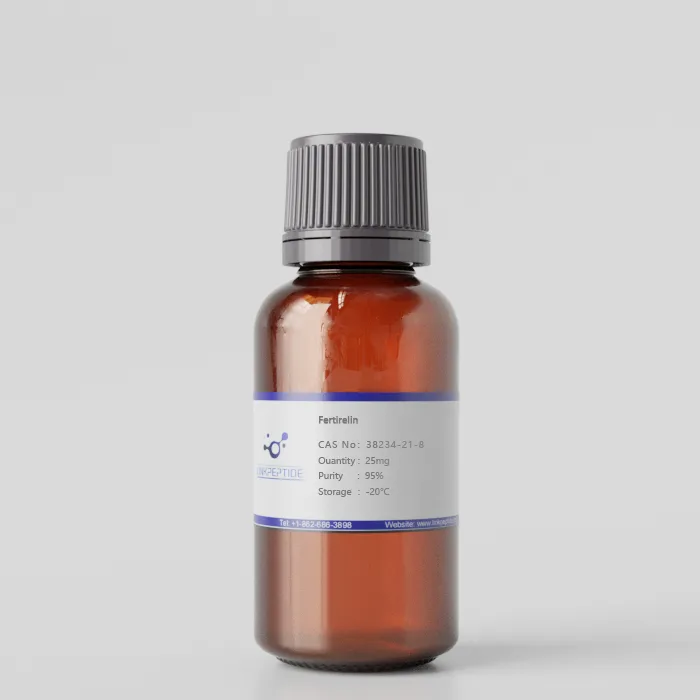
Product Name:Fertirelin
Form:Acetate salt
Purity:95%
Storage:-20oC
Cas No:38234-21-8
Molar Mass:1153.3
Chemical Formula:C55H76N16O12
IUPAC Name:(2S)-N-[(2S)-1-[[(2S)-1-[[(2S)-1-[[(2S)-1-[[2-[[(2S)-1-[[(2S)-5-(diaminomethylideneamino)-1-[(2S)-2-(ethylcarbamoyl)pyrrolidin-1-yl]-1-oxopentan-2-yl]amino]-4-methyl-1-oxopentan-2-yl]amino]-2-oxoethyl]amino]-3-(4-hydroxyphenyl)-1-oxopropan-2-yl]amino]-3-hydroxy-1-oxopropan-2-yl]amino]-3-(1H-indol-3-yl)-1-oxopropan-2-yl]amino]-3-(1H-imidazol-5-yl)-1-oxopropan-2-yl]-5-oxopyrrolidine-2-carboxamide
SMILES:CCNC(=O)[C@@H]1CCCN1C(=O)[C@H](CCCN=C(N)N)NC(=O)[C@H](CC(C)C)NC(=O)CNC(=O)[C@H](CC2=CC=C(C=C2)O)NC(=O)[C@H](CO)NC(=O)[C@H](CC3=CNC4=CC=CC=C43)NC(=O)[C@H](CC5=CN=CN5)NC(=O)[C@@H]6CCC(=O)N6??
InChIKey:DGCPIBPDYFLAAX-YTAGXALCSA-N?
InChI:InChI=1S/C55H76N16O12/c1-4-59-53(82)44-12-8-20-71(44)54(83)38(11-7-19-60-55(56)57)66-49(78)39(21-30(2)3)65-46(75)27-62-47(76)40(22-31-13-15-34(73)16-14-31)67-52(81)43(28-72)70-50(79)41(23-32-25-61-36-10-6-5-9-35(32)36)68-51(80)42(24-33-26-58-29-63-33)69-48(77)37-17-18-45(74)64-37/h5-6,9-10,13-16,25-26,29-30,37-44,61,72-73H,4,7-8,11-12,17-24,27-28H2,1-3H3,(H,58,63)(H,59,82)(H,62,76)(H,64,74)(H,65,75)(H,66,78)(H,67,81)(H,68,80)(H,69,77)(H,70,79)(H4,56,57,60)/t37-,38-,39-,40-,41-,42-,43-,44-/m0/s1?
Sequence:XHWSYGLRP
Application:Fertirelin is a synthetic analog of gonadotropin-releasing hormone (GnRH) that stimulates the release of luteinizing hormone (LH) and follicle-stimulating hormone (FSH) from the pituitary gland. It is primarily used in reproductive medicine and veterinary applications to manage ovulation disorders, enhance fertility, and synchronize estrus cycles. Fertirelin has higher biological potency and receptor affinity compared to natural GnRH, making it effective for ovulation induction and hormone regulation. Current research explores its potential in assisted reproductive technologies (ART), infertility treatments, and endocrine dysfunction, positioning it as a promising agent in human and animal reproductive health.
Current Research:Fertirelin is a synthetic gonadotropin-releasing hormone (GnRH) analog that plays a crucial role in reproductive hormone regulation. By acting on the hypothalamic-pituitary-gonadal (HPG) axis, Fertirelin stimulates the pituitary release of luteinizing hormone (LH) and follicle-stimulating hormone (FSH), influencing ovulation, spermatogenesis, and reproductive cycle synchronization. It has been widely used in veterinary medicine for managing fertility in livestock, but emerging research explores its potential in human reproductive health, assisted reproductive technologies (ART), and endocrine dysfunction. Reproductive Health and Fertility Applications Fertirelin has demonstrated effectiveness in regulating ovulation and improving fertility outcomes in both women and men. Ovulation induction: It is being studied as an alternative to human chorionic gonadotropin (hCG) for inducing final oocyte maturation in assisted reproductive technologies (ART), such as in vitro fertilization (IVF). Polycystic ovary syndrome (PCOS): Research suggests that Fertirelin may help regulate LH/FSH balance, improving ovulatory function and menstrual cycle regularity in women with PCOS. Hypogonadotropic hypogonadism: Studies explore its potential in treating delayed puberty and infertility in men with gonadotropin deficiencies, enhancing testosterone production and spermatogenesis. Luteal phase support: Fertirelin is being assessed for its ability to enhance corpus luteum function, improving pregnancy rates in ART protocols. Veterinary Medicine and Livestock Fertility Management Fertirelin is widely used in cattle, swine, and equine reproduction programs to enhance fertility and synchronize estrus cycles. Estrus synchronization: It is used in fixed-time artificial insemination (FTAI) protocols to improve conception rates. Anovulation and ovarian cyst treatment: Fertirelin is effective in treating ovarian dysfunction and persistent follicular cysts in livestock. Dairy cow fertility improvement: Research suggests Fertirelin may enhance reproductive efficiency and reduce postpartum anestrus in high-producing dairy cows. Emerging Research Areas Endocrine dysfunction and hormone regulation: Studies investigate its role in modulating pituitary function for gonadotropin control in hormone-related disorders. Testosterone modulation in aging men: Research explores Fertirelin??s effects on LH stimulation for boosting endogenous testosterone production in men with late-onset hypogonadism. Combination therapies in ART: Fertirelin is being tested in combination with GnRH antagonists, gonadotropins, and estrogen modulators to optimize ovulation induction protocols. Cancer research: Some studies explore its role in hormone-sensitive cancers, such as prostate and breast cancer, by regulating gonadotropin levels. With expanding research, Fertirelin is emerging as a key agent in reproductive medicine, offering potential applications in fertility treatments, endocrine regulation, and hormone therapy.
Get a Quote
 LinkPeptide