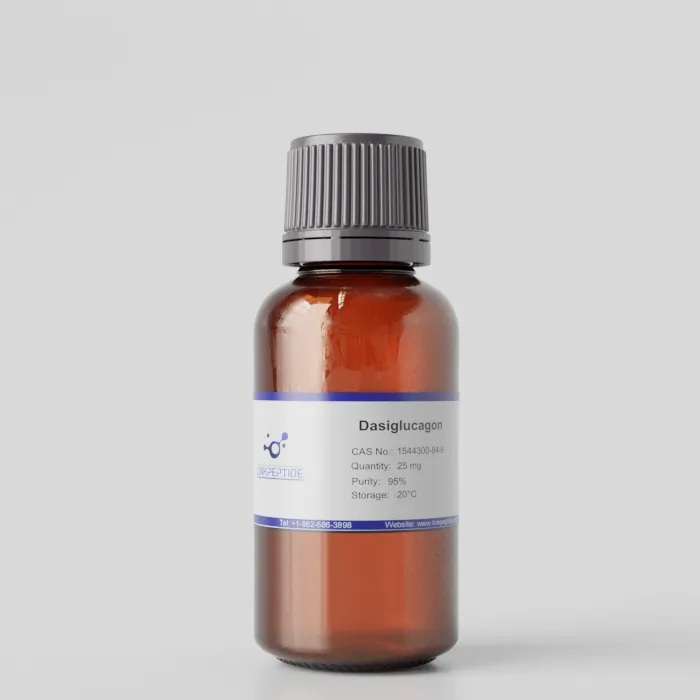
Product Name: Dasiglucagon
Form: TFA salt
CAS No: 1544300-84-6
Molar Mass: 3381.66
Chemical Formula: C152H222N38O50
Synonyms: ZP4207; ZP 4207; ZP-4207
Storage: Store at -20℃
Sequence: HSQGTFTSDYSKYLDXARAEEFVKWLEST
Target: glucagon receptors
Application:
Dasiglucagon (CAS: 1544300-84-6) is a glucagon receptor agonist used in the treatment of severe hypoglycemia in patients with diabetes. It acts by binding to glucagon receptors in the liver, stimulating the release of glucose into the bloodstream through glycogenolysis and gluconeogenesis. Dasiglucagon is particularly effective in cases of severe hypoglycemia where traditional methods of glucose administration, such as oral intake or intravenous glucose, are not feasible. In pharmaceutical chemistry, dasiglucagon's targeted action on glucagon receptors represents a significant advancement in the management of acute hypoglycemic episodes, providing a rapid and reliable means of restoring blood glucose levels to prevent neurological complications and other adverse effects associated with severe hypoglycemia. Its application underscores its importance in emergency medicine and diabetes care, offering a life-saving intervention for patients at risk of hypoglycemic emergencies. Additionally, ongoing research explores dasiglucagon's potential in other therapeutic areas, such as glycemic control in diabetes management and the treatment of other metabolic disorders.
Current Research:
Dasiglucagon is a synthetic glucagon analog used for the treatment of severe hypoglycemia (low blood sugar) in individuals with diabetes, particularly in emergency situations where oral glucose administration is not feasible. It is an injectable peptide that works by stimulating the liver to release glucose into the bloodstream, thus rapidly increasing blood sugar levels. Dasiglucagon is a part of the class of glucagon-like agents, offering a critical intervention in cases of insulin-induced hypoglycemia, especially in individuals with type 1 or type 2 diabetes. Its development represents a significant advancement over traditional glucagon therapy, providing a more stable and easier-to-administer option.
Mechanism of Action
Dasiglucagon works by mimicking the action of natural glucagon, a hormone produced by the alpha cells of the pancreas. Glucagon's primary function is to raise blood glucose levels by stimulating glycogen breakdown (glycogenolysis) in the liver, thereby releasing glucose into the bloodstream. Dasiglucagon, like natural glucagon, binds to the glucagon receptor in the liver, activating signaling pathways that increase glucose production. This results in a rapid increase in blood glucose levels, helping to reverse the symptoms of hypoglycemia. Dasiglucagon is engineered to have greater stability in solution compared to traditional glucagon, making it easier to store and administer, especially in emergency situations.
Indications and Uses
Dasiglucagon is indicated for the treatment of severe hypoglycemia in individuals with diabetes who are at risk of hypoglycemic episodes. It is used when the individual is unable to ingest oral glucose, such as in unconscious or unresponsive patients. Dasiglucagon is available as an injectable formulation, often provided in an auto-injection device, which allows non-medical personnel to administer it in emergency situations. The drug is typically administered subcutaneously, and it works rapidly, with an onset of action within 10 minutes, making it a reliable option for quickly addressing severe hypoglycemia in diabetic patients.
Efficacy and Clinical Benefits
Clinical trials have demonstrated that Dasiglucagon effectively raises blood glucose levels in patients experiencing severe hypoglycemia. In comparison to traditional glucagon formulations, Dasiglucagon has been shown to have a more predictable and stable response, with a lower likelihood of adverse reactions such as nausea or vomiting, which can be common with older glucagon preparations. Dasiglucagon also offers the convenience of a ready-to-use, stable formulation, eliminating the need for reconstitution before administration. Studies have shown that Dasiglucagon can reverse hypoglycemia within minutes, providing a quick and reliable treatment in emergency situations. Furthermore, it has been proven to be safe and effective in both adults and children with diabetes, making it a versatile option for managing hypoglycemia across various age groups.
Safety and Tolerability
Dasiglucagon is generally well tolerated, with few side effects. The most common adverse effects associated with its use include nausea and vomiting, which are typically mild and transient. However, these symptoms are less frequent and less severe than with traditional glucagon preparations. Other side effects may include injection site reactions such as redness, swelling, or pain, although these are typically short-lived. Serious side effects are rare, but caution should be exercised in patients with pheochromocytoma or insulinoma, as glucagon may exacerbate these conditions. Additionally, as Dasiglucagon rapidly increases blood glucose levels, there is a risk of hyperglycemia, though this is less of a concern when administered correctly in the context of severe hypoglycemia.
Advantages and Limitations
The primary advantage of Dasiglucagon is its ability to provide a rapid, effective response to severe hypoglycemia without the need for reconstitution, making it easier to administer in emergency situations. Its stability at room temperature makes it more convenient for storage and reduces the risk of improper handling, which can be an issue with older glucagon formulations that require refrigeration and reconstitution. The auto-injection device also adds convenience, allowing patients, caregivers, or bystanders to administer the drug without the need for advanced medical training. However, Dasiglucagon’s use is limited to severe hypoglycemia episodes and is not intended for the management of mild or moderate hypoglycemia, for which oral glucose administration remains the preferred approach.
Future Directions
Ongoing research into Dasiglucagon is focused on evaluating its long-term effectiveness and safety in broader diabetic populations, including those with type 2 diabetes or other comorbid conditions. There is also potential for developing alternative delivery methods or formulations, such as intranasal or oral preparations, to further enhance its ease of use and availability. Additionally, studies are exploring its use in combination with other diabetes treatments or technologies, such as continuous glucose monitors (CGMs) and insulin pumps, to improve overall diabetes management and reduce the risk of hypoglycemic episodes. As the understanding of glucagon’s role in metabolic regulation expands, Dasiglucagon may also be studied for its potential benefits in conditions beyond diabetes, such as in the treatment of certain rare metabolic disorders.
Reference:
Blair, H. A. (2021). Dasiglucagon: first approval. Drugs, 81(9), 1115-1120.
Get a Quote
 LinkPeptide