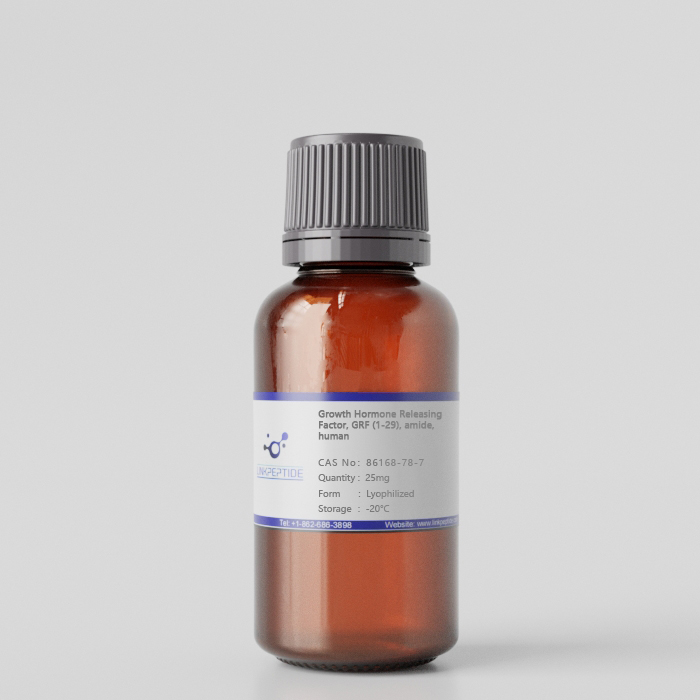
Product Name: Growth Hormone Releasing Factor, GRF (1-29), amide, human
Sequence One Letter Code: YADAIFTNSYRKVLGQLSARKLLQDIMSR-NH2
Sequence Three Letter Code: H-Tyr-Ala-Asp-Ala-Ile-Phe-Thr-Asn-Ser-Tyr-Arg-Lys-Val-Leu-Gly-Gln-Leu-Ser-Ala-Arg-Lys-Leu-Leu-Gln-Asp-Ile-Met-Ser-Arg-NH2
Cas No: 86168-78-7
Chemical Formula:C149H246N44O42S
Molecular Weight: 3358.1
Purity: 95%
Form: Lyophilized
Storage Conditions: - 20 °C
Research Area: Endocrinology Disease Research
SMILES: CC[C@H](C)[C@@H](C(=O)N[C@@H](CC1=CC=CC=C1)C(=O)N[C@@H]([C@@H](C)O)C(=O)N[C@@H](CC(=O)N)C(=O)N[C@@H](CO)C(=O)N[C@@H](CC2=CC=C(C=C2)O)C(=O)N[C@@H](CCCNC(=N)N)C(=O)N[C@@H](CCCCN)C(=O)N[C@@H](C(C)C)C(=O)N[C@@H](CC(C)C)C(=O)NCC(=O)N[C@@H](CCC(=O)N)C(=O)N[C@@H](CC(C)C)C(=O)N[C@@H](CO)C(=O)N[C@@H](C)C(=O)N[C@@H](CCCNC(=N)N)C(=O)N[C@@H](CCCCN)C(=O)N[C@@H](CC(C)C)C(=O)N[C@@H](CC(C)C)C(=O)N[C@@H](CCC(=O)N)C(=O)N[C@@H](CC(=O)O)C(=O)N[C@@H]([C@@H](C)CC)C(=O)N[C@@H](CCSC)C(=O)N[C@@H](CO)C(=O)N[C@@H](CCCNC(=N)N)C(=O)N)NC(=O)[C@H](C)NC(=O)[C@H](CC(=O)O)NC(=O)[C@H](C)NC(=O)[C@H](CC3=CC=C(C=C3)O)N
IUPAC: (3S)-4-[[(2S)-1-[[(2S,3S)-1-[[(2S)-1-[[(2S,3R)-1-[[(2S)-4-amino-1-[[(2S)-1-[[(2S)-1-[[(2S)-1-[[(2S)-6-amino-1-[[(2S)-1-[[(2S)-1-[[2-[[(2S)-5-amino-1-[[(2S)-1-[[(2S)-1-[[(2S)-1-[[(2S)-1-[[(2S)-6-amino-1-[[(2S)-1-[[(2S)-1-[[(2S)-5-amino-1-[[(2S)-1-[[(2S,3S)-1-[[(2S)-1-[[(2S)-1-[[(2S)-1-amino-5-carbamimidamido-1-oxopentan-2-yl]amino]-3-hydroxy-1-oxopropan-2-yl]amino]-4-methylsulfanyl-1-oxobutan-2-yl]amino]-3-methyl-1-oxopentan-2-yl]amino]-3-carboxy-1-oxopropan-2-yl]amino]-1,5-dioxopentan-2-yl]amino]-4-methyl-1-oxopentan-2-yl]amino]-4-methyl-1-oxopentan-2-yl]amino]-1-oxohexan-2-yl]amino]-5-carbamimidamido-1-oxopentan-2-yl]amino]-1-oxopropan-2-yl]amino]-3-hydroxy-1-oxopropan-2-yl]amino]-4-methyl-1-oxopentan-2-yl]amino]-1,5-dioxopentan-2-yl]amino]-2-oxoethyl]amino]-4-methyl-1-oxopentan-2-yl]amino]-3-methyl-1-oxobutan-2-yl]amino]-1-oxohexan-2-yl]amino]-5-carbamimidamido-1-oxopentan-2-yl]amino]-3-(4-hydroxyphenyl)-1-oxopropan-2-yl]amino]-3-hydroxy-1-oxopropan-2-yl]amino]-1,4-dioxobutan-2-yl]amino]-3-hydroxy-1-oxobutan-2-yl]amino]-1-oxo-3-phenylpropan-2-yl]amino]-3-methyl-1-oxopentan-2-yl]amino]-1-oxopropan-2-yl]amino]-3-[[(2S)-2-[[(2S)-2-amino-3-(4-hydroxyphenyl)propanoyl]amino]propanoyl]amino]-4-oxobutanoic acid
INCHIKEY: WGWPRVFKDLAUQJ-MITYVQBRSA-N
INCHI:
InChI=1S/C149H246N44O42S/c1-20-77(13)116(191-122(211)81(17)168-132(221)104(66-113(204)205)178-121(210)79(15)167-123(212)88(152)62-84-39-43-86(198)44-40-84)145(234)185-102(63-83-32-23-22-24-33-83)138(227)193-118(82(18)197)146(235)186-103(65-111(155)202)137(226)189-108(71-196)142(231)182-101(64-85-41-45-87(199)46-42-85)136(225)175-93(38-31-56-165-149(161)162)126(215)174-91(35-26-28-53-151)131(220)190-115(76(11)12)143(232)184-97(58-72(3)4)124(213)166-68-112(203)170-94(47-49-109(153)200)128(217)180-100(61-75(9)10)135(224)188-106(69-194)140(229)169-80(16)120(209)172-92(37-30-55-164-148(159)160)125(214)173-90(34-25-27-52-150)127(216)179-99(60-74(7)8)134(223)181-98(59-73(5)6)133(222)176-95(48-50-110(154)201)129(218)183-105(67-114(206)207)139(228)192-117(78(14)21-2)144(233)177-96(51-57-236-19)130(219)187-107(70-195)141(230)171-89(119(156)208)36-29-54-163-147(157)158/h22-24,32-33,39-46,72-82,88-108,115-118,194-199H,20-21,25-31,34-38,47-71,150-152H2,1-19H3,(H2,153,200)(H2,154,201)(H2,155,202)(H2,156,208)(H,166,213)(H,167,212)(H,168,221)(H,169,229)(H,170,203)(H,171,230)(H,172,209)(H,173,214)(H,174,215)(H,175,225)(H,176,222)(H,177,233)(H,178,210)(H,179,216)(H,180,217)(H,181,223)(H,182,231)(H,183,218)(H,184,232)(H,185,234)(H,186,235)(H,187,219)(H,188,224)(H,189,226)(H,190,220)(H,191,211)(H,192,228)(H,193,227)(H,204,205)(H,206,207)(H4,157,158,163)(H4,159,160,164)(H4,161,162,165)/t77-,78-,79-,80-,81-,82+,88-,89-,90-,91-,92-,93-,94-,95-,96-,97-,98-,99-,100-,101-,102-,103-,104-,105-,106-,107-,108-,115-,116-,117-,118-/m0/s1
Source / Species: human
Conjugation: Unconjugated
Code Nacres: NA.26
Application: Human Growth Hormone Releasing Factor (GRF) (1–29) is a biologically active fragment of the hypothalamic peptide that stimulates growth hormone secretion from the anterior pituitary. The 1–29 sequence retains full receptor-binding affinity and activity comparable to the full-length GRF. Structure–activity studies have identified amino acids 13–21 as critical for high-affinity receptor interaction. This peptide exhibits strong sequence homology across species, supporting its broad use in research. GRF (1–29) is widely applied in studies of growth hormone regulation, pituitary function, and neuroendocrine signaling. It serves as a valuable tool for investigating hormone secretion mechanisms, receptor interactions, and pathways involved in endocrine system control and physiological growth processes.
Current Research: Human Growth Hormone Releasing Factor (GRF) (1–29), also known as a biologically active fragment of growth hormone–releasing hormone (GHRH), is a 29-amino-acid peptide derived from the N-terminal region of the full-length hypothalamic hormone. Despite being truncated, this fragment retains full biological activity and receptor-binding affinity, making it a widely used tool in endocrine and neuroendocrine research. GRF (1–29) plays a central role in stimulating growth hormone (GH) secretion from the anterior pituitary, providing a reliable model for investigating hormonal regulation and signaling pathways involved in growth and metabolism. Role of GRF in Growth Hormone Regulation In physiological conditions, GRF is secreted by the hypothalamus and acts on the anterior pituitary gland to regulate the release of growth hormone. This process is essential for: Somatic growth and development Metabolic regulation, including protein synthesis and lipid metabolism Maintenance of tissue repair and regeneration GRF (1–29) mimics the action of endogenous GRF by binding to GHRH receptors (GHRHR) on pituitary somatotroph cells, triggering GH secretion. Structural and Functional Characteristics The GRF (1–29) fragment represents the minimal sequence required for full biological activity. Extensive structure–activity relationship studies have demonstrated that: The N-terminal region is essential for receptor activation Amino acids 13–21 are critical for high-affinity receptor binding The truncated peptide retains comparable potency to full-length GRF This optimized structure makes GRF (1–29) particularly suitable for experimental applications, as it combines functional integrity with reduced peptide length, improving synthesis efficiency and experimental handling. Mechanism of Action GRF (1–29) exerts its effects by binding to the GHRH receptor, a G protein–coupled receptor expressed on pituitary somatotrophs. Upon activation, the receptor initiates intracellular signaling cascades involving: cAMP production and activation of protein kinase A (PKA) Calcium influx and vesicle exocytosis Transcriptional regulation of growth hormone synthesis These pathways lead to rapid secretion of stored GH as well as increased synthesis of new hormone. Applications in Endocrine and Neuroendocrine Research Due to its well-characterized activity, GRF (1–29) is widely used as a model peptide in studies of hormone secretion and receptor signaling. It enables precise investigation of pituitary function and hypothalamic–pituitary axis regulation. Common applications include: Growth hormone secretion assays in pituitary cell models Receptor binding and signaling studies involving GHRH receptors Analysis of intracellular signaling pathways regulating hormone release Evaluation of neuroendocrine control mechanisms Screening of compounds that modulate GH secretion Its high potency and reproducibility make it a preferred reagent for both in vitro and in vivo experimental systems. Cross-Species Relevance GRF (1–29) exhibits strong sequence homology across species, which contributes to its broad applicability in animal models. This conservation allows researchers to study growth hormone regulation in different biological systems while maintaining translational relevance to human physiology. Role in Growth and Metabolic Studies Growth hormone plays a critical role in regulating body composition, metabolism, and development. By stimulating GH release, GRF (1–29) provides a valuable tool for studying: Endocrine control of growth processes Interactions between hypothalamic and pituitary signaling Metabolic effects of GH on tissues such as liver, muscle, and adipose tissue These studies are essential for understanding disorders related to growth hormone deficiency or dysregulation. A Valuable Tool for Hormone Signaling Research Human GRF (1–29) represents a functionally complete and experimentally efficient analogue of the full-length hormone. Its ability to stimulate growth hormone secretion with high potency makes it indispensable for investigating pituitary function, receptor interactions, and neuroendocrine signaling pathways. By supporting detailed analysis of hormone release mechanisms and endocrine system regulation, GRF (1–29) continues to contribute to advances in understanding growth physiology, metabolic control, and therapeutic approaches targeting the growth hormone axis.
Get a Quote
 LinkPeptide