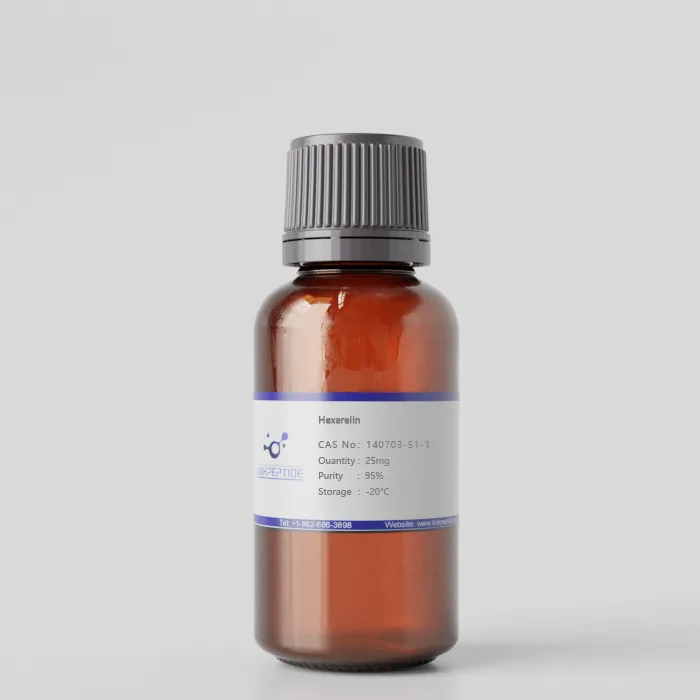
Product Name:Hexarelin
Form:Acetate salt
Purity:95%
Storage:-20oC
Cas No:140703-51-1
Molar Mass:887
Chemical Formula:C47H58N12O6
Synonyms:Examorelin
IUPAC Name:(2S)-6-amino-2-[[(2R)-2-[[(2S)-2-[[(2S)-2-[[(2R)-2-[[(2S)-2-amino-3-(1H-imidazol-5-yl)propanoyl]amino]-3-(2-methyl-1H-indol-3-yl)propanoyl]amino]propanoyl]amino]-3-(1H-indol-3-yl)propanoyl]amino]-3-phenylpropanoyl]amino]hexanamide
SMILES:CC1=C(C2=CC=CC=C2N1)C[C@H](C(=O)N[C@@H](C)C(=O)N[C@@H](CC3=CNC4=CC=CC=C43)C(=O)N[C@H](CC5=CC=CC=C5)C(=O)N[C@@H](CCCCN)C(=O)N)NC(=O)[C@H](CC6=CN=CN6)N
InChIKey:RVWNMGKSNGWLOL-GIIHNPQRSA-N
InChI:InChI=1S/C47H58N12O6/c1-27-34(33-15-7-9-17-37(33)54-27)23-41(58-44(62)35(49)22-31-25-51-26-53-31)45(63)55-28(2)43(61)57-40(21-30-24-52-36-16-8-6-14-32(30)36)47(65)59-39(20-29-12-4-3-5-13-29)46(64)56-38(42(50)60)18-10-11-19-48/h3-9,12-17,24-26,28,35,38-41,52,54H,10-11,18-23,48-49H2,1-2H3,(H2,50,60)(H,51,53)(H,55,63)(H,56,64)(H,57,61)(H,58,62)(H,59,65)/t28-,35-,38-,39+,40-,41+/m0/s1
Sequence:HXAWFK
Application:Hexarelin is a synthetic growth hormone secretagogue (GHS) and ghrelin receptor agonist that stimulates the pituitary gland to increase growth hormone (GH) secretion. It is structurally related to GHRP-6 but with greater potency and stability, making it a promising candidate for growth hormone deficiency (GHD), muscle wasting, and metabolic disorders. Hexarelin also exhibits cardioprotective effects, promoting cardiac repair, reducing fibrosis, and improving cardiac function. Current research explores its potential in anti-aging medicine, neuroprotection, osteoporosis, and metabolic syndrome, positioning it as a multifunctional peptide with therapeutic applications beyond endocrinology.
Current Research:Hexarelin is a synthetic hexapeptide that acts as a growth hormone secretagogue (GHS) by stimulating GH release via ghrelin receptor activation (GHS-R1a). Unlike endogenous growth hormone-releasing hormone (GHRH), Hexarelin can bypass feedback inhibition, leading to sustained GH elevation. Beyond its role in GH regulation, Hexarelin has demonstrated cardioprotective, metabolic, and neuroprotective properties, making it a promising therapeutic agent for multiple medical applications. Growth Hormone Deficiency (GHD) and Muscle Wasting Hexarelin has been studied as an alternative to recombinant GH therapy for patients with GHD, sarcopenia, and cachexia. GH and IGF-1 elevation: Hexarelin significantly increases IGF-1 levels, which supports muscle growth, recovery, and metabolism. Muscle preservation: Studies show potential benefits in preventing muscle atrophy in conditions like aging-related sarcopenia and cancer-related cachexia. Fat metabolism enhancement: Research suggests Hexarelin promotes lipolysis, reducing visceral fat and improving body composition. Cardioprotection and Heart Disease Research One of the most exciting areas of Hexarelin research is its cardioprotective effects, independent of GH stimulation. Myocardial repair: Studies indicate that Hexarelin protects cardiac cells and promotes angiogenesis and tissue regeneration after myocardial infarction (MI). Fibrosis reduction: Research shows Hexarelin reduces cardiac fibrosis, preserving heart function in heart failure models. Heart failure and cardiomyopathy treatment: Hexarelin may improve cardiac output and reduce inflammation in patients with heart failure and ischemic heart disease. Neuroprotection and Cognitive Health Hexarelin is being explored for its role in brain function and neuroprotection. Alzheimer??s and Parkinson??s disease: Studies suggest that Hexarelin may protect neurons from oxidative stress and amyloid toxicity, making it a potential therapy for neurodegenerative disorders. Cognitive function improvement: Research indicates that GH secretagogues like Hexarelin may enhance memory, learning, and synaptic plasticity. Metabolic and Endocrine Research Hexarelin??s effects on metabolism and insulin regulation make it a potential candidate for treating metabolic disorders. Insulin sensitivity improvement: Research suggests Hexarelin may help regulate glucose metabolism and insulin function, benefiting type 2 diabetes and metabolic syndrome. Bone health and osteoporosis prevention: Studies indicate that Hexarelin enhances bone mineralization, making it a potential treatment for osteoporosis and bone loss disorders. Emerging Research Areas Wound healing and tissue regeneration: Hexarelin is being studied for its potential in skin repair and surgical recovery. Reproductive health and testosterone regulation: Research suggests it may modulate testosterone secretion and improve fertility outcomes. Longevity and anti-aging research: Given its GH-boosting properties, Hexarelin is being explored for anti-aging interventions. With continued research, Hexarelin is emerging as a versatile therapeutic peptide with promising applications in endocrinology, cardiology, neurology, and metabolic health.
Get a Quote
 LinkPeptide