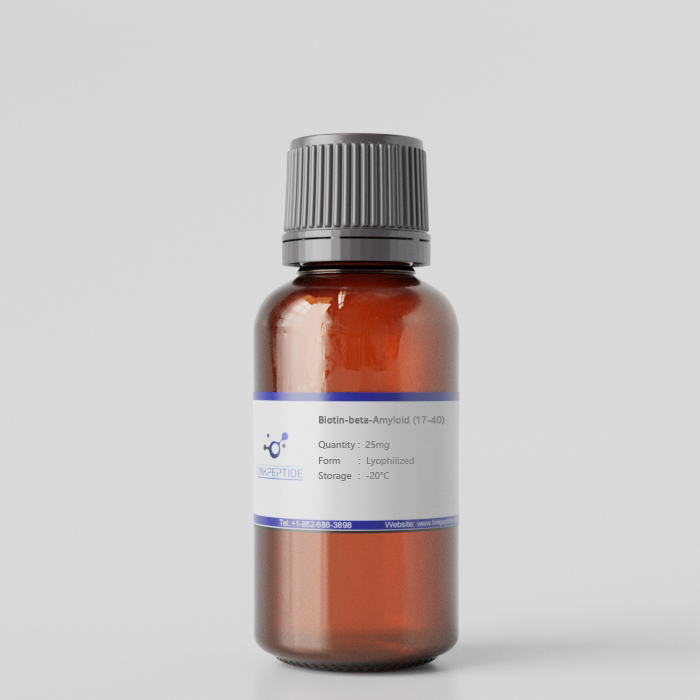
Product Name: Histone H3 (69-89)-K(Biotin)
Sequence One Letter Code: RLVREIAQDFKTDLRFQSSAV-K(Biotin)
Sequence Three Letter Code: H-Arg-Leu-Val-Arg-Glu-Ile-Ala-Gln-Asp-Phe-Lys-Thr-Asp-Leu-Arg-Phe-Gln-Ser-Ser-Ala-Val-Lys(Biotin)-OH
Molecular Weight: 2834.4
Purity: 95%
Form: Lyophilized
Storage Conditions: - 20 °C
Research Area: epigenetics
Source / Species: human
Conjugation: Conjugated
Conjugation Type: Biotins
Code Nacres: NA.26
Application: Histone H3 (69–89)-K(Biotin) is a synthetic peptide corresponding to residues 69–89 of histone H3 and biotinylated through the ε-amino side chain of a C-terminal lysine residue. This region of histone H3 contributes to chromatin organization and mediates protein–protein interactions involved in nucleosome stability and epigenetic regulation. The incorporated biotin tag enables efficient capture using streptavidin-based systems, facilitating pull-down assays, affinity purification, and interaction studies. As a result, the peptide provides a convenient tool for identifying histone-binding proteins and characterizing chromatin-associated complexes. It is widely used in epigenetics and chromatin biology research to investigate histone recognition domains, nucleosome dynamics, and regulatory factors that interact with histone H3 during transcriptional control and chromatin remodeling processes.
Current Research: The regulation of chromatin structure is central to controlling gene expression, genome stability, and cellular differentiation. Histone proteins, which package DNA into nucleosomes, play a key role in this regulatory system through their ability to interact with numerous chromatin-associated proteins. Synthetic histone peptides are widely used in modern epigenetics research because they allow scientists to isolate and study specific histone regions involved in chromatin dynamics. One such research reagent is Histone H3 (69–89)-K(Biotin), a biotinylated peptide designed to investigate histone-mediated protein interactions and chromatin regulatory mechanisms. Structural Context of Histone H3 in Chromatin Histone H3 is one of the four core histone proteins that assemble into the nucleosome, the fundamental repeating unit of chromatin. Together with histones H2A, H2B, and H4, histone H3 helps organize genomic DNA into a compact yet dynamic structure that regulates DNA accessibility. While the N-terminal tail of histone H3 is well known for containing numerous modification sites, regions within the globular core domain also contribute to chromatin architecture and protein recruitment. The 69–89 amino acid segment of histone H3 lies within this structured region and participates in maintaining nucleosome stability and mediating interactions with chromatin-associated proteins. This region contributes to the structural framework that supports nucleosome assembly and can influence the recognition of histone surfaces by regulatory complexes. Because of these properties, peptides derived from this segment provide valuable insight into how chromatin-binding proteins recognize and interact with histone surfaces. Design of the Histone H3 (69–89)-K(Biotin) Peptide The Histone H3 (69–89)-K(Biotin) peptide reproduces residues 69–89 of the histone H3 sequence while incorporating a biotin moiety attached to the ε-amino group of a C-terminal lysine residue. This design maintains the native histone sequence responsible for protein interactions while adding a highly useful affinity handle. Biotin is widely used in biochemical assays due to its exceptionally strong and specific interaction with streptavidin and avidin proteins. This interaction allows the peptide to be immobilized or captured efficiently in a variety of experimental systems. By combining a biologically relevant histone sequence with a robust affinity tag, this peptide serves as a practical tool for studying chromatin-associated protein complexes and histone recognition mechanisms. Advantages of Biotinylation for Chromatin Studies The addition of a biotin label greatly expands the experimental utility of this peptide. Streptavidin-based systems offer extremely high binding affinity and stability, making them ideal for capturing peptide–protein complexes in biochemical assays. Key advantages include: Efficient pull-down assays for isolating histone-interacting proteins Affinity purification of chromatin-binding complexes Stable immobilization on streptavidin-coated beads or surfaces Compatibility with proteomics workflows, including mass spectrometry analysis These features enable researchers to identify proteins that recognize histone H3 surfaces and to characterize their binding properties under controlled experimental conditions. Applications in Epigenetics and Chromatin Biology The Histone H3 (69–89)-K(Biotin) peptide supports a variety of experimental approaches in chromatin research. Because it represents a defined segment of the histone H3 structure, it can be used to investigate protein recognition events that occur on the nucleosome surface. Common applications include: Protein interaction studies The peptide can be used in pull-down experiments to identify histone-binding proteins such as chromatin remodelers, transcriptional regulators, or structural chromatin components. Affinity purification of chromatin-associated complexes Biotinylated peptides immobilized on streptavidin beads allow selective enrichment of interacting proteins from nuclear extracts or purified systems. Mapping histone recognition domains Many chromatin regulatory proteins contain domains that specifically recognize histone surfaces or modifications. Using defined peptides helps determine which regions of histone H3 are involved in these interactions. Investigating nucleosome dynamics Studies using histone peptides contribute to understanding how histone–protein interactions influence nucleosome assembly, stability, and remodeling. Epigenetic regulatory research By isolating specific histone interaction partners, researchers can better understand the networks that regulate transcription, DNA repair, and chromatin accessibility. Supporting the Discovery of Chromatin Regulatory Mechanisms Understanding how proteins recognize and interact with histones is fundamental to deciphering epigenetic regulation. Many regulatory complexes—including transcription factors, chromatin remodelers, and histone-modifying enzymes—rely on precise recognition of histone surfaces to perform their biological functions. Synthetic peptides such as Histone H3 (69–89)-K(Biotin) provide a simplified and controllable model system for examining these interactions. Because the peptide can be easily captured through streptavidin binding, it enables efficient isolation of interacting proteins and detailed biochemical characterization. These studies contribute to a deeper understanding of chromatin organization, nucleosome stability, and transcriptional regulation, all of which are central to cellular function and disease biology. Conclusion The Histone H3 (69–89)-K(Biotin) peptide is a versatile reagent for researchers investigating chromatin biology and epigenetic regulation. By combining a structurally relevant histone H3 sequence with a biotin affinity tag, the peptide enables efficient capture and analysis of histone-interacting proteins. Through applications such as pull-down assays, affinity purification, and protein interaction mapping, this peptide supports studies aimed at uncovering the molecular mechanisms governing chromatin structure and gene regulation. As research in epigenetics continues to expand, tools like this peptide remain essential for exploring the complex networks that control genome function.
Get a Quote
 LinkPeptide

![EGF Receptor Substrate 2 [DADE-pY-LIPQQG], Biot...](https://www.linkpeptide.com/wp-content/uploads/2026/06/EGF-Receptor-Substrate-2-DADE-pY-LIPQQG-Biotinylated.jpg "EGF Receptor Substrate 2 [DADE-pY-LIPQQG], Biot...")
![[Lys(Me2)20]-Histone H4 (8-30)-WGK(Biotin)](https://www.linkpeptide.com/wp-content/uploads/2026/06/LysMe220-Histone-H4-8-30-WGKBiotin.jpg "[Lys(Me2)20]-Histone H4 (8-30)-WGK(Biotin)")
![Ser(OGlcNAc)]400-KWK-Tau (388-411)-KK(Biotin)-NH2](https://www.linkpeptide.com/wp-content/uploads/2026/06/SerOGlcNAc400-KWK-Tau-388-411-KKBiotin-NH2.jpg "Ser(OGlcNAc)]400-KWK-Tau (388-411)-KK(Biotin)-NH2")