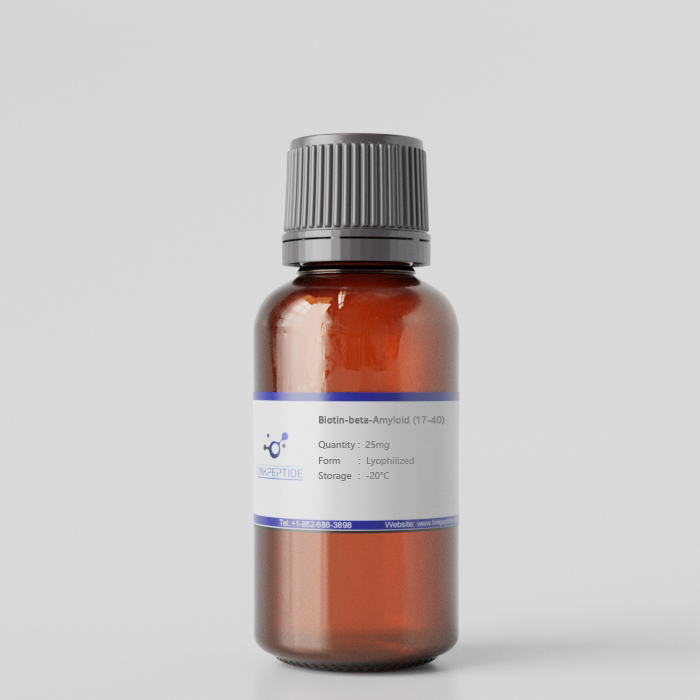
Product Name: Biotin-beta-Amyloid (17-40)
Sequence One Letter Code: Biotin-LVFFAEDVGSNKGAIIGLMVGGVV
Sequence Three Letter Code: Biotin-Leu-Val-Phe-Phe-Ala-Glu-Asp-Val-Gly-Ser-Asn-Lys-Gly-Ala-Ile-Ile-Gly-Leu-Met-Val-Gly-Gly-Val-Val-OH
Chemical Formula:C120H192N28O33S2
Molecular Weight: 2619.3
Purity: 95%
Form: Lyophilized
Storage Conditions: - 20 °C
Research Area: Alzheimer's Disease
Source / Species: human
Conjugation: Conjugated
Conjugation Type: Biotins
Code Nacres: NA.26
Application: Biotin–β-Amyloid (17–40) is an N-terminally biotinylated fragment corresponding to residues 17–40 of the β-amyloid sequence, representing the α-secretase–derived p3 peptide. This fragment has been detected in amyloid plaques and is associated with pro-inflammatory signaling. It induces cytokine and chemokine production in cellular and animal models, contributing to neuroinflammatory responses. Biotin conjugation facilitates affinity capture, pull-down assays, and detection workflows. This peptide is widely used in neurodegeneration research to study amyloid fragment interactions, immune activation, and protein–protein binding events relevant to Alzheimer’s disease pathology.
Current Research: Biotin–β-Amyloid (17–40) is an N-terminally biotinylated peptide corresponding to residues 17–40 of the β-amyloid (Aβ) sequence. This fragment represents the p3 peptide generated through α-secretase processing of amyloid precursor protein (APP), followed by γ-secretase cleavage. Unlike the full-length Aβ1–40/42 peptides produced via β-secretase pathways, the p3 fragment lacks the N-terminal region implicated in canonical fibrillogenesis but retains hydrophobic core elements that support aggregation and membrane interaction. The addition of a biotin moiety enables affinity-based capture and detection in biochemical and cellular assays. Biological Context of the p3 Fragment The Aβ(17–40) fragment has been detected in amyloid deposits and plaque-associated regions in Alzheimer’s disease (AD) pathology. Although historically considered less pathogenic than full-length Aβ species, accumulating evidence suggests that p3 fragments can contribute to neuroinflammatory signaling and cellular stress responses. Residues 17–40 encompass part of the hydrophobic central and C-terminal domains of Aβ, which are associated with membrane binding and β-sheet formation. These structural features enable the fragment to interact with lipid bilayers and cellular receptors, potentially triggering downstream inflammatory cascades. Pro-Inflammatory and Immune Signaling Experimental studies demonstrate that Aβ(17–40) can induce cytokine and chemokine production in glial cells and peripheral immune cells. The fragment has been shown to activate microglia and astrocytes, contributing to neuroinflammatory responses characterized by increased expression of pro-inflammatory mediators such as IL-1β, TNF-α, and MCP-1. Through engagement of pattern recognition receptors and membrane-associated signaling pathways, this fragment participates in innate immune activation processes relevant to AD-associated neuroinflammation. As such, it provides a focused model for dissecting inflammatory signaling independent of full-length Aβ toxicity. Biotinylation and Affinity Applications The N-terminal biotin modification allows high-affinity interaction with streptavidin or avidin platforms, enabling a range of experimental applications, including: Pull-down assays to identify interacting proteins Affinity purification of binding partners Surface immobilization for receptor-binding studies ELISA-based detection systems Surface plasmon resonance (SPR) and biosensor analyses Biotinylation facilitates quantitative investigation of protein–protein interactions and receptor engagement under controlled experimental conditions. Applications in Neurodegeneration Research Biotin–β-Amyloid (17–40) is widely employed in: Studies of amyloid fragment binding partners Microglial activation assays Cytokine production measurements Investigation of membrane association dynamics Screening of modulators of amyloid-induced inflammation Because the fragment retains aggregation-prone regions, it also supports analysis of oligomer formation and interaction with lipid membranes. Experimental Advantages Represents physiologically generated p3 amyloid fragment Retains hydrophobic domain relevant to membrane interaction Biotin conjugation enables affinity capture and detection Compatible with biochemical and cell-based assays Suitable for interaction mapping and inflammatory pathway studies Research Significance Biotin–β-Amyloid (17–40) provides a mechanistically informative tool for studying amyloid fragment biology beyond full-length Aβ peptides. By enabling affinity-based identification of interacting proteins and characterization of pro-inflammatory signaling, it supports investigation of amyloid-driven immune activation and protein–protein interactions relevant to Alzheimer’s disease pathology. Its defined sequence and functional biotin tag make it particularly valuable for mechanistic and translational neurodegeneration research.
Get a Quote
 LinkPeptide