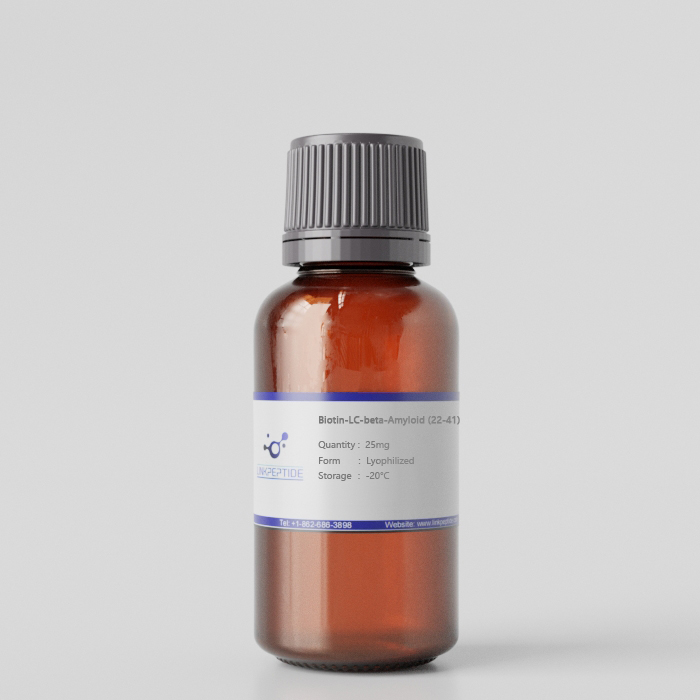
Product Name: Biotin-LC-beta-Amyloid (22-41)
Sequence One Letter Code: Biotin-LC-EDVGSNKGAIIGLMVGGVVI
Sequence Three Letter Code: Biotin-LC-Glu-Asp-Val-Gly-Ser-Asn-Lys-Gly-Ala-Ile-Ile-Gly-Leu-Met-Val-Gly-Gly-Val-Val-Ile-OH
Molecular Weight: 2267.9
Purity: 95%
Form: Lyophilized
Storage Conditions: - 20 °C
Research Area: Cancer Disease Research
Source / Species: human
Conjugation: Unconjugated
Code Nacres: NA.26
Application: Biotin-LC-β-Amyloid (22–41) is a synthetic peptide encompassing residues 22–41 of β-amyloid, a region containing the hydrophobic core critical for aggregation and fibril formation. The peptide is biotinylated at the N-terminus through a long-chain spacer, facilitating affinity capture while minimizing steric interference with binding interactions. This fragment is widely used to study amyloid assembly, protein–protein interactions, and receptor engagement relevant to Alzheimer’s disease. The biotin tag enables pull-down assays, ELISA development, and interaction profiling. This peptide supports aggregation studies, screening of aggregation-modulating compounds, and characterization of amyloid-associated toxicity mechanisms.
Current Research: β-Amyloid (Aβ) peptides are central to the molecular pathology of Alzheimer’s disease (AD), where misfolding, oligomerization, and fibril deposition contribute to synaptic dysfunction and neurodegeneration. Among the various regions of Aβ, residues 22–41 encompass a highly hydrophobic segment that plays a decisive role in β-sheet formation, nucleation, and fibrillogenesis. Biotin-LC-β-Amyloid (22–41) is a synthetic peptide corresponding to this aggregation-prone domain, modified at the N-terminus with biotin via a long-chain (LC) spacer to enable affinity-based applications without significantly perturbing structural behavior. The 22–41 segment includes critical residues within the central hydrophobic core and C-terminal region that drive intermolecular association. This domain participates in conformational transitions from random coil or α-helical intermediates to β-sheet–rich assemblies characteristic of amyloid fibrils. By isolating this minimal aggregation-relevant fragment, researchers can focus on the structural determinants governing nucleation kinetics, protofibril formation, and fibril elongation. Compared with full-length Aβ peptides, the truncated 22–41 fragment offers a more defined system for dissecting aggregation mechanisms while retaining key hydrophobic interactions essential for self-assembly. N-terminal biotinylation through a long-chain spacer enhances the peptide’s versatility in biochemical assays. The LC linker spatially separates the biotin moiety from the amyloid sequence, reducing steric hindrance and minimizing interference with β-sheet stacking or receptor-binding surfaces. This design is particularly important in aggregation and interaction studies, where subtle alterations in conformation can significantly influence assembly dynamics. The biotin tag enables high-affinity capture using streptavidin- or avidin-based platforms, supporting pull-down assays, immobilization on biosensor surfaces, and ELISA development. In protein–protein interaction studies, Biotin-LC-β-Amyloid (22–41) facilitates identification and characterization of binding partners implicated in AD pathogenesis. Immobilized peptide can be used to probe interactions with chaperone proteins, apolipoproteins, membrane receptors, or aggregation-modulating factors. Subsequent detection by Western blotting or mass spectrometry allows mapping of amyloid-associated interaction networks. Such approaches contribute to understanding how extracellular Aβ assemblies engage neuronal receptors, disrupt synaptic signaling, or activate microglial responses. The peptide is also valuable in screening assays for aggregation-modulating compounds. Small molecules, antibodies, and peptide-based inhibitors designed to interfere with β-sheet formation or hydrophobic stacking can be evaluated using in vitro aggregation models incorporating the 22–41 fragment. Thioflavin T fluorescence assays, circular dichroism spectroscopy, and transmission electron microscopy are commonly employed to monitor fibril formation and morphological changes. The defined sequence and biotin functionality enable parallel binding studies, allowing correlation between compound interaction and functional inhibition of aggregation. Mechanistic investigations into amyloid-associated toxicity also benefit from this fragment. Oligomeric intermediates derived from hydrophobic core regions are frequently implicated as primary neurotoxic species in AD. By focusing on residues 22–41, researchers can examine how specific sequence elements contribute to membrane disruption, calcium dysregulation, or oxidative stress in neuronal models. When combined with affinity capture techniques, the biotinylated peptide supports analysis of receptor engagement and downstream signaling pathways associated with amyloid-induced cellular dysfunction. Additionally, Biotin-LC-β-Amyloid (22–41) is suited for biosensor-based applications such as surface plasmon resonance (SPR) or biolayer interferometry (BLI), where controlled immobilization is essential for quantitative binding analysis. The long-chain spacer promotes accessible presentation of the amyloid sequence, improving reproducibility and kinetic measurements of ligand interactions. In summary, Biotin-LC-β-Amyloid (22–41) integrates a structurally critical amyloidogenic fragment with an affinity-compatible biotin tag separated by a long-chain linker. This design preserves aggregation-relevant features while enabling robust capture and detection strategies. The peptide is widely applied in studies of amyloid assembly, interaction profiling, receptor engagement, and compound screening. As research continues to elucidate the molecular basis of Alzheimer’s disease, this targeted fragment provides a focused and adaptable platform for advancing mechanistic insight and therapeutic discovery.
Get a Quote
 LinkPeptide

![[Lys(Me3)27]-Histone H3 (23-34)-GGK(Biotin)](https://www.linkpeptide.com/wp-content/uploads/2026/05/LysMe327-Histone-H3-23-34-GGKBiotin.jpg "[Lys(Me3)27]-Histone H3 (23-34)-GGK(Biotin)")