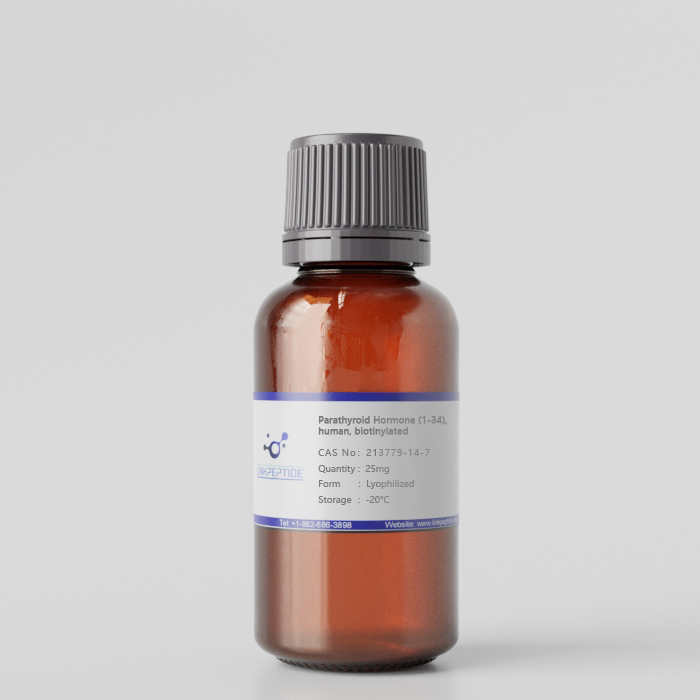
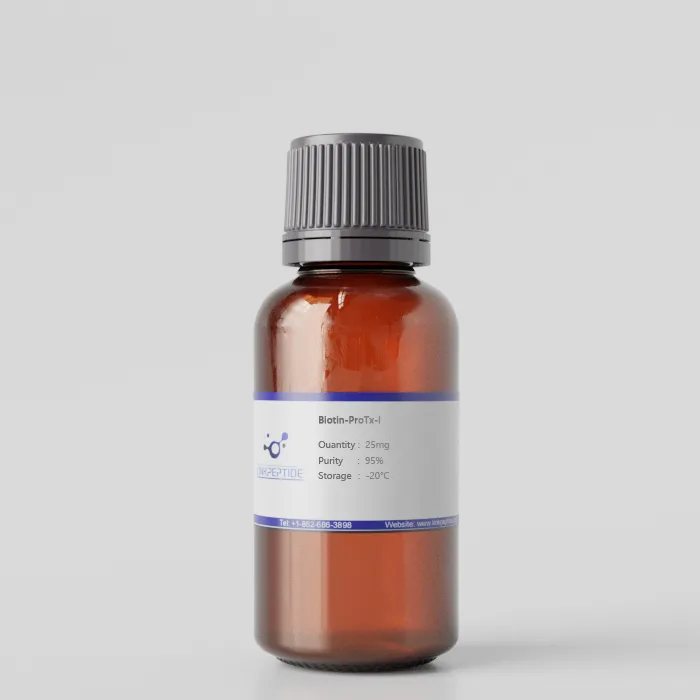
Product Name: Parathyroid Hormone (1-34), human, biotinylated
Sequence One Letter Code: Biotin-SVSEIQLMHNLGKHLNSMERVEWLRKKLQDVHNF
Sequence Three Letter Code: Biotin-Ser-Val-Ser-Glu-Ile-Gln-Leu-Met-His-Asn-Leu-Gly-Lys-His-Leu-Asn-Ser-Met-Glu-Arg-Val-Glu-Trp-Leu-Arg-Lys-Lys-Leu-Gln-Asp-Val-His-Asn-Phe-OH
Cas No: 213779-14-7
Chemical Formula:C191H305N57O53S3
Molecular Weight: 4344.3
Purity: 95%
Form: Lyophilized
Storage Conditions: - 20 °C
Research Area: Diabetes and Metabolic Syndrome
Source / Species: human
Conjugation: Unconjugated
Code Nacres: NA.26
Application: Parathyroid Hormone (1–34), human, biotinylated is a biologically active N-terminal fragment of PTH modified with biotin to facilitate detection and affinity-based applications. The 1–34 fragment contains the receptor-binding and signaling domains required for activation of PTH1R and PTH2R, regulating calcium and phosphate metabolism in bone and kidney. Biotin conjugation enables use in pull-down assays, receptor-binding studies, and surface immobilization platforms. This peptide is widely employed in mineral metabolism research, bone remodeling studies, and endocrine signaling investigations. It provides a defined tool for probing PTH receptor interactions, downstream cAMP signaling, and mechanisms underlying skeletal and cardiovascular regulation.
Current Research: Parathyroid Hormone (1–34), human, biotinylated is a synthetic, biologically active N-terminal fragment of human parathyroid hormone (PTH) modified with a biotin moiety to enable detection, immobilization, and affinity-based applications. The 1–34 region of PTH contains the full receptor-binding and signaling domains required for activation of parathyroid hormone receptors (PTH1R and PTH2R). This fragment retains the essential pharmacological properties of the full-length 84–amino acid hormone while offering enhanced experimental versatility through biotin conjugation. Receptor Activation and Signaling PTH regulates systemic calcium and phosphate homeostasis through binding to PTH1R, a class B G protein–coupled receptor highly expressed in bone and kidney. Engagement of PTH1R activates G_s-mediated signaling pathways, resulting in adenylyl cyclase stimulation and increased intracellular cAMP production. Downstream activation of protein kinase A (PKA) drives transcriptional programs that regulate osteoblast function, renal calcium reabsorption, and phosphate excretion. In addition to G_s signaling, PTH can activate G_q pathways, stimulating phospholipase C and intracellular calcium mobilization. The 1–34 fragment fully preserves these receptor-activating properties, making it widely used for mechanistic studies of endocrine signaling. Role in Bone and Mineral Metabolism PTH (1–34) modulates bone remodeling by influencing osteoblast activity and indirectly regulating osteoclast differentiation through RANKL expression. Intermittent PTH signaling promotes anabolic bone formation, whereas sustained exposure favors bone resorption. These dual effects have made PTH (1–34) central to research on skeletal homeostasis and osteoporosis therapy. In renal physiology, PTH enhances calcium reabsorption in the distal tubule and reduces phosphate reabsorption in the proximal tubule. Experimental systems utilizing PTH (1–34) help delineate receptor-mediated mechanisms controlling mineral balance and endocrine feedback loops involving vitamin D metabolism. Biotinylation and Experimental Utility The biotin modification expands the functionality of this peptide by enabling high-affinity interaction with streptavidin or avidin platforms. This allows: Receptor-binding assays using immobilized ligand Pull-down and affinity purification experiments Surface plasmon resonance (SPR) and biosensor studies Fluorescent or enzymatic detection via streptavidin conjugates Localization studies in cell-based imaging systems Biotinylated PTH (1–34) facilitates quantitative evaluation of receptor–ligand interactions and supports kinetic analysis of binding affinity and receptor occupancy. Applications in Endocrine and Skeletal Research Parathyroid Hormone (1–34), human, biotinylated is widely used in: cAMP accumulation assays Osteoblast and osteocyte signaling studies Bone remodeling and mineralization models Renal epithelial cell assays PTH receptor internalization and trafficking analysis Pharmacological evaluation of PTH analogs and antagonists Its defined structure ensures reproducible activation of PTH receptors in both in vitro and ex vivo systems. Cardiovascular and Broader Physiological Context Emerging research links PTH signaling to cardiovascular function, vascular calcification, and smooth muscle cell biology. The ability to track and isolate receptor interactions using a biotinylated ligand supports mechanistic studies examining these broader physiological effects. Experimental Advantages Retains full biological activity of the N-terminal receptor-binding domain Enables affinity capture and immobilization through biotin Compatible with streptavidin-based detection systems Suitable for biochemical, cellular, and receptor pharmacology assays Supports kinetic and mechanistic investigation of PTH signaling Research Significance Parathyroid Hormone (1–34), human, biotinylated provides a versatile and mechanistically defined tool for studying calcium and phosphate regulation, skeletal remodeling, and endocrine receptor dynamics. By combining preserved receptor activation with biotin-enabled detection and immobilization capabilities, this peptide supports advanced investigation of PTH receptor interactions, downstream signaling pathways, and disease mechanisms affecting bone and mineral metabolism.
Get a Quote
 LinkPeptide