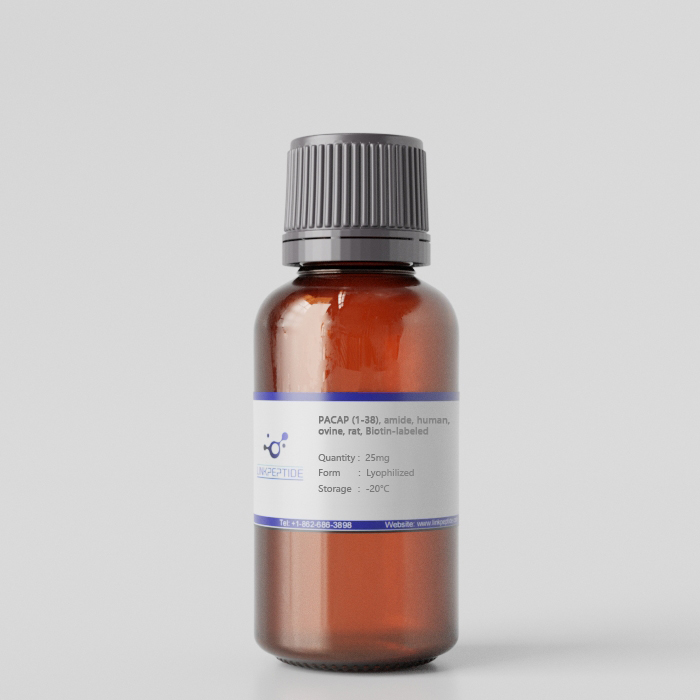
Product Name: PACAP (1-38)-Lys(Biotin), amide, human, ovine, rat
Sequence One Letter Code: HSDGIFTDSYSRYRKQMAVKKYLAAVLGKRYKQRVKNKK(Biotin)-NH2
Sequence Three Letter Code: H-His-Ser-Asp-Gly-Ile-Phe-Thr-Asp-Ser-Tyr-Ser-Arg-Tyr-Arg-Lys-Gln-Met-Ala-Val-Lys-Lys-Tyr-Leu-Ala-Ala-Val-Leu-Gly-Lys-Arg-Tyr-Lys-Gln-Arg-Val-Lys-Asn-Lys-Lys(Biotin)-NH2
Molecular Weight: 4888.8
Purity: 95%
Form: Lyophilized
Storage Conditions: - 20 °C
Research Area: Diabetes and Metabolic Syndrome
Source / Species: human, ovine, rat
Conjugation: Conjugated
Conjugation Type: Biotins
Code Nacres: NA.26
Application: PACAP (1–38)–Lys(Biotin), amide is a biotinylated form of the 38–amino acid pituitary adenylate cyclase–activating polypeptide (PACAP38), a member of the VIP/secretin/glucagon peptide family. PACAP activates PAC1, VPAC1, and VPAC2 receptors, stimulating adenylate cyclase and elevating intracellular cAMP levels. It regulates neuroendocrine secretion, metabolic function, and immune modulation. Biotin conjugation enables affinity-based capture, receptor-binding analysis, and detection in pull-down assays. This peptide is widely used in neuroscience, endocrinology, and metabolic research to investigate PACAP receptor signaling, neuroimmune interactions, and pancreatic islet function.
Current Research: PACAP (1–38)–Lys(Biotin), Amide PACAP (1–38)–Lys(Biotin), amide is a biotinylated derivative of the 38–amino acid pituitary adenylate cyclase–activating polypeptide (PACAP38), a neuropeptide belonging to the VIP/secretin/glucagon peptide family. PACAP38 is the predominant endogenous isoform and exerts potent biological effects through activation of PAC1, VPAC1, and VPAC2 receptors. These receptors are class B G protein–coupled receptors (GPCRs) that primarily stimulate adenylate cyclase, leading to increased intracellular cAMP and activation of downstream signaling cascades. The incorporation of a biotin moiety at a lysine residue preserves receptor activity while enabling affinity-based detection and binding studies. Receptor Pharmacology and Signaling PACAP exhibits highest affinity for the PAC1 receptor, though it also activates VPAC1 and VPAC2 receptors shared with vasoactive intestinal peptide (VIP). Upon receptor engagement, PACAP predominantly couples to G_s proteins, stimulating cAMP production and activating protein kinase A (PKA). In certain cellular contexts, PAC1 receptors can additionally couple to G_q proteins, triggering phospholipase C activation and intracellular calcium mobilization. Through these pathways, PACAP regulates transcriptional programs, ion channel activity, and hormone secretion. Its pleiotropic signaling profile supports diverse physiological functions in neural, endocrine, and peripheral tissues. Neuroendocrine and Metabolic Functions PACAP plays a critical role in neuroendocrine regulation. It modulates hypothalamic–pituitary signaling, influences stress hormone release, and regulates neurotransmitter systems in the central nervous system. In pancreatic islets, PACAP enhances glucose-stimulated insulin secretion and contributes to β-cell survival signaling. Beyond endocrine control, PACAP influences energy homeostasis, thermogenesis, and metabolic balance. It has also been implicated in appetite regulation and adaptive responses to metabolic stress. Neuroimmune and Cytoprotective Roles PACAP exhibits immunomodulatory and neuroprotective properties. It can regulate cytokine production, modulate microglial activation, and attenuate inflammatory responses in neural tissues. In models of neurodegeneration or ischemic injury, PACAP signaling has been associated with anti-apoptotic and cytoprotective effects mediated through cAMP-dependent and MAPK pathways. These functions make PACAP a molecule of interest in research focused on neuroinflammation, stress adaptation, and immune–neural cross-talk. Biotinylation and Experimental Applications The lysine-linked biotin modification enables high-affinity interaction with streptavidin or avidin platforms, expanding the peptide’s utility in biochemical and cell-based assays. Applications include: Receptor-binding affinity measurements Pull-down assays to identify interacting proteins Surface immobilization for biosensor analysis Fluorescent or enzymatic detection via streptavidin conjugates Quantitative receptor occupancy studies Because the biotin group facilitates immobilization without requiring additional chemical modification, it supports reproducible assay development and mechanistic investigation of receptor–ligand interactions. Applications in Research PACAP (1–38)–Lys(Biotin), amide is widely used in: Neuroscience studies of PAC1 receptor signaling Endocrine research on hormone secretion pathways Pancreatic islet function assays Neuroimmune interaction investigations cAMP signaling and GPCR pharmacology experiments Its defined structure allows precise evaluation of receptor activation, downstream second messenger pathways, and ligand-binding kinetics. Experimental Advantages Full-length PACAP38 sequence retaining receptor activity High affinity for PAC1 receptor Biotin conjugation enabling affinity capture and detection Suitable for biochemical, cellular, and receptor-binding assays Supports mechanistic and translational research applications Research Significance PACAP (1–38)–Lys(Biotin), amide provides a versatile platform for studying PACAP receptor pharmacology and cAMP-mediated signaling. By combining preserved biological activity with biotin-enabled detection and immobilization capabilities, it supports detailed analysis of neuroendocrine regulation, metabolic signaling, and neuroimmune interactions across diverse experimental systems.
Get a Quote
 LinkPeptide