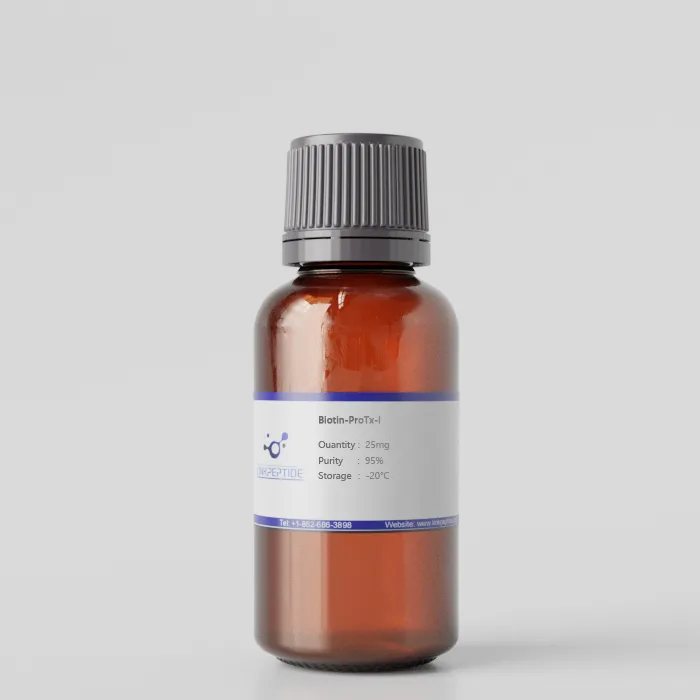
Product Name:Biotin-ProTx-I
Purity:95%
Molar Mass:3987.5
Chemical Formula:C171H245N53O47S6
Storage:Store at -20 degrees Celsius
Sequence:Glu-Cys2-Arg-Tyr-Trp-Leu-Gly-Gly-Cys9-Ser-Ala-Gly-Gln-Thr-Cys15-Cys16-Lys-His-Leu-Val-Cys21-Ser-Arg-Arg-His-Gly-Trp-Cys28-Val-Trp-Asp-Gly-Thr-Phe-Ser-OH
Application:
Biotin-ProTx-I is a biotinylated form of the ProTx-I peptide toxin, originally isolated from the venom of the tarantula Thrixopelma pruriens. ProTx-I selectively inhibits voltage-gated sodium channels (such as Nav1.2 and Nav1.5) and voltage-gated calcium channels by modulating their voltage-dependence, thus blocking ion flow and preventing action potential initiation. By attaching a biotin molecule to ProTx-I, this modified version can be used for streptavidin-based applications, including affinity purification, detection, and immobilization in assays. Biotin-ProTx-I is particularly useful in studies focused on understanding ion channel function and interactions, especially in cardiac and neurological research, and in the development of potential therapeutics targeting sodium and calcium channels.
Current Research:
Biotin-ProTx-I is a biotinylated derivative of ProTx-I, a peptide toxin originally isolated from the venom of the Peruvian green velvet tarantula (Thrixopelma pruriens). ProTx-I is known for its potent inhibition of voltage-gated sodium channels, particularly the Naᵥ1.8 subtype, with an IC₅₀ of approximately 27 nM. It also affects Naᵥ1.2, Naᵥ1.5, and Naᵥ1.7 channels, with IC₅₀ values ranging between 50 and 100 nM.
Structural and Functional Characteristics
ProTx-I is a 35-amino-acid peptide featuring three disulfide bridges, which contribute to its stability and high affinity for sodium channels. The conjugation of a biotin moiety to ProTx-I enables its detection and purification using streptavidin-based methods without significantly altering its biological activity. This modification facilitates various biochemical assays to study ProTx-I's interactions with sodium channels.
Applications in Research
The biotinylation of ProTx-I enhances its utility in several research applications:
Affinity Purification: Biotin-ProTx-I can be employed to isolate and study Naᵥ1.8 channels from complex biological samples through streptavidin-based affinity purification techniques.
Binding Studies: The biotin tag allows for the quantification of ProTx-I binding to sodium channels using streptavidin-linked detection systems, facilitating detailed pharmacological analyses.
Protein-Protein Interaction Assays: Biotin-ProTx-I serves as a probe in assays designed to investigate interactions between sodium channels and other proteins, aiding in the elucidation of signaling pathways involved in pain perception.
Handling and Storage
Biotin-ProTx-I is typically supplied as a lyophilized powder. For optimal stability, it should be stored at -20°C, protected from light and moisture. Upon reconstitution, aliquots should be prepared to avoid repeated freeze-thaw cycles, which can degrade the peptide.
Conclusion
Biotin-ProTx-I combines the potent inhibitory properties of ProTx-I with the versatile biotin tag, offering researchers a powerful tool to study Naᵥ1.8 sodium channels. Its application enhances the understanding of sodium channel physiology and contributes to advancements in neurobiology and the development of pain therapeutics.
Reference:
Get a Quote
 LinkPeptide