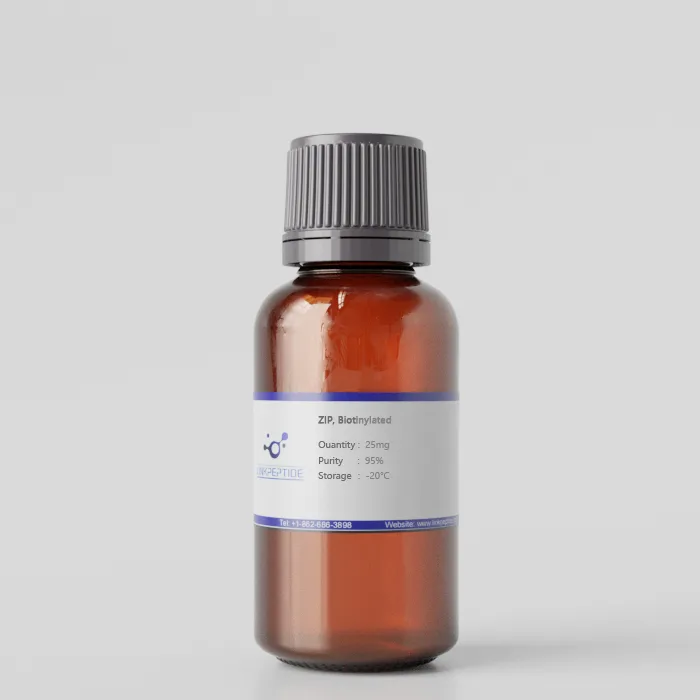
Product Name:ZIP, Biotinylated
Purity:95%
Molar Mass:2154.69
Chemical Formula:C100H168N32O19S
Storage:Store at -20 degrees Celsius
Sequence:SIYRRGARRWRKL
Target:avidins
Application:
Biotinylated ZIP is a modified version of the ??-inhibitory peptide (ZIP) where biotin is conjugated to the peptide. ZIP targets protein kinase M?? (PKM??), a kinase involved in the maintenance of long-term memory and synaptic plasticity. The addition of biotin allows for easy detection and isolation of ZIP-bound complexes using streptavidin-based assays. This biotinylated variant is used in research to study PKM??'s role in memory processes and synaptic plasticity, as well as in exploring the mechanisms underlying learning and memory. It facilitates the investigation of protein interactions and localization in various experimental contexts.
Current Research:
Biotinylated zeta inhibitory peptide (ZIP) is a modified form of the standard ZIP, designed for enhanced detection and analysis in biochemical assays. ZIP itself is a synthetic peptide that mimics the pseudosubstrate sequence of protein kinase M zeta (PKM??), effectively inhibiting its activity. This inhibition has been instrumental in studies exploring the molecular mechanisms underlying memory maintenance and synaptic plasticity.
Biotinylation and Its Advantages
The addition of a biotin moiety to ZIP facilitates its interaction with avidin or streptavidin proteins, which have a high affinity for biotin. This modification enables the use of various detection and purification techniques, such as:
Affinity Purification: Biotinylated ZIP can be isolated from complex mixtures using streptavidin-coated matrices, allowing for the purification of ZIP-bound protein complexes.
Imaging and Localization: When coupled with streptavidin-conjugated fluorophores, biotinylated ZIP can be visualized in cellular contexts, aiding in the study of PKM?? distribution and activity.
Quantitative Assays: The strong biotin-streptavidin interaction facilitates the development of sensitive assays to quantify ZIP interactions and inhibitory effects.
Applications in Research
Biotinylated ZIP has been utilized in various research settings, including:
Synaptic Plasticity Studies: Investigating the role of PKM?? in long-term potentiation and memory processes by enabling precise tracking and quantification of ZIP's inhibitory effects.
Protein Interaction Analysis: Identifying and characterizing proteins that interact with PKM?? by isolating ZIP-bound complexes through biotin-streptavidin affinity methods.
Therapeutic Research: Exploring potential interventions for memory-related disorders by assessing the impact of PKM?? inhibition in cellular and animal models.
Availability
Biotinylated ZIP is available from various biochemical suppliers, including Creative Peptides and BOC Sciences. Researchers can obtain this modified peptide for use in their experimental protocols.
Conclusion
The biotinylation of ZIP enhances its utility in biochemical and cellular assays, providing researchers with a powerful tool to study PKM?? function and its implications in neurobiology. By enabling specific detection and purification, biotinylated ZIP facilitates advanced investigations into the molecular underpinnings of memory and synaptic plasticity.
Reference:
Get a Quote
 LinkPeptide

![[Lys(Me2)20]-Histone H4 (8-30)-WGK(Biotin)](https://www.linkpeptide.com/wp-content/uploads/2026/06/LysMe220-Histone-H4-8-30-WGKBiotin.jpg "[Lys(Me2)20]-Histone H4 (8-30)-WGK(Biotin)")