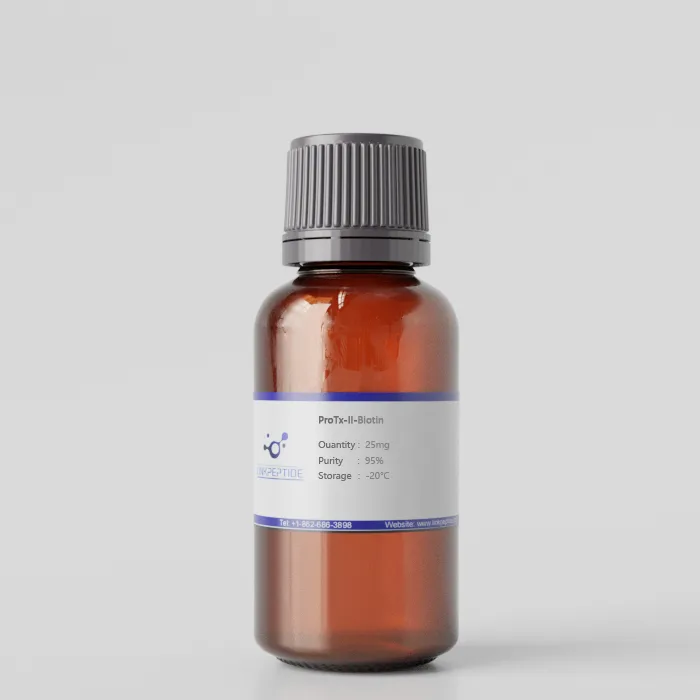
Product Name:ProTx-II-Biotin
Synonyms:β/ω-theraphotoxin-Tp2a-Biotin, Protoxin-2-Biotin, PT-II-Biotin, ProTx2-Biotin, Protoxin2-Biotin
Purity:95%
Molar Mass:4053
Chemical Formula:C178H254N48O43S9
Storage:Store at -20 degrees Celsius
Sequence:Biotin-YCQKWMWTCDSERKCCEGMVCRLWCKKKLW
Target:NaV Na+ channels and T-type Ca2+ channels
Application:
ProTx-II-Biotin is a biotinylated version of the peptide toxin ProTx-II, originally derived from the venom of the tarantula Thrixopelma pruriens. ProTx-II selectively inhibits voltage-gated sodium channels, particularly Nav1.7, which plays a crucial role in pain signaling. By conjugating ProTx-II with biotin, this version allows for easy affinity-based purification, detection, or immobilization using streptavidin-based systems. ProTx-II-Biotin is commonly used in binding assays, biotin-streptavidin pull-down experiments, and receptor-ligand interaction studies, facilitating detailed investigations of sodium channel function and the development of pain therapeutics. This biotin-labeled toxin is especially valuable for high-sensitivity assays and drug discovery research targeting Nav1.7.
Current Research:
ProTx-II-Biotin is a biotinylated derivative of ProTx-II, a peptide toxin originally isolated from the venom of the Peruvian green velvet tarantula (Thrixopelma pruriens). ProTx-II is known for its potent inhibition of voltage-gated sodium channels, particularly the Naᵥ1.7 subtype, which plays a crucial role in pain perception. The conjugation of a biotin moiety to ProTx-II enables its use in various biochemical assays, facilitating the study of its interactions with sodium channels and aiding in the development of potential therapeutic agents.
Structural and Functional Characteristics
ProTx-II is a 30-amino-acid peptide that adopts an inhibitor cystine knot (ICK) motif, contributing to its stability and high affinity for sodium channels. The biotinylation of ProTx-II allows for its detection and purification using streptavidin-based methods without significantly altering its biological activity. ProTx-II-Biotin retains high specificity for Naᵥ1.7 channels, with an inhibition constant (IC₅₀) of approximately 0.3 nM, and exhibits at least 100-fold selectivity over other sodium channel subtypes.
Applications in Research
The biotinylation of ProTx-II enhances its utility in various research applications:
Affinity Purification: ProTx-II-Biotin can be used to isolate and study Naᵥ1.7 channels from complex biological samples through streptavidin-based affinity purification techniques.
Binding Studies: The biotin tag allows for the quantification of ProTx-II binding to sodium channels using streptavidin-linked detection systems, facilitating detailed pharmacological analyses.
Protein-Protein Interaction Assays: ProTx-II-Biotin serves as a probe in assays designed to investigate interactions between sodium channels and other proteins, aiding in the elucidation of signaling pathways involved in pain perception.
Handling and Storage
ProTx-II-Biotin is typically supplied as a lyophilized powder. For optimal stability, it should be stored at -20°C, protected from light and moisture. Upon reconstitution, aliquots should be prepared to avoid repeated freeze-thaw cycles, which can degrade the peptide.
Conclusion
ProTx-II-Biotin combines the potent inhibitory properties of ProTx-II with the versatile biotin tag, offering researchers a powerful tool to study Naᵥ1.7 sodium channels. Its application enhances the understanding of sodium channel physiology and contributes to advancements in neurobiology and the development of pain therapeutics.
Reference:
Get a Quote
 LinkPeptide