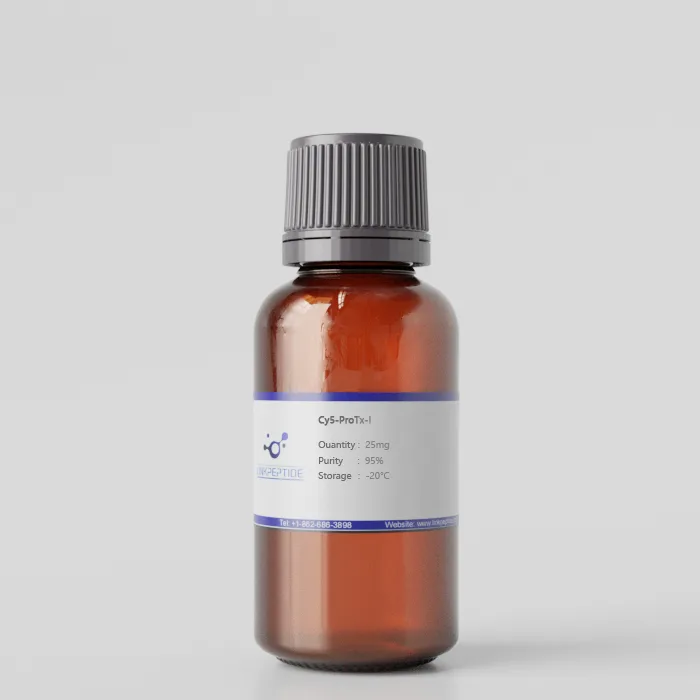
Product Name:Cy5-ProTx-I
Purity:95%
Molar Mass:3987.5
Chemical Formula:C171H245N53O47S6
Storage:Store at -20 degrees Celsius
Sequence:Glu-Cys2-Arg-Tyr-Trp-Leu-Gly-Gly-Cys9-Ser-Ala-Gly-Gln-Thr-Cys15-Cys16-Lys-His-Leu-Val-Cys21-Ser-Arg-Arg-His-Gly-Trp-Cys28-Val-Trp-Asp-Gly-Thr-Phe-Ser-OH
Application:
Cy5-ProTx-I is a fluorescently labeled version of the peptide toxin ProTx-I, originally derived from the venom of the tarantula Thrixopelma pruriens. ProTx-I selectively inhibits voltage-gated sodium channels (such as Nav1.2 and Nav1.5) and voltage-gated calcium channels by modulating their activation, thus blocking ion flow and preventing action potential generation. By conjugating Cy5, a bright fluorescent dye, to ProTx-I, researchers can track and visualize its interaction with ion channels in real time using fluorescence-based techniques. Cy5-ProTx-I is a valuable tool for studying the biophysics of sodium and calcium channels, performing live-cell imaging, and conducting high-throughput screening assays aimed at drug discovery, especially in areas related to pain, cardiac arrhythmias, and neurophysiological disorders.
Current Research:
Cy5-ProTx-I is a fluorescently labeled derivative of ProTx-I, a peptide toxin isolated from the venom of the Peruvian green velvet tarantula (Thrixopelma pruriens). ProTx-I is known for its potent inhibition of voltage-gated sodium channels, particularly the Naᵥ1.8 subtype, with an IC₅₀ of approximately 27 nM. It also affects Naᵥ1.2, Naᵥ1.5, and Naᵥ1.7 channels, with IC₅₀ values ranging between 50 and 100 nM.
Structural and Functional Characteristics
ProTx-I is a 35-amino-acid peptide featuring three disulfide bridges, which contribute to its stability and high affinity for sodium channels. The conjugation of the Cy5 fluorophore to ProTx-I enables real-time visualization and tracking of the peptide's interaction with sodium channels in various biological systems. This modification facilitates various biochemical assays to study ProTx-I's interactions with sodium channels without significantly altering its biological activity.
Applications in Research
The fluorescent properties of Cy5-ProTx-I enhance its utility in several research applications:
Visualization of Channel Distribution: Cy5-ProTx-I facilitates the mapping of Naᵥ1.8 channel distribution in tissues and cells, enhancing the understanding of channel localization and density.
Live-Cell Imaging: The Cy5 label allows for real-time observation of toxin-channel interactions in living cells, providing insights into the dynamics of channel function and regulation.
Drug Development: Cy5-ProTx-I serves as a probe in high-throughput screening assays aimed at identifying novel modulators of Naᵥ1.8 channels, which are potential therapeutic targets for pain management.
Handling and Storage
Cy5-ProTx-I is typically supplied as a lyophilized powder. For optimal stability, it should be stored at -20°C, protected from light and moisture. Upon reconstitution, aliquots should be prepared to avoid repeated freeze-thaw cycles, which can degrade the peptide.
Conclusion
Cy5-ProTx-I combines the potent inhibitory properties of ProTx-I with the fluorescent capabilities of the Cy5 dye, offering researchers a powerful tool to study Naᵥ1.8 sodium channels. Its application enhances the visualization and understanding of sodium channel physiology, contributing to advancements in neurobiology and the development of pain therapeutics.
Get a Quote
 LinkPeptide