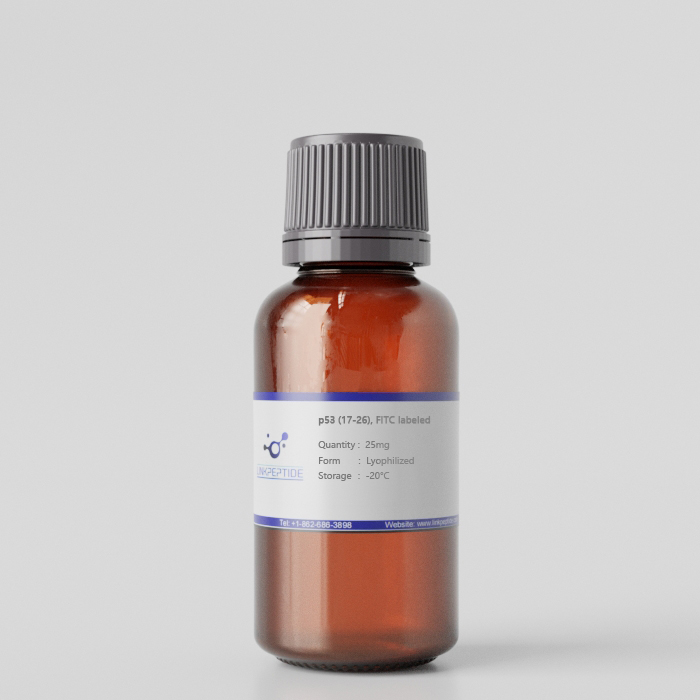
Product Name: p53 (17-26), FITC labeled
Sequence One Letter Code: FITC-LC-ETFSDLWKLL-NH2
Sequence Three Letter Code: FITC-LC-Glu-Thr-Phe-Ser-Asp-Leu-Trp-Lys-Leu-Leu-NH2
Molecular Weight: 1753.1
Purity: 95%
Form: Lyophilized
Storage Conditions: - 20 °C Protected from light
Research Area: Cancer Disease Research
Source / Species: human
Conjugation: Conjugated
Conjugation Type: Fluorescent dyes
Code Nacres: NA.26
Application: p53 (17–26), FITC labeled, is a fluorescent peptide derived from the N-terminal MDM2-binding domain of the tumor suppressor protein p53. This region mediates the critical interaction between p53 and MDM2, a key negative regulator of p53 stability and transcriptional activity. Conjugation with fluorescein isothiocyanate (FITC) enables sensitive detection in fluorescence polarization, pull-down, and binding competition assays. The peptide is widely used to characterize p53–MDM2 interactions, screen small-molecule inhibitors, and quantify binding affinities in drug discovery workflows. It also supports mechanistic studies examining the structural determinants of tumor suppressor regulation. This reagent is a valuable tool in oncology research focused on restoring p53 function and targeting protein–protein interactions involved in tumor progression.
Current Research: The tumor suppressor protein p53 plays a central role in maintaining genomic stability by regulating cell cycle arrest, DNA repair, apoptosis, and senescence. In many cancers, p53 function is compromised not only through gene mutations but also through dysregulation of its key negative regulator, MDM2 (Murine Double Minute 2). MDM2 binds to the N-terminal transactivation domain of p53, leading to ubiquitination and proteasomal degradation of the protein. As a result, disruption of the p53–MDM2 interaction has become a major therapeutic strategy in oncology. The p53 (17–26), FITC-labeled peptide, derived from the MDM2-binding region of p53, has become an important experimental tool for investigating this regulatory interaction and for screening compounds that restore p53 activity. Current research frequently employs this fluorescent peptide in fluorescence polarization (FP)–based binding assays, one of the most widely used techniques for studying protein–protein interactions in drug discovery. In these assays, the FITC-labeled p53 peptide binds to purified MDM2, producing a measurable change in fluorescence polarization due to the increased molecular size of the complex. When potential inhibitors are introduced, they compete with the peptide for the MDM2 binding pocket, leading to displacement of the fluorescent probe and a reduction in polarization signal. This format enables rapid and quantitative assessment of binding affinity and inhibitor potency, making the peptide particularly useful for high-throughput screening of small-molecule libraries. A major area of ongoing research focuses on the development of small-molecule MDM2 antagonists. Structural studies have shown that the p53 peptide binds within a well-defined hydrophobic pocket of MDM2 through three key residues—Phe19, Trp23, and Leu26—which anchor the peptide into the binding groove. Using the FITC-labeled p53 (17–26) peptide as a probe, researchers can measure how effectively candidate compounds mimic these interactions. Several clinically relevant MDM2 inhibitors, including nutlin-based compounds and other structure-guided molecules, were originally identified and optimized using fluorescence-based competitive binding assays involving p53-derived peptides. This research continues to guide the design of next-generation inhibitors aimed at restoring p53 signaling in tumors that retain wild-type p53 but exhibit elevated MDM2 activity. Beyond inhibitor screening, the fluorescent peptide also plays a key role in mechanistic studies of protein–protein interactions. By combining fluorescence polarization assays with mutational analysis of MDM2 or modified peptide analogs, researchers can investigate how structural changes influence binding affinity and specificity. These studies help define the molecular determinants that govern recognition between p53 and MDM2. Such insights are critical for rational drug design, particularly when targeting interfaces traditionally considered difficult for small molecules to disrupt. Another expanding research direction involves the integration of fluorescent peptide probes with biophysical and structural characterization methods. Techniques such as surface plasmon resonance (SPR), isothermal titration calorimetry (ITC), and nuclear magnetic resonance (NMR) spectroscopy are frequently used alongside fluorescence assays to obtain complementary data on binding kinetics and thermodynamics. The FITC-labeled p53 peptide provides a convenient and sensitive probe for validating interactions identified through these methods. Recent work also explores protein–protein interaction modulators beyond MDM2, including MDMX (also known as MDM4), another negative regulator of p53. Although structurally related to MDM2, MDMX exhibits distinct binding properties and regulatory mechanisms. Fluorescent p53-derived peptides allow researchers to compare binding behavior across these regulatory proteins and evaluate inhibitors capable of targeting both pathways. In summary, the p53 (17–26), FITC-labeled peptide remains a widely used probe in cancer research focused on the regulation of p53 activity. Its ability to enable sensitive, quantitative analysis of the p53–MDM2 interaction makes it indispensable for inhibitor screening, mechanistic investigations, and structural studies. As interest in targeting protein–protein interactions continues to grow, fluorescent peptide probes such as this one will remain essential tools for advancing therapeutic strategies aimed at reactivating tumor suppressor pathways.
Get a Quote
 LinkPeptide