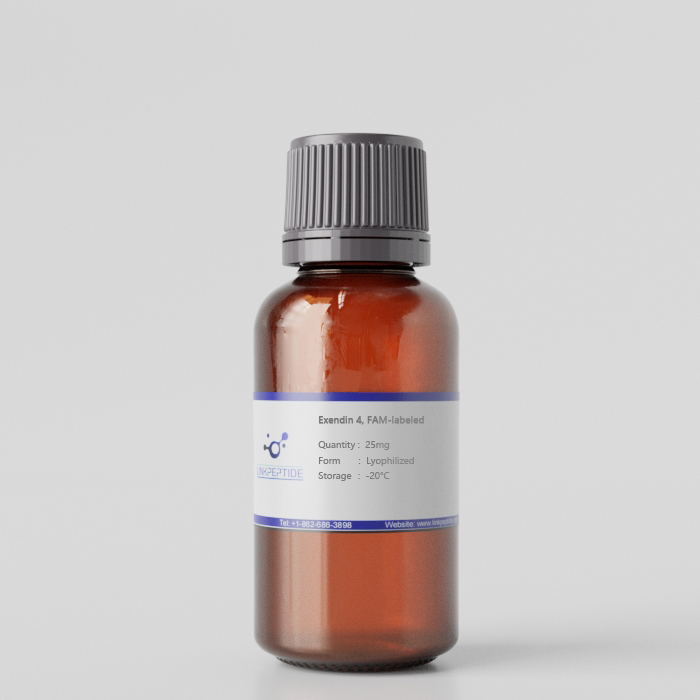
Product Name: Exendin 4, FAM-labeled
Sequence One Letter Code: FAM-HGEGTFTSDLSKQMEEEAVRLFIEWLKNGGPSSGAPPPS-NH2
Sequence Three Letter Code: FAM-His-Gly-Glu-Gly-Thr-Phe-Thr-Ser-Asp-Leu-Ser-Lys-Gln-Met-Glu-Glu-Glu-Ala-Val-Arg-Leu-Phe-Ile-Glu-Trp-Leu-Lys-Asn-Gly-Gly-Pro-Ser-Ser-Gly-Ala-Pro-Pro-Pro-Ser-NH2
Chemical Formula:C205H292N50O66S
Molecular Weight: 4545.1
Purity: 95%
Form: Lyophilized
Storage Conditions: - 20 °C Protected from light
Research Area: Diabetes and Metabolic Syndrome
Source / Species: Gila
Conjugation: Conjugated
Conjugation Type: Fluorescent dyes
Code Nacres: NA.26
Application: Exendin-4, FAM-labeled, is a fluorescently tagged full-length peptide agonist of the glucagon-like peptide-1 (GLP-1) receptor developed for receptor binding and signaling investigations. This 39-amino acid peptide, originally isolated from Heloderma suspectum, shares approximately 53% sequence homology with human GLP-1 while demonstrating enhanced resistance to enzymatic degradation and prolonged plasma stability. Exendin-4 stimulates glucose-dependent insulin secretion through selective activation of the GLP-1 receptor, making it a valuable molecular tool in metabolic and endocrine research. Conjugation of the fluorophore 5-carboxyfluorescein (FAM) at the N-terminus enables direct fluorescence-based detection, with excitation and emission maxima at 494 and 519 nm, respectively. The fluorescent tag supports real-time visualization of receptor distribution, ligand–receptor binding dynamics, receptor internalization, and downstream signaling pathways in live-cell or fixed-cell systems. This labeled peptide is well suited for mechanistic studies of GLP-1 receptor pharmacology and cellular trafficking. Current Research: Exendin-4, FAM-labeled, is a fluorescently tagged full-length peptide agonist of the glucagon-like peptide-1 receptor (GLP-1R) designed for receptor binding, trafficking, and signaling investigations. Derived from the 39-amino acid peptide originally isolated from Heloderma suspectum, Exendin-4 shares approximately 53% sequence homology with human GLP-1 while exhibiting enhanced resistance to enzymatic degradation and improved plasma stability. These properties have made it a widely adopted molecular scaffold for probing GLP-1 receptor pharmacology in metabolic and endocrine research. As a potent and selective GLP-1R agonist, Exendin-4 stimulates glucose-dependent insulin secretion through activation of class B G protein-coupled receptor signaling pathways. Upon receptor engagement, it promotes adenylate cyclase activation, intracellular cAMP accumulation, and downstream signaling cascades that regulate insulin release and cellular metabolic responses. Because of its structural stability and strong receptor affinity, Exendin-4 is frequently used as a reference agonist in studies evaluating GLP-1R expression, ligand bias, receptor internalization, and signal compartmentalization. Conjugation of 5-carboxyfluorescein (FAM) at the N-terminus enables direct fluorescence-based detection without the need for secondary labeling reagents. FAM exhibits excitation and emission maxima at approximately 494 nm and 519 nm, respectively, making the probe fully compatible with standard FITC filter sets in fluorescence microscopy, flow cytometry, and plate-based fluorescence assays. This labeling strategy allows real-time visualization of ligand–receptor interactions in both live-cell and fixed-cell systems. Exendin-4, FAM-labeled, supports a broad range of experimental applications. In receptor localization studies, it enables identification of GLP-1R-positive cell populations and assessment of membrane distribution under basal conditions. Upon stimulation, the fluorescent signal can be tracked to monitor ligand-induced receptor internalization, endosomal trafficking, and recycling dynamics. These processes are central to understanding how GLP-1R signaling is spatially regulated within the cell and how receptor trafficking influences signal duration and strength. The probe is also well suited for quantitative binding studies. Competitive binding assays can be performed by measuring displacement of Exendin-4–FAM with unlabeled ligands, allowing comparison of relative affinities and receptor occupancy. Kinetic analyses of association and dissociation provide insight into ligand–receptor interaction stability, while fluorescence intensity measurements support high-content imaging and flow cytometric quantification of receptor engagement. In addition to trafficking investigations, Exendin-4, FAM-labeled, can be integrated with functional assays to correlate receptor localization with downstream signaling outputs such as cAMP production or reporter gene activation. This combined approach facilitates mechanistic analysis of receptor activation, desensitization, and resensitization processes. It is particularly valuable in studies examining GLP-1R pharmacological modulation, biased agonism, or altered receptor behavior in disease-relevant cellular models. Because GLP-1R plays a central role in glucose homeostasis and incretin biology, fluorescent Exendin-4 derivatives have become indispensable tools in diabetes, obesity, and broader metabolic disease research. The stability and receptor selectivity of Exendin-4 ensure reliable performance across diverse experimental platforms, while the FAM fluorophore provides a straightforward and sensitive detection modality. Overall, Exendin-4, FAM-labeled, offers a robust and versatile approach for dissecting GLP-1 receptor binding characteristics, activation mechanisms, and intracellular trafficking pathways. Its combination of pharmacological fidelity and fluorescent traceability makes it an effective tool for detailed mechanistic studies of GLP-1R biology in both basic research and translational investigation settings.
Get a Quote
 LinkPeptide

![Tyrosine Kinase Peptide 1 [KVEKIGEGTYGVVYK], 5-...](https://www.linkpeptide.com/wp-content/uploads/2026/06/Tyrosine-Kinase-Peptide-1-KVEKIGEGTYGVVYK-5-TMR-labeled.jpg "Tyrosine Kinase Peptide 1 [KVEKIGEGTYGVVYK], 5-...")