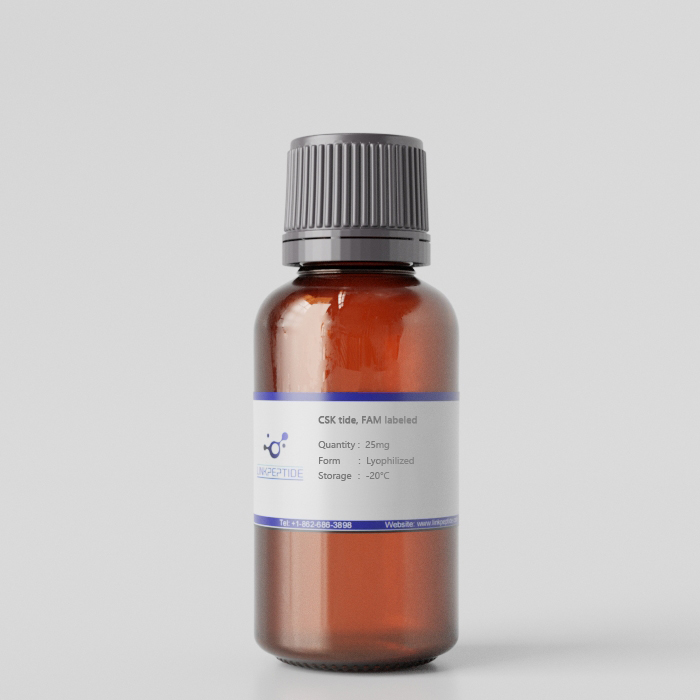
Product Name: SAMs peptide, FAM labeled
Sequence One Letter Code: 5-FAM-HMRSAMSGLHLVKRR
Sequence Three Letter Code: 5-FAM-His-Met-Arg-Ser-Ala-Met-Ser-Gly-Leu-His-Leu-Val-Lys-Arg-Arg-OH
Chemical Formula:C95H141N29O24S2
Molecular Weight: 2137.6
Purity: 95%
Form: Lyophilized
Storage Conditions: - 20 °C Protected from light
Research Area: Peptide Series
Conjugation: Conjugated
Conjugation Type: Fluorescent dyes
Code Nacres: NA.26
Application: The FAM-labeled SAMs peptide is a fluorescent substrate designed for in vitro kinase assays targeting AMP-activated protein kinase (AMPK). Incorporation of a FAM fluorophore enables sensitive fluorescence-based detection of phosphorylation events. This peptide is used to quantify AMPK activity, determine enzyme kinetics, and screen activators or inhibitors of AMPK signaling. It supports metabolic research, drug discovery programs, and studies of cellular energy sensing and stress-response pathways regulated by AMPK.
Current Research: AMP-activated protein kinase (AMPK) is a master regulator of cellular energy homeostasis, activated in response to increases in the AMP/ATP or ADP/ATP ratio. Once activated, AMPK coordinates metabolic adaptation by promoting catabolic pathways that generate ATP while suppressing anabolic processes that consume energy. Dysregulation of AMPK signaling has been implicated in metabolic syndrome, type 2 diabetes, cardiovascular disease, cancer, and aging-related disorders. The FAM-labeled SAMS peptide is a synthetic fluorescent substrate widely used to measure AMPK catalytic activity in vitro and to evaluate modulators of AMPK signaling. The SAMS peptide sequence is derived from the AMPK phosphorylation site in acetyl-CoA carboxylase (ACC), one of the best-characterized physiological substrates of AMPK. It contains a serine residue embedded within a consensus recognition motif efficiently phosphorylated by AMPK. Incorporation of a 5-carboxyfluorescein (FAM) fluorophore enables fluorescence-based detection of phosphorylation events. This modification allows sensitive, non-radioactive quantification of kinase activity and supports high-throughput assay formats. In kinase assays, recombinant AMPK is incubated with the FAM-labeled SAMS peptide in the presence of ATP and appropriate cofactors. Phosphorylation of the serine residue can be detected using several fluorescence-based strategies, including fluorescence polarization, capillary electrophoresis mobility shift assays, or phospho-specific binding reagents. In mobility shift formats, phosphorylation alters peptide charge and migration behavior, enabling separation and quantification of phosphorylated versus non-phosphorylated species. The fluorescent tag ensures high signal sensitivity and compatibility with microplate readers or automated systems. The FAM-SAMS substrate supports detailed enzymatic characterization of AMPK. By varying peptide or ATP concentrations, investigators can determine kinetic parameters such as Km and Vmax. These measurements provide insight into catalytic efficiency and isoform-specific differences among AMPK heterotrimeric complexes. Because AMPK activity depends on phosphorylation at Thr172 within the activation loop and on binding of AMP or ADP to regulatory γ-subunits, the assay can also be used to assess allosteric regulation and upstream kinase effects. In drug discovery, the fluorescent SAMS peptide is extensively used to screen small molecules that activate or inhibit AMPK. Activators may enhance catalytic turnover directly or promote conformational changes that increase substrate phosphorylation. Inhibitors reduce phosphorylation signal in a dose-dependent manner, enabling determination of IC50 values. The fluorescence-based format eliminates the need for radiolabeled ATP, simplifying assay workflow and improving safety for large-scale compound screening. The substrate also supports research into metabolic signaling pathways regulated by AMPK. Because AMPK integrates signals from nutrient deprivation, oxidative stress, and exercise, quantifying its catalytic activity provides a functional readout of energy-sensing mechanisms. In cell-based assays, immunoprecipitated AMPK complexes can be evaluated using the FAM-SAMS peptide to correlate upstream signaling events with direct enzymatic output. Furthermore, the fluorescent format enables real-time or endpoint measurements with high reproducibility. The FAM label provides stable excitation and emission properties compatible with standard fluorescence detection platforms. This enhances assay robustness and facilitates comparative analysis across experimental conditions. In summary, the FAM-labeled SAMS peptide is a fluorescent AMPK substrate designed for sensitive and quantitative kinase assays. By enabling accurate measurement of AMPK activity, enzyme kinetics, and pharmacological modulation, it plays a central role in metabolic research and therapeutic development. Its application advances understanding of cellular energy sensing and supports drug discovery efforts targeting AMPK-regulated stress-response and metabolic pathways.
Get a Quote
 LinkPeptide