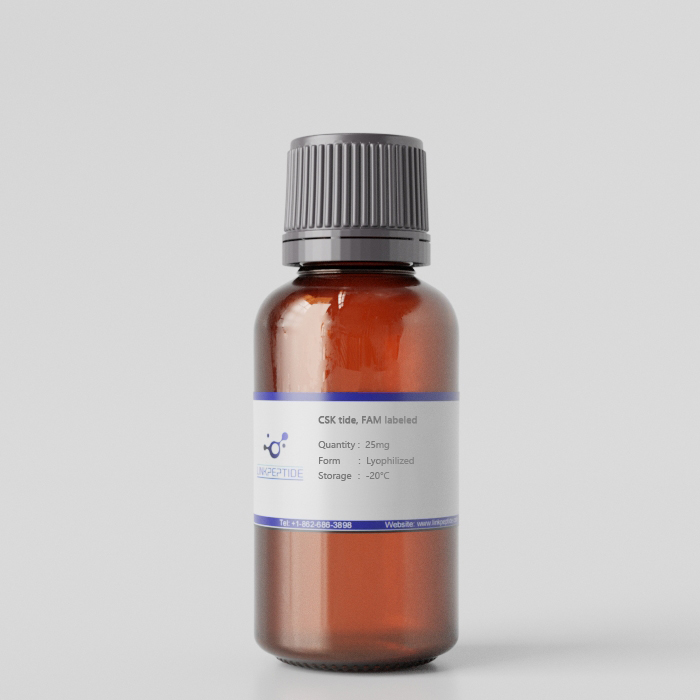
Product Name: CSK tide, FAM labeled
Sequence One Letter Code: 5-FAM-KKKKEEIYFFFG-NH2
Sequence Three Letter Code: 5-FAM-Lys-Lys-Lys-Lys-Glu-Glu-Ile-Tyr-Phe-Phe-Phe-Gly-NH2
Chemical Formula:C99H125N17O23
Molecular Weight: 1921.2
Purity: 95%
Form: Lyophilized
Storage Conditions: - 20 °C Protected from light
Research Area: peptide substrate
Conjugation: Conjugated
Conjugation Type: Fluorescent dyes
Code Nacres: NA.26
Application: This peptide is a fluorescently labeled substrate designed for phosphorylation by C-terminal Src kinase (Csk) as well as numerous receptor and non-receptor tyrosine kinases involved in cellular signaling pathways. The peptide is conjugated with a 5-carboxyfluorescein (FAM) fluorophore, allowing sensitive fluorescence-based detection of phosphorylation events in biochemical assays. The fluorescent tag enables real-time monitoring or endpoint measurement of kinase activity, making the peptide particularly suitable for high-throughput screening and quantitative enzymatic studies. It can be used to evaluate kinase activity, characterize substrate recognition, and screen small-molecule inhibitors targeting tyrosine kinase signaling networks. Because Src family kinases and related receptor tyrosine kinases are central regulators of cell proliferation, migration, and oncogenic transformation, this peptide is widely applied in signaling research, cancer biology, and drug discovery programs focused on kinase-driven pathways.
Current Research: Protein phosphorylation mediated by tyrosine kinases is a central mechanism in cellular signaling networks that regulate proliferation, differentiation, migration, and survival. Dysregulation of these kinases is frequently associated with diseases such as cancer and inflammatory disorders. To investigate kinase activity and regulatory mechanisms, researchers often rely on synthetic peptide substrates that can be efficiently phosphorylated and easily detected in biochemical assays. One such tool is a fluorescently labeled peptide substrate conjugated with 5-carboxyfluorescein (FAM), designed to support sensitive detection of phosphorylation events catalyzed by C-terminal Src kinase (Csk) and other tyrosine kinases. Tyrosine Kinases in Cellular Signaling Tyrosine kinases represent a major class of signaling enzymes that regulate intracellular communication through phosphorylation of tyrosine residues on target proteins. These enzymes are broadly categorized into receptor tyrosine kinases (RTKs) and non-receptor tyrosine kinases. Receptor tyrosine kinases, such as EGFR, PDGFR, and VEGFR, are activated by extracellular ligands and initiate signaling cascades that control cell growth and differentiation. Non-receptor kinases, including Src family kinases, operate within the cytoplasm and often interact with activated receptors to propagate downstream signals. A critical regulator of Src family kinases is C-terminal Src kinase (Csk). Csk phosphorylates a conserved tyrosine residue located in the regulatory tail of Src kinases, thereby suppressing their catalytic activity. This negative regulatory mechanism helps maintain proper signaling balance and prevents uncontrolled kinase activation. Because of the central role of tyrosine kinases in signaling pathways, reliable tools for measuring kinase activity are essential for understanding cellular regulation and disease mechanisms. Fluorescent Peptide Substrates for Kinase Assays Synthetic peptide substrates provide a simplified system for evaluating kinase activity. These peptides typically contain a specific phosphorylation site recognized by the kinase, allowing researchers to monitor catalytic activity in controlled biochemical conditions. When combined with fluorescent tags, peptide substrates become powerful tools for fluorescence-based detection of phosphorylation reactions. Fluorescent labeling allows rapid, sensitive measurement of enzymatic activity without requiring radioactive reagents. The peptide described here incorporates 5-carboxyfluorescein (FAM), a widely used fluorophore known for its strong fluorescence signal and compatibility with many assay platforms. The FAM tag enables detection using standard fluorescence readers and imaging systems. Advantages of FAM Fluorescent Labeling FAM labeling provides several benefits for kinase assays. The fluorophore allows high-sensitivity detection, making it possible to measure small changes in phosphorylation levels. This sensitivity is particularly useful in experiments involving low enzyme concentrations or limited sample volumes. In addition, fluorescence-based detection supports both real-time monitoring and endpoint measurements. Researchers can track phosphorylation as the reaction proceeds or measure fluorescence after a defined incubation period. Fluorescent substrates also eliminate the need for radiolabeled ATP, making assays safer and easier to implement in high-throughput screening environments. Applications in Kinase Activity Measurement FAM-labeled peptide substrates are widely used in in vitro kinase assays to quantify enzymatic activity. In a typical experiment, purified kinase is incubated with the fluorescent peptide and ATP. As the kinase phosphorylates the peptide, changes in fluorescence or mobility can be detected depending on the assay format. These experiments allow researchers to determine key enzymatic parameters such as reaction velocity, substrate affinity, and catalytic efficiency. Such measurements provide insights into how kinases recognize substrates and how their activity is regulated. Because the substrate is small and chemically defined, it allows precise experimental control and reproducibility across assays. High-Throughput Screening for Kinase Inhibitors Tyrosine kinases are major targets in drug discovery programs, particularly in oncology. Many cancers are driven by mutations or overactivation of kinase signaling pathways. As a result, pharmaceutical research has focused extensively on developing small-molecule kinase inhibitors. Fluorescent peptide substrates such as FAM-labeled kinase substrates are well suited for high-throughput screening (HTS). In these assays, large libraries of candidate compounds can be tested for their ability to inhibit kinase activity. Compounds that reduce phosphorylation of the fluorescent substrate can be identified as potential inhibitors. The fluorescence-based detection format enables rapid analysis of many samples simultaneously, making it an efficient tool for early-stage drug discovery. Investigating Substrate Recognition and Signaling Pathways Beyond inhibitor screening, FAM-labeled peptide substrates are useful for studying kinase substrate recognition and signaling pathway regulation. Researchers can evaluate how mutations in kinase domains influence substrate phosphorylation or examine how regulatory proteins modulate kinase activity. Because the substrate can be phosphorylated by Csk and other receptor or non-receptor tyrosine kinases, it provides a versatile platform for studying diverse kinase signaling networks. Such studies are particularly relevant for understanding oncogenic signaling pathways, where abnormal kinase activation can drive uncontrolled cell proliferation and survival. A Versatile Tool for Signaling and Cancer Research The FAM-labeled peptide substrate for tyrosine kinase phosphorylation offers a convenient and sensitive platform for measuring kinase activity in biochemical assays. Its fluorescent labeling enables rapid detection, real-time monitoring, and compatibility with high-throughput experimental formats. By supporting experiments that evaluate kinase activity, substrate recognition, and inhibitor potency, this peptide contributes to research efforts focused on signal transduction, cancer biology, and therapeutic targeting of kinase-driven pathways. As tyrosine kinase signaling continues to be a major focus of biomedical research, fluorescent peptide substrates remain valuable tools for dissecting the molecular mechanisms that regulate these critical cellular processes.
Get a Quote
 LinkPeptide