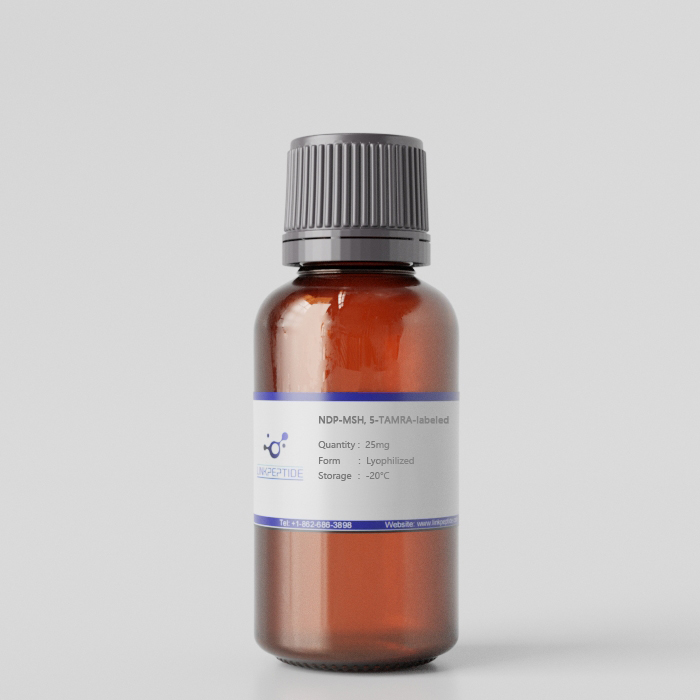
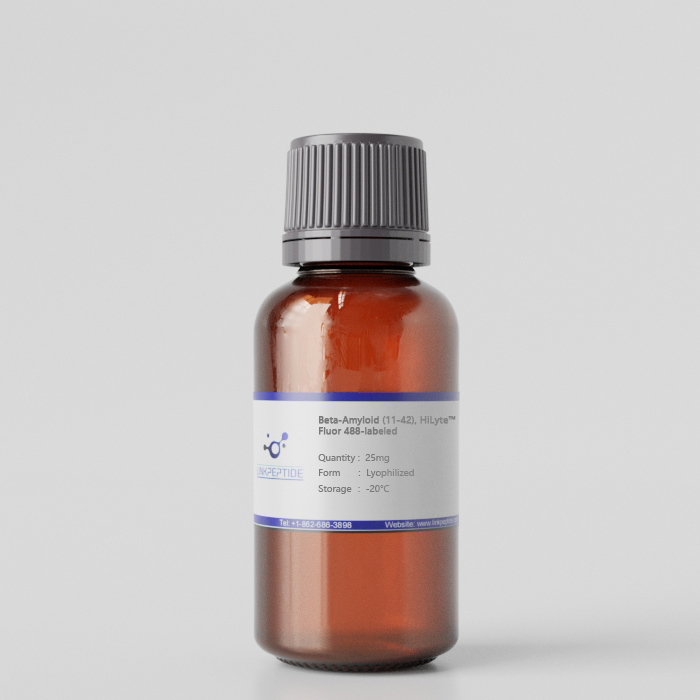
Product Name: Beta-Amyloid (11-42), HiLyte™ Fluor 488-labeled
Sequence One Letter Code: HiLyte™ Fluor 488-EVHHQKLVFFAEDVGSNKGAIIGLMVGGVVIA
Sequence Three Letter Code: Hilyte™ Fluor 488-Glu-Val-His-His-Gln-Lys-Leu-Val-Phe-Phe-Ala-Glu-Asp-Val-Gly-Ser-Asn-Lys-Gly-Ala-Ile-Ile-Gly-Leu-Met-Val-Gly-Gly-Val-Val-Ile-Ala-OH
Molecular Weight: 3692.5
Purity: 95%
Form: Lyophilized
Storage Conditions: - 20 °C Protected from light
Research Area: Alzheimer's Disease
Source / Species: human
Conjugation: Conjugated
Conjugation Type: Fluorescent dyes
Code Nacres: NA.26
Application: This peptide corresponds to residues 11–42 of β-amyloid and is labeled with HiLyte™ Fluor 488 for enhanced fluorescence detection. The Aβ(11–42) fragment contributes to insoluble amyloid deposits observed in Alzheimer’s disease brain tissue. The HiLyte™ Fluor 488 dye provides brighter and more stable fluorescence compared to traditional fluorophores such as FITC or FAM, enabling sensitive visualization. This labeled peptide is suitable for aggregation assays, fluorescence microscopy, binding studies, and cellular uptake experiments. It is widely used in neurodegeneration research to investigate amyloid assembly, aggregation kinetics, and mechanisms underlying amyloid-associated toxicity.
Current Research: Amyloid-β (Aβ) peptides play a central role in the pathology of Alzheimer’s disease, where their aggregation into oligomers and fibrillar deposits contributes to neuronal dysfunction and neurodegeneration. To investigate the molecular mechanisms underlying amyloid formation, researchers often use fluorescently labeled peptides that enable real-time visualization and quantitative analysis of aggregation processes. The HiLyte™ Fluor 488–labeled β-amyloid (11–42) peptide represents a useful reagent for studying amyloid assembly and cellular interactions, combining a biologically relevant amyloid fragment with a bright and stable fluorescent probe. Amyloid-β and Alzheimer’s Disease Amyloid-β peptides are produced through sequential proteolytic cleavage of the amyloid precursor protein (APP) by β-secretase and γ-secretase enzymes. The resulting peptides vary in length, with Aβ40 and Aβ42 being the most abundant forms in the human brain. Aggregation of these peptides into oligomers, protofibrils, and mature fibrils is a defining feature of Alzheimer’s disease. These aggregates accumulate in extracellular plaques within brain tissue and are associated with neuronal loss, synaptic dysfunction, and chronic neuroinflammation. Although full-length peptides are commonly studied, shorter fragments can also reproduce important aspects of amyloid aggregation and toxicity. The Aβ (11–42) fragment represents one such region with strong aggregation potential. Biological Significance of the Aβ (11–42) Region The peptide corresponding to residues 11–42 of amyloid-β contains much of the hydrophobic core responsible for amyloid aggregation. This region contributes to β-sheet formation and intermolecular interactions that drive fibril assembly. Fragments containing the C-terminal portion of amyloid-β are particularly prone to forming insoluble aggregates, and peptides derived from this region have been detected in amyloid deposits in Alzheimer’s disease brain tissue. Because the Aβ (11–42) sequence retains key aggregation determinants while being shorter than the full peptide, it provides a convenient system for studying amyloid assembly mechanisms in vitro. Fluorescent Labeling with HiLyte™ Fluor 488 To enable visualization and quantitative analysis, the Aβ (11–42) peptide is labeled with HiLyte™ Fluor 488, a fluorescent dye that emits strong green fluorescence when excited by blue light. HiLyte Fluor dyes are designed to provide several advantages over traditional fluorophores such as FITC (fluorescein isothiocyanate) or FAM. These advantages include improved brightness, enhanced photostability, and reduced susceptibility to photobleaching during imaging experiments. The superior fluorescence properties of HiLyte Fluor 488 allow researchers to monitor amyloid peptides with high sensitivity, making it particularly useful for imaging-based assays and kinetic studies of peptide aggregation. Applications in Amyloid Aggregation Assays Fluorescently labeled amyloid peptides are widely used in aggregation assays that monitor the formation of oligomers and fibrils over time. The fluorescence signal enables researchers to track peptide distribution and structural changes as aggregation proceeds. By measuring fluorescence intensity or changes in fluorescence behavior, investigators can analyze aggregation kinetics, nucleation events, and fibril growth rates. These assays help clarify the mechanisms that drive amyloid assembly and identify factors that influence peptide aggregation. Visualization by Fluorescence Microscopy The HiLyte Fluor 488 label makes the peptide suitable for fluorescence microscopy, enabling direct visualization of amyloid structures in experimental systems. Researchers can observe how peptides aggregate into fibrils, interact with cellular membranes, or accumulate within cells. This capability is particularly valuable for studying how amyloid aggregates interact with neuronal cells and other cell types involved in neurodegenerative processes. Microscopy-based experiments also allow researchers to examine the spatial distribution of amyloid peptides and investigate how aggregation patterns change under different conditions. Studying Protein–Ligand and Protein–Protein Interactions The labeled peptide can also be used in binding studies that examine interactions between amyloid peptides and other molecules. Researchers may investigate how proteins, antibodies, or small molecules bind to amyloid sequences and influence aggregation behavior. These experiments help identify factors that promote or inhibit amyloid formation and contribute to understanding the molecular interactions that govern amyloid stability and toxicity. Cellular Uptake and Toxicity Studies Fluorescent labeling allows the peptide to be tracked in cellular uptake experiments, where researchers study how amyloid peptides interact with cell membranes and enter cells. These studies provide insight into how amyloid aggregates affect neuronal cells and contribute to neurotoxicity. By monitoring the localization and accumulation of fluorescent peptides within cells, investigators can explore the cellular pathways involved in amyloid-induced stress responses and toxicity mechanisms. Relevance to Alzheimer’s Disease Research Understanding how amyloid peptides aggregate and interact with cells is essential for deciphering the molecular mechanisms underlying Alzheimer’s disease. Fluorescent peptide tools such as the HiLyte Fluor 488–labeled Aβ (11–42) peptide enable detailed investigation of amyloid assembly, aggregation kinetics, and peptide–cell interactions. These insights help researchers evaluate potential therapeutic strategies aimed at preventing or disrupting amyloid aggregation. Conclusion The HiLyte™ Fluor 488–labeled β-amyloid (11–42) peptide provides a powerful tool for studying amyloid aggregation and neurodegenerative mechanisms. By combining a biologically relevant amyloid fragment with a bright and photostable fluorescent label, the peptide enables sensitive detection and visualization in biochemical and cellular assays. Its applications include aggregation kinetics studies, fluorescence microscopy imaging, binding assays, and cellular uptake experiments, making it a valuable reagent for advancing research into Alzheimer’s disease and the molecular processes that drive amyloid-associated neurodegeneration.
Get a Quote
 LinkPeptide

![Srctide [GEEPLYWSFPAKKK-NH2], FAM labeled](https://www.linkpeptide.com/wp-content/uploads/2026/06/Srctide-GEEPLYWSFPAKKK-NH2-FAM-labeled.jpg "Srctide [GEEPLYWSFPAKKK-NH2], FAM labeled")