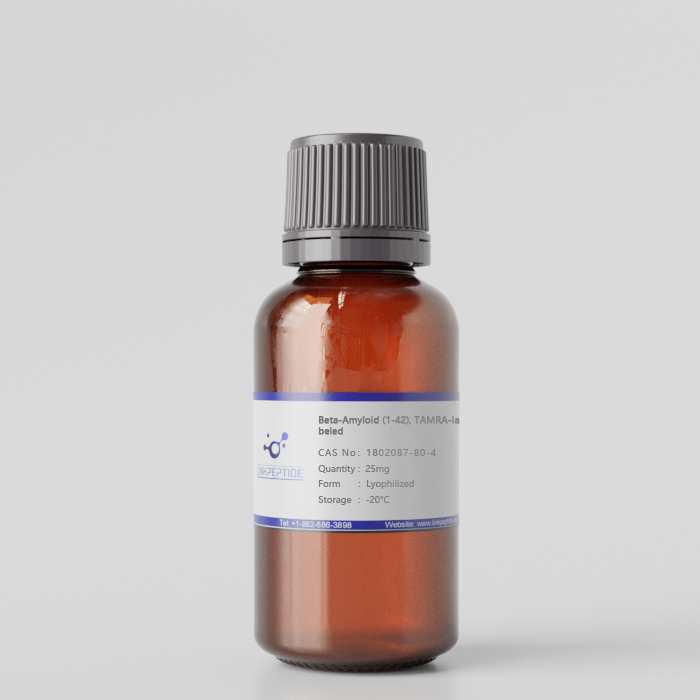
Product Name: Beta-Amyloid (1-42), TAMRA-labeled
Sequence One Letter Code: TAMRA-DAEFRHDSGYEVHHQKLVFFAEDVGSNKGAIIGLMVGGVVIA
Sequence Three Letter Code: TAMRA-Asp-Ala-Glu-Phe-Arg-His-Asp-Ser-Gly-Tyr-Glu-Val-His-His-Gln-Lys-Leu-Val-Phe-Phe-Ala-Glu-Asp-Val-Gly-Ser-Asn-Lys-Gly-Ala-Ile-Ile-Gly-Leu-Met-Val-Gly-Gly-Val-Val-Ile-Ala-OH
Cas No: 1802087-80-4
Chemical Formula:C228H331N57O64S
Molecular Weight: 4926.9
Purity: 95%
Form: Lyophilized
Storage Conditions: - 20 °C Protected from light
Research Area: Alzheimer's Disease
Source / Species: human
Conjugation: Conjugated
Conjugation Type: Fluorescent dyes
Code Nacres: NA.26
Application: Beta-Amyloid (1–42), TAMRA-labeled, is a fluorescently tagged form of the aggregation-prone amyloid-β species associated with senile plaque formation in Alzheimer’s disease. Aβ (1–42) exhibits high neurotoxicity and aggregation propensity relative to shorter isoforms. TAMRA conjugation enables fluorescence detection at excitation/emission 544/572 nm, facilitating studies of aggregation kinetics, cellular uptake, intracellular trafficking, and clearance mechanisms in neurodegeneration research.
Current Research: Beta-Amyloid (1–42), TAMRA-labeled is a fluorescently conjugated form of the 42–amino acid amyloid-β (Aβ) peptide, the aggregation-prone species strongly associated with senile plaque formation in Alzheimer’s disease (AD). Among Aβ isoforms, Aβ (1–42) exhibits greater hydrophobicity, accelerated aggregation kinetics, and increased neurotoxicity compared with shorter variants such as Aβ (1–40), making it a central focus in neurodegeneration research. Conjugation with tetramethylrhodamine (TAMRA) enables fluorescence detection with excitation/emission maxima of approximately 544/572 nm, supporting high-sensitivity visualization and quantitative analysis in cellular and biochemical assays. Biological Context Aβ peptides are generated by sequential cleavage of amyloid precursor protein (APP) via β-secretase (BACE1) and γ-secretase. The 1–42 isoform has: Increased β-sheet–forming propensity Enhanced oligomerization and fibrillization Greater synaptotoxic and neurotoxic effects Soluble Aβ oligomers are widely implicated in synaptic dysfunction, oxidative stress, and neuroinflammatory activation in AD pathology. Functional Advantages of TAMRA Labeling TAMRA provides: Bright fluorescence with high photostability Reduced spectral overlap with GFP/FITC-based probes Compatibility with confocal microscopy and flow cytometry Suitability for multi-color imaging experiments The red-shifted emission (572 nm) facilitates simultaneous monitoring with green fluorophores in co-localization studies. Research Applications 1. Aggregation Kinetics Studies TAMRA-Aβ (1–42) enables real-time monitoring of peptide aggregation using fluorescence-based assays. It is frequently used alongside Thioflavin T or other aggregation reporters to assess oligomer and fibril formation dynamics. 2. Cellular Uptake and Trafficking The labeled peptide supports visualization of neuronal uptake, endosomal trafficking, and lysosomal localization using fluorescence microscopy. 3. Intracellular Localization and Co-Localization Researchers employ TAMRA-Aβ to examine co-localization with: Synaptic markers Mitochondrial proteins Autophagy-related structures Microglial activation markers 4. Clearance and Degradation Studies The peptide can be used to investigate mechanisms of Aβ clearance, including proteolytic degradation, receptor-mediated uptake, and glial phagocytosis. 5. Neurotoxicity Assays Fluorescent tracking allows correlation of aggregation state and cellular localization with downstream toxicity endpoints such as ROS generation or apoptosis markers. Experimental Considerations Fluorophore conjugation may influence aggregation kinetics; validation against unlabeled Aβ (1–42) is recommended when studying fibrillization dynamics. Preparation protocols (e.g., monomerization steps) should be standardized to ensure reproducibility. Light-sensitive handling conditions are advised to maintain fluorophore integrity.
Get a Quote
 LinkPeptide

![Tyrosine Kinase Peptide 1 [KVEKIGEGTYGVVYK], 5-...](https://www.linkpeptide.com/wp-content/uploads/2026/06/Tyrosine-Kinase-Peptide-1-KVEKIGEGTYGVVYK-5-TMR-labeled.jpg "Tyrosine Kinase Peptide 1 [KVEKIGEGTYGVVYK], 5-...")