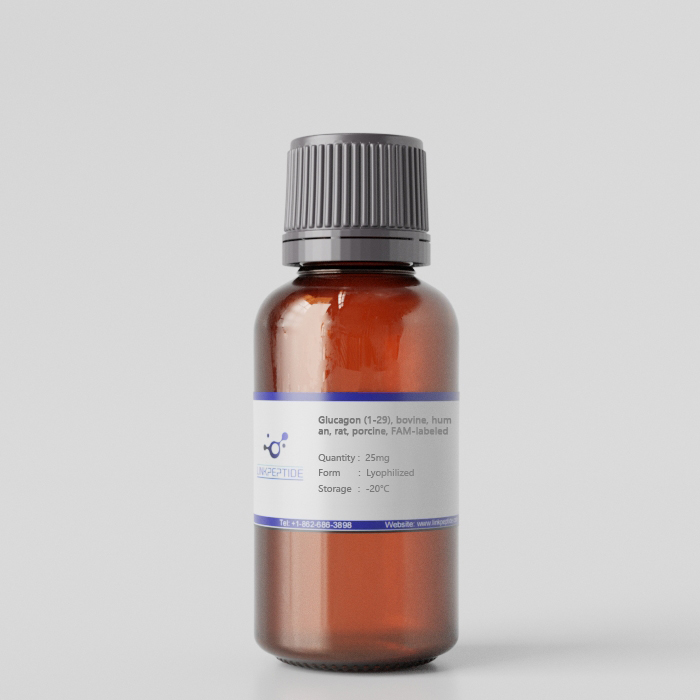
Product Name: Glucagon (1-29), bovine, human, rat, porcine, FAM-labeled
Sequence One Letter Code: FAM-HSQGTFTSDYSKYLDSRRAQDFVQWLMNT
Sequence Three Letter Code: FAM-His-Ser-Gln-Gly-Thr-Phe-Thr-Ser-Asp-Tyr-Ser-Lys-Tyr-Leu-Asp-Ser-Arg-Arg-Ala-Gln-Asp-Phe-Val-Gln-Trp-Leu-Met-Asn-Thr-OH
Chemical Formula:C174H235N43O55S
Molecular Weight: 3841.3
Purity: 95%
Form: Lyophilized
Storage Conditions: - 20 °C Protected from light
Research Area: Diabetes and Metabolic Syndrome
Source / Species: bovine, human, rat, porcine
Conjugation: Conjugated
Conjugation Type: Fluorescent dyes
Code Nacres: NA.26
Application: Glucagon (1–29), FAM-labeled, is a fluorescently tagged form of the biologically active glucagon peptide, which is conserved across human, bovine, rat, and porcine species. Secreted by pancreatic α-cells in response to hypoglycemia, glucagon plays a central role in maintaining glucose homeostasis by stimulating hepatic glucose production and regulating glycogen metabolism. Conjugation with carboxyfluorescein (FAM) enables sensitive fluorescence-based detection while preserving receptor-binding functionality. The labeled peptide supports visualization of glucagon receptor interactions, receptor trafficking, and downstream signaling events in cellular systems. Fluorescence is detected at excitation and emission wavelengths of 494 and 521 nm. Glucagon (1–29), FAM-labeled, is suitable for receptor pharmacology studies, enzymatic assays, and investigations into dysregulated glucagon signaling associated with metabolic disorders, including type 2 diabetes and related endocrine pathologies.
Current Research: Glucagon (1–29), FAM-labeled, is a fluorescently tagged derivative of the full-length, biologically active glucagon peptide. The 29-amino acid sequence is highly conserved across human, bovine, rat, and porcine species and represents the mature hormone secreted by pancreatic α-cells. Under conditions of hypoglycemia, glucagon is released into circulation to restore euglycemia by stimulating hepatic glucose production, promoting glycogenolysis, and enhancing gluconeogenesis. Through these actions, glucagon serves as a key counter-regulatory hormone to insulin and is central to systemic glucose homeostasis. Glucagon exerts its effects primarily via the glucagon receptor (GCGR), a class B G protein–coupled receptor expressed predominantly in hepatocytes but also present in other metabolically active tissues. Receptor activation stimulates adenylate cyclase through Gs protein coupling, leading to increased intracellular cAMP levels and activation of protein kinase A (PKA). This signaling cascade regulates transcriptional and enzymatic pathways controlling carbohydrate and lipid metabolism. Dysregulation of glucagon signaling has been implicated in hyperglycemia, insulin resistance, and the pathophysiology of type 2 diabetes. Conjugation of 5-carboxyfluorescein (FAM) to glucagon (1–29) enables fluorescence-based detection while preserving receptor-binding functionality. FAM provides high sensitivity and photostability and exhibits excitation and emission maxima at approximately 494 nm and 521 nm, respectively. These spectral properties allow compatibility with standard FITC filter sets in fluorescence microscopy, flow cytometry, and microplate-based fluorescence assays. Glucagon (1–29), FAM-labeled, supports real-time visualization of ligand–receptor interactions in cellular systems. Fluorescent binding assays can be used to quantify receptor occupancy, determine relative affinity, and perform competitive displacement experiments with unlabeled glucagon analogs or receptor antagonists. The probe also enables monitoring of receptor internalization and trafficking dynamics following ligand stimulation, providing insight into GCGR regulation, endosomal signaling, and receptor recycling mechanisms. In addition to receptor pharmacology studies, the fluorescent glucagon analog can be integrated into enzymatic assays evaluating peptide stability or processing. Because endogenous glucagon is subject to proteolytic regulation, fluorescence detection facilitates quantitative assessment of degradation kinetics and enzyme–substrate interactions in controlled systems. The labeled peptide is particularly valuable in metabolic research investigating altered glucagon signaling in disease states. In type 2 diabetes and related endocrine disorders, inappropriate glucagon secretion contributes to excessive hepatic glucose output and persistent hyperglycemia. By enabling precise analysis of receptor engagement and downstream signaling responses, Glucagon (1–29), FAM-labeled, supports mechanistic studies aimed at understanding dysregulated α-cell function and therapeutic modulation of the glucagon axis. Overall, Glucagon (1–29), FAM-labeled, provides a sensitive and versatile tool for studying glucagon receptor binding, intracellular signaling, and peptide metabolism. Its preserved biological activity combined with fluorescence-based traceability makes it well suited for investigations into glucose homeostasis, endocrine regulation, and metabolic disease–associated signaling abnormalities.
Get a Quote
 LinkPeptide