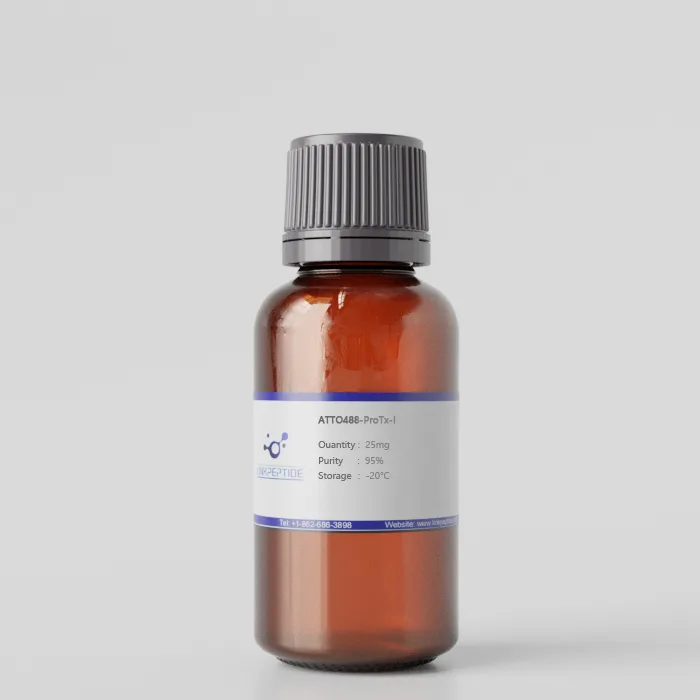
Product Name: Angiotensin II, human, FAM-labeled
Sequence One Letter Code: FAM-DRVYIHPF
Sequence Three Letter Code: FAM-Asp-Arg-Val-Tyr-Ile-His-Pro-Phe-OH
Chemical Formula:C71H81N13O18
Molecular Weight: 1404.5
Purity: 95%
Form: Lyophilized
Storage Conditions: - 20 °C Protected from light
Research Area: Cardiovascular Disease Research
Source / Species: human
Conjugation: Conjugated
Conjugation Type: Fluorescent dyes
Code Nacres: NA.26
Application: Angiotensin II, human, FAM-labeled, is a fluorescent derivative of the bioactive octapeptide angiotensin II, a principal effector of the renin–angiotensin system. Angiotensin II regulates blood pressure, fluid balance, and vascular tone through activation of angiotensin receptors, which are G protein–coupled receptors. Beyond cardiovascular control, it influences cellular proliferation, fibrosis, inflammation, and apoptosis. This peptide is conjugated with carboxyfluorescein (FAM), providing improved photostability and sensitive fluorescence detection compared with traditional FITC labeling. The labeled probe enables real-time monitoring of receptor binding, internalization, and downstream signaling events. Angiotensin II is physiologically generated from angiotensin I by angiotensin-converting enzyme or chymase, making this fluorescent analog suitable for enzymatic assays and receptor pharmacology studies. Fluorescence detection is achieved at excitation and emission wavelengths of 494 and 518 nm, supporting cardiovascular and signaling research applications.
Current Research: Angiotensin II, human, FAM-labeled, is a fluorescently tagged analog of the endogenous octapeptide angiotensin II (Asp–Arg–Val–Tyr–Ile–His–Pro–Phe), the principal effector molecule of the renin–angiotensin system (RAS). Angiotensin II is a central regulator of cardiovascular homeostasis, controlling blood pressure, vascular tone, sodium retention, and fluid balance through activation of angiotensin receptors. These receptors, primarily AT₁ and AT₂, belong to the G protein–coupled receptor (GPCR) superfamily and mediate distinct but overlapping physiological and pathological responses. Binding of angiotensin II to the AT₁ receptor initiates signaling cascades involving phospholipase C activation, inositol trisphosphate generation, intracellular calcium mobilization, and protein kinase C activation. These pathways drive vasoconstriction, aldosterone secretion, sympathetic activation, and cellular growth responses. In addition to its classical cardiovascular functions, angiotensin II influences processes such as fibrosis, inflammation, oxidative stress, and apoptosis, contributing to pathological remodeling in hypertension, heart failure, chronic kidney disease, and metabolic disorders. Conjugation of 5-carboxyfluorescein (FAM) to angiotensin II provides a fluorescent probe suitable for receptor binding and signaling investigations. FAM offers improved photostability and consistent fluorescence performance compared with traditional fluorescein isothiocyanate (FITC) labeling. The fluorophore exhibits excitation and emission maxima at approximately 494 nm and 518 nm, respectively, making the peptide compatible with standard FITC filter sets used in fluorescence microscopy, flow cytometry, and plate-based fluorescence assays. The FAM-labeled analog enables direct visualization of ligand–receptor interactions in live or fixed cellular systems. Fluorescence-based binding assays can be used to determine receptor distribution, assess receptor density, and perform competitive displacement studies with unlabeled ligands or receptor antagonists. Real-time imaging supports analysis of receptor internalization, endosomal trafficking, and recycling dynamics following ligand stimulation, providing insight into GPCR regulation and signal compartmentalization. In addition to receptor pharmacology, Angiotensin II, human, FAM-labeled, is suitable for enzymatic studies. Physiologically, angiotensin II is generated from angiotensin I through cleavage by angiotensin-converting enzyme (ACE) or alternative proteases such as chymase. The fluorescent analog can be incorporated into assay systems designed to evaluate enzymatic processing, receptor activation kinetics, or ligand stability. Its defined fluorescence properties allow sensitive detection of ligand interactions and downstream signaling events. The probe is also valuable for studying differential signaling between AT₁ and AT₂ receptor subtypes. By combining fluorescence imaging with functional readouts—such as calcium flux measurements or phosphorylation assays—researchers can correlate receptor engagement with specific intracellular responses. This is particularly relevant in cardiovascular research, where selective modulation of angiotensin receptor signaling has significant therapeutic implications. Overall, Angiotensin II, human, FAM-labeled, provides a sensitive and versatile tool for investigating renin–angiotensin system biology. Its preserved biological activity combined with fluorescence-based traceability supports detailed examination of receptor binding, internalization, and downstream signaling mechanisms. The peptide is well suited for cardiovascular research, GPCR pharmacology studies, and mechanistic analyses of angiotensin-mediated cellular responses in both basic and translational settings.
Get a Quote
 LinkPeptide

![Tyrosine Kinase Peptide 1 [KVEKIGEGTYGVVYK], 5-...](https://www.linkpeptide.com/wp-content/uploads/2026/06/Tyrosine-Kinase-Peptide-1-KVEKIGEGTYGVVYK-5-TMR-labeled.jpg "Tyrosine Kinase Peptide 1 [KVEKIGEGTYGVVYK], 5-...")