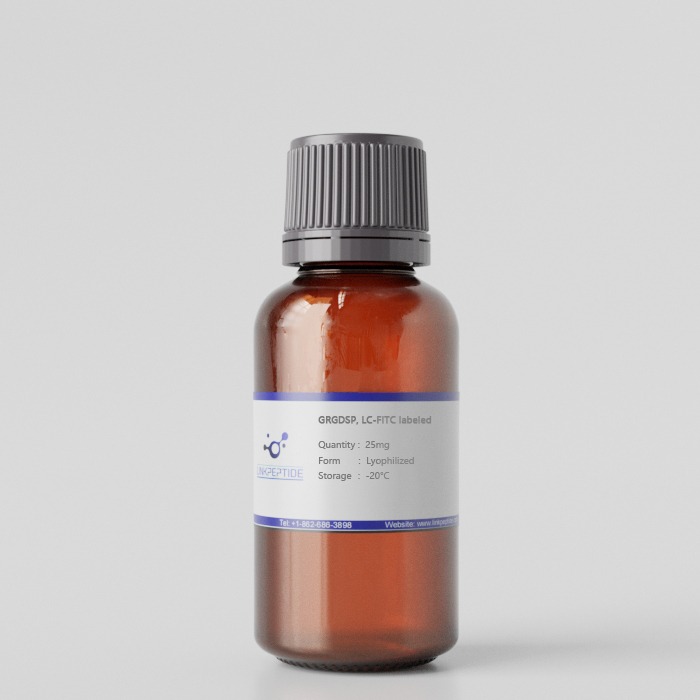
Product Name: GRGDSP, LC-FITC labeled
Sequence One Letter Code: FITC-LC-GRGDSP
Sequence Three Letter Code: FITC-LC-Gly-Arg-Gly-Asp-Ser-Pro-OH
Molecular Weight: 1090.2
Purity: 95%
Form: Lyophilized
Storage Conditions: - 20 °C Protected from light
Research Area: Cancer Disease Research
Source / Species: synthetic
Conjugation: Conjugated
Conjugation Type: Fluorescent dyes
Code Nacres: NA.26
Application: GRGDSP, LC-FITC labeled is a fluorescent peptide probe incorporating the canonical Arg-Gly-Asp (RGD) integrin recognition motif. The peptide is conjugated to fluorescein (FITC) via a long-chain spacer to minimize steric hindrance and preserve integrin-binding affinity. With excitation/emission maxima at 492/516 nm, this probe enables direct visualization and quantification of integrin–ligand interactions in living cells. RGD-binding integrins, including αvβ3 and α5β1, play central roles in cell adhesion, migration, angiogenesis, and thrombosis. GRGDSP-FITC is widely used in flow cytometry, fluorescence microscopy, and competitive binding assays to assess integrin expression and receptor occupancy. Its defined sequence and optical properties support mechanistic studies of extracellular matrix engagement and integrin-mediated signaling pathways.
Current Research: GRGDSP, LC-FITC labeled is a fluorescent peptide probe containing the canonical Arg-Gly-Asp (RGD) integrin recognition motif, conjugated to fluorescein (FITC) through a long-chain (LC) spacer. The RGD sequence is the minimal binding motif recognized by several adhesion receptors in the integrin family, particularly αvβ3, αvβ5, and α5β1. By incorporating a flexible spacer between the peptide and the fluorophore, this probe minimizes steric interference and preserves high-affinity integrin binding. With excitation and emission maxima at 492/516 nm, GRGDSP-FITC enables direct visualization and quantitative analysis of integrin–ligand interactions in living cells. Integrin Biology and RGD Recognition Integrins are heterodimeric transmembrane receptors composed of α and β subunits that mediate cell adhesion to extracellular matrix (ECM) components such as fibronectin, vitronectin, fibrinogen, and osteopontin. Many of these ECM proteins present the RGD motif as a critical ligand-binding determinant. Engagement of RGD-binding integrins triggers conformational activation and clustering, leading to recruitment of cytoskeletal and signaling proteins at focal adhesions. Activation of integrins regulates essential cellular processes, including: Cell adhesion and spreading Cytoskeletal organization Cell migration and invasion Angiogenesis Platelet aggregation and thrombosis Dysregulated integrin signaling contributes to cancer progression, inflammatory disorders, vascular disease, and impaired wound healing. Fluorescent Labeling and Detection The LC-FITC modification enhances experimental performance by distancing the fluorescein moiety from the RGD core motif, thereby reducing steric hindrance that could otherwise impair receptor engagement. FITC provides strong fluorescence intensity with spectral properties compatible with standard flow cytometers and fluorescence microscopes. Upon binding to cell-surface integrins, GRGDSP-FITC generates a measurable fluorescent signal proportional to receptor occupancy. Because the interaction is reversible and concentration-dependent, it can be used to assess binding kinetics and competitive inhibition. Applications in Integrin Research GRGDSP-FITC is widely applied in: Flow cytometric analysis of integrin expression Fluorescence microscopy of cell adhesion dynamics Competitive binding assays with RGD antagonists Receptor occupancy and affinity measurements Live-cell imaging of integrin clustering and internalization In cancer research, αvβ3 and α5β1 integrins are frequently upregulated in invasive tumor cells and angiogenic endothelial cells. This probe enables quantitative evaluation of integrin levels and functional engagement in tumor models. In vascular biology, it supports studies of endothelial activation and platelet adhesion mechanisms. Mechanistic Studies of Cell Adhesion and Signaling Integrin ligation initiates outside-in signaling cascades involving focal adhesion kinase (FAK), Src-family kinases, and downstream MAPK pathways. GRGDSP-FITC allows researchers to examine how integrin engagement correlates with cytoskeletal rearrangement, migration speed, and signal transduction. Because RGD peptides can also function as competitive inhibitors of endogenous ECM binding, fluorescent GRGDSP can be used to evaluate integrin-blocking strategies or characterize receptor conformational states under activating or inhibitory conditions. Experimental Advantages Canonical RGD motif for broad integrin recognition Long-chain spacer preserves binding affinity Bright FITC fluorescence (Ex 492 nm / Em 516 nm) Compatible with standard fluorescence instrumentation Suitable for live-cell and fixed-cell applications The defined sequence and optical properties enable reproducible quantification of integrin–ligand interactions across multiple assay formats. Research Impact By combining a minimal integrin-binding motif with a robust fluorescent reporter, GRGDSP, LC-FITC labeled provides a versatile tool for studying extracellular matrix engagement and integrin-mediated signaling. It supports mechanistic investigations into adhesion biology, tumor angiogenesis, thrombosis, and cell migration, making it valuable in both basic research and translational studies targeting integrin-driven disease processes.
Get a Quote
 LinkPeptide

![Tyrosine Kinase Peptide 1 [KVEKIGEGTYGVVYK], 5-...](https://www.linkpeptide.com/wp-content/uploads/2026/06/Tyrosine-Kinase-Peptide-1-KVEKIGEGTYGVVYK-5-TMR-labeled.jpg "Tyrosine Kinase Peptide 1 [KVEKIGEGTYGVVYK], 5-...")