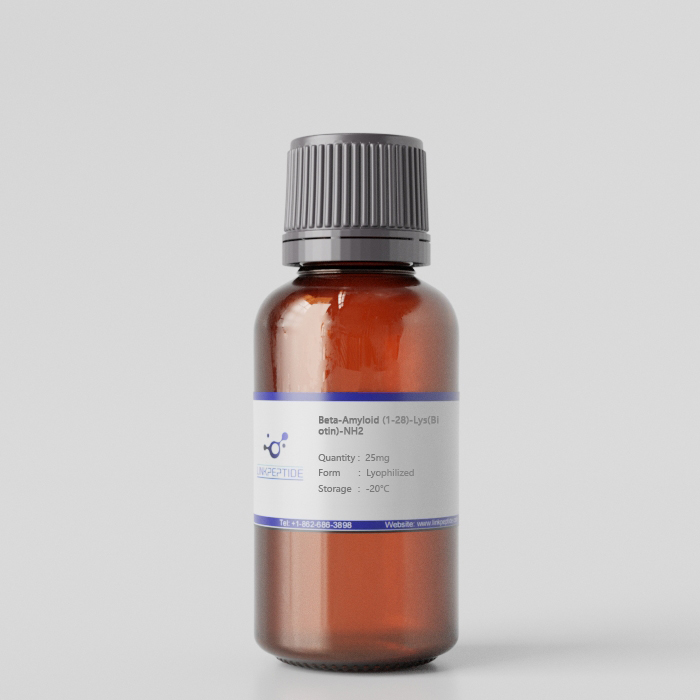
Product Name: Beta-Amyloid (1-28)-Lys(Biotin)-NH2
Sequence One Letter Code: DAEFRHDSGYEVHHQKLVFFAEDVGSNK-K(Biotin)-NH2
Sequence Three Letter Code: H-Asp-Ala-Glu-Phe-Arg-His-Asp-Ser-Gly-Tyr-Glu-Val-His-His-Gln-Lys-Leu-Val-Phe-Phe-Ala-Glu-Asp-Val-Gly-Ser-Asn-Lys-Lys(Biotin)-NH2
Molecular Weight: 3616.2
Purity: 95%
Form: Lyophilized
Storage Conditions: - 20 °C
Research Area: Alzheimer's Disease
Source / Species: human
Conjugation: Conjugated
Conjugation Type: Biotins
Code Nacres: NA.26
Application: β-Amyloid (1–28)-Lys(Biotin)-NH₂ is a synthetic peptide corresponding to the N-terminal 28 residues of β-amyloid, biotinylated on a lysine side chain. The N-terminal region contributes to metal ion binding, receptor interactions, and early aggregation processes in Alzheimer’s disease pathology. The biotin modification enables affinity capture, interaction mapping, and assay development. This peptide is widely used to study amyloid-binding partners, aggregation dynamics, and modulation of amyloid-associated toxicity. It supports biochemical and cellular investigations aimed at elucidating mechanisms of amyloid-driven neurodegeneration and evaluating therapeutic candidates targeting early-stage aggregation events.
Current Research: β-Amyloid (Aβ) peptides are central to the molecular etiology of Alzheimer’s disease (AD), where misfolding, oligomerization, and plaque deposition contribute to synaptic dysfunction and progressive neurodegeneration. While full-length Aβ peptides such as Aβ1–40 and Aβ1–42 are most commonly associated with fibrillar plaque formation, the N-terminal region (residues 1–28) plays a critical role in early aggregation events, metal ion coordination, and receptor interactions. β-Amyloid (1–28)-Lys(Biotin)-NH₂ is a synthetic peptide encompassing this N-terminal domain, modified by biotinylation on a lysine side chain to facilitate affinity-based applications. The N-terminal 1–28 segment contains residues essential for coordinating transition metal ions, including Cu²⁺, Zn²⁺, and Fe³⁺. Histidine residues within this region contribute to high-affinity metal binding, influencing peptide conformation, redox activity, and aggregation kinetics. Metal coordination has been implicated in oxidative stress generation and modulation of amyloid assembly pathways. By isolating this defined fragment, researchers can investigate metal-dependent structural transitions and their contribution to early-stage oligomer formation without the complexity of the full-length peptide’s highly hydrophobic C-terminal domain. In addition to metal interactions, the Aβ1–28 region participates in receptor binding and membrane-associated processes. Interactions with cell surface receptors such as RAGE (receptor for advanced glycation end products), integrins, and other pattern-recognition molecules are influenced by N-terminal sequence determinants. These engagements can trigger intracellular signaling cascades, inflammatory responses, and oxidative stress pathways implicated in AD pathology. The truncated 1–28 fragment provides a focused platform to dissect how early amyloid–receptor interactions contribute to downstream neurotoxic signaling. Biotinylation at a lysine side chain enables high-affinity capture using streptavidin- or avidin-based systems while preserving the peptide’s N-terminal structure and functional motifs. Side-chain labeling, rather than terminal modification, minimizes interference with receptor-binding interfaces or aggregation-prone sequences. The amide (–NH₂) C-terminus further stabilizes the peptide by eliminating a free carboxylate charge, which can influence solubility and aggregation behavior. The biotin tag supports a wide range of biochemical and cellular assays. In pull-down experiments, immobilized β-Amyloid (1–28)-Lys(Biotin)-NH₂ can be used to identify interacting proteins from cell lysates, cerebrospinal fluid, or brain homogenates. Coupled with immunoblotting or mass spectrometry, these assays facilitate mapping of amyloid-binding partners, including chaperones, apolipoproteins, and membrane receptors. Such interaction profiling contributes to understanding the molecular networks involved in amyloid recognition and clearance. In aggregation studies, the 1–28 fragment enables examination of early nucleation processes. Although less prone to rapid fibrillization than longer Aβ isoforms, this region participates in conformational transitions that precede β-sheet–rich fibril formation. Researchers use techniques such as circular dichroism spectroscopy, dynamic light scattering, and fluorescence-based aggregation assays to monitor structural changes and oligomer formation. The biotin functionality permits parallel immobilization for surface-based binding assays, including ELISA and biosensor platforms such as surface plasmon resonance (SPR). Cellular studies also benefit from this biotinylated fragment. By tracking peptide binding and uptake in neuronal or glial cultures, investigators can assess how early amyloid species interact with cell membranes and initiate toxicity pathways. Competitive binding assays can evaluate therapeutic candidates designed to block receptor engagement or disrupt oligomer formation. Additionally, screening of small molecules or antibodies targeting the N-terminal domain can be conducted using affinity-capture or fluorescence-based readouts. From a therapeutic development perspective, early aggregation events and soluble oligomers are increasingly recognized as key drivers of synaptic impairment in AD. β-Amyloid (1–28)-Lys(Biotin)-NH₂ supports targeted investigation of these initial molecular interactions, offering a controlled system to evaluate aggregation modulators and metal-chelating compounds. By focusing on the N-terminal domain, researchers can dissect contributions of metal binding and receptor engagement to amyloid-associated neurotoxicity. In summary, β-Amyloid (1–28)-Lys(Biotin)-NH₂ integrates a functionally significant N-terminal amyloid fragment with a biotin affinity handle for versatile biochemical applications. It serves as a valuable tool for studying metal interactions, receptor binding, aggregation dynamics, and early pathogenic mechanisms in Alzheimer’s disease, supporting mechanistic research and therapeutic exploration aimed at mitigating amyloid-driven neurodegeneration.
Get a Quote
 LinkPeptide

![[Lys(Me3)27]-Histone H3 (23-34)-GGK(Biotin)](https://www.linkpeptide.com/wp-content/uploads/2026/05/LysMe327-Histone-H3-23-34-GGKBiotin.jpg "[Lys(Me3)27]-Histone H3 (23-34)-GGK(Biotin)")