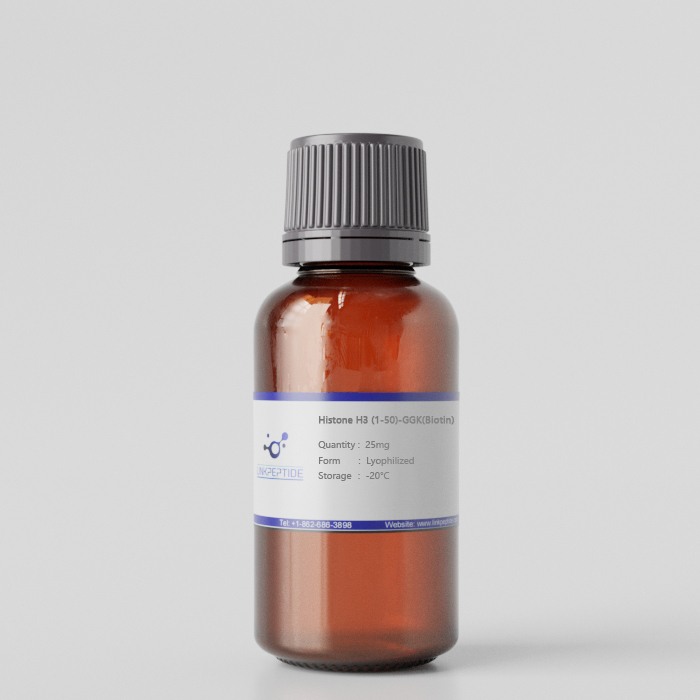
Product Name: Histone H3 (1-50)-GGK(Biotin) - 0.25 mg
Sequence One Letter Code: ARTKQTARKSTGGKAPRKQLATKAARKSAPATGGVKKPHRYRPGTVALRE-GGK(Biotin)
Sequence Three Letter Code: H-Ala-Arg-Thr-Lys-Gln-Thr-Ala-Arg-Lys-Ser-Thr-Gly-Gly-Lys-Ala-Pro-Arg-Lys-Gln-Leu-Ala-Thr-Lys-Ala-Ala-Arg-Lys-Ser-Ala-Pro-Ala-Thr-Gly-Gly-Val-Lys-Lys-Pro-His-Arg-Tyr-Arg-Pro-Gly-Thr-Val-Ala-Leu-Arg-Glu-Gly-Gly-Lys(Biotin)-OH
Molecular Weight: 5810.1
Purity: 95%
Form: Lyophilized
Storage Conditions: - 20 °C
Research Area: Cancer Disease Research
Source / Species: human
Conjugation: Conjugated
Conjugation Type: Biotins
Code Nacres: NA.26
Application: Histone H3 (1–50)-GGK(Biotin) is a synthetic peptide corresponding to the N-terminal 50 amino acids of histone H3, biotinylated at the C-terminus via a GGK linker. The H3 N-terminal tail is a major regulatory domain subject to extensive post-translational modifications, including methylation, acetylation, and phosphorylation, which collectively govern chromatin remodeling and gene transcription. This region mediates interactions with chromatin-associated proteins and epigenetic reader, writer, and eraser complexes. The C-terminal biotin tag enables affinity purification, pull-down assays, and proteomic profiling of H3-interacting proteins. This peptide is widely used in epigenetics research to investigate histone–protein interactions, modification-dependent binding events, and enzymatic regulation of chromatin structure in biochemical and molecular assays.
Current Research: Histone H3 (1–50)-GGK(Biotin) is a synthetic peptide encompassing the N-terminal 50 amino acids of histone H3, conjugated at the C-terminus to biotin via a flexible GGK linker. The N-terminal tail of histone H3 is one of the most extensively modified regions in chromatin and serves as a central regulatory platform for epigenetic signaling. By providing a defined and accessible fragment of this regulatory domain, the peptide enables mechanistic investigation of histone-mediated chromatin control. The H3 N-terminal tail protrudes from the nucleosome core and is highly accessible to chromatin-modifying enzymes and reader proteins. It contains numerous lysine, arginine, serine, and threonine residues that undergo post-translational modifications (PTMs), including acetylation (e.g., H3K9ac, H3K14ac), methylation (e.g., H3K4me3, H3K9me3, H3K27me3), phosphorylation (e.g., H3S10ph), and ubiquitin-dependent cross-talk events. These modifications collectively form a combinatorial regulatory system often referred to as the “histone code,” influencing transcriptional activation, repression, DNA repair, replication, and chromatin compaction. The 1–50 segment includes key regulatory sites such as lysine 4 (K4), lysine 9 (K9), lysine 14 (K14), lysine 27 (K27), and serine 10 (S10), all of which are critical determinants of chromatin state. For example, H3K4 trimethylation is associated with active promoters, H3K9 and H3K27 methylation are linked to transcriptional repression, and H3 acetylation generally correlates with open chromatin and gene activation. The unmodified 1–50 peptide serves as a foundational scaffold for studying enzyme specificity and modification-dependent protein recruitment. The C-terminal GGK(Biotin) modification allows immobilization of the peptide on streptavidin-coated beads or surfaces, enabling affinity purification and pull-down assays. This configuration is widely used to isolate and characterize H3-interacting proteins from nuclear extracts. When coupled with mass spectrometry, it supports proteomic identification of chromatin-associated complexes that recognize specific sequence motifs or modification states within the H3 tail. In enzymology research, Histone H3 (1–50)-GGK(Biotin) is used as a substrate for histone-modifying enzymes, including histone acetyltransferases (HATs), histone methyltransferases (HMTs), kinases, and demethylases. In vitro assays assess catalytic efficiency, substrate selectivity, and regulatory cofactor dependence. Modified variants of the peptide can be generated to evaluate how pre-existing PTMs influence enzymatic activity, providing insight into hierarchical and combinatorial modification patterns. The peptide also supports studies of epigenetic reader domains such as bromodomains (acetyl-lysine recognition), chromodomains (methyl-lysine recognition), PHD fingers, and Tudor domains. By using modified or unmodified versions of the H3 tail, researchers can define binding affinities and specificity profiles for these domains using techniques such as fluorescence polarization, surface plasmon resonance, or isothermal titration calorimetry. Additionally, the peptide is valuable for antibody validation. Antibodies directed against specific H3 modifications are tested against defined peptides to confirm selectivity and exclude cross-reactivity. This is essential for reliable chromatin immunoprecipitation (ChIP) and epigenomic profiling experiments. Overall, Histone H3 (1–50)-GGK(Biotin) provides a versatile and experimentally tractable model of the histone H3 N-terminal regulatory domain. Its inclusion of major modification sites and its affinity tag for purification make it an indispensable tool in biochemical, structural, and proteomic studies aimed at elucidating histone–protein interactions, chromatin remodeling mechanisms, and the epigenetic regulation of gene expression.
Get a Quote
 LinkPeptide

![[Lys(Me2)20]-Histone H4 (8-30)-WGK(Biotin)](https://www.linkpeptide.com/wp-content/uploads/2026/06/LysMe220-Histone-H4-8-30-WGKBiotin.jpg "[Lys(Me2)20]-Histone H4 (8-30)-WGK(Biotin)")