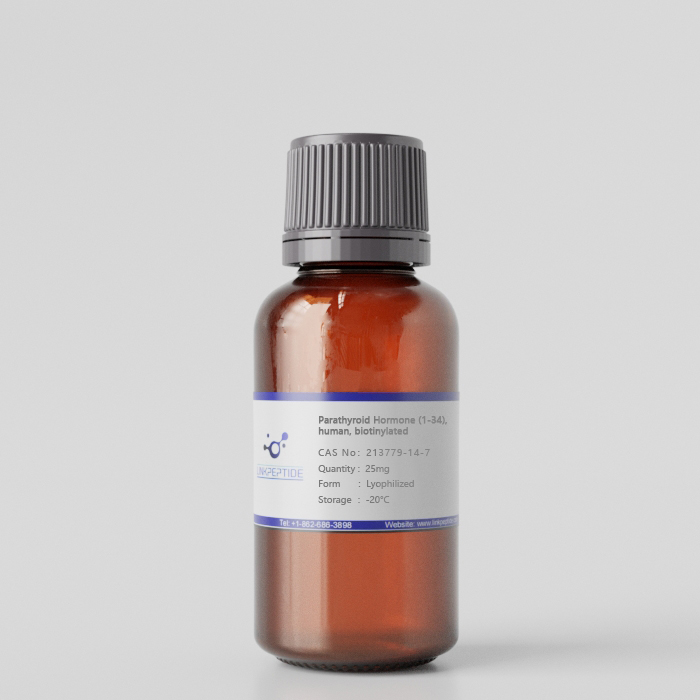
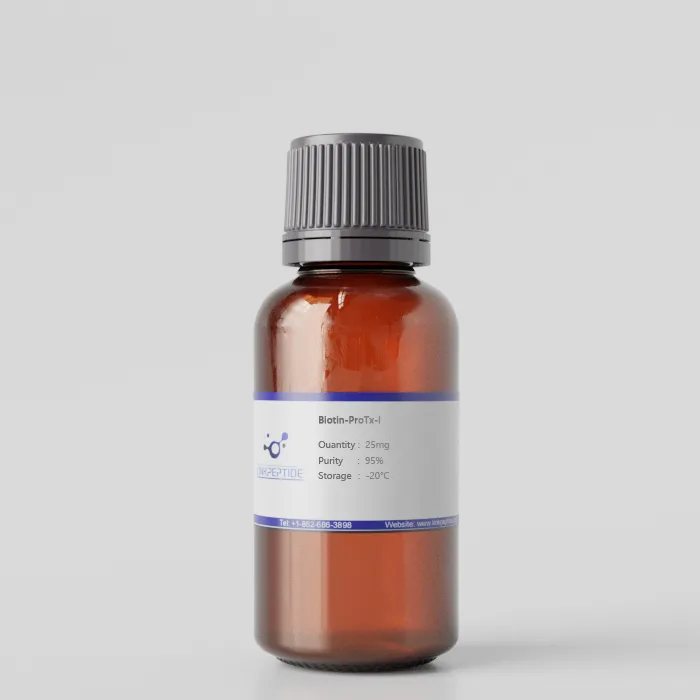
Product Name: Parathyroid Hormone (1-34)-Lys(Biotin), human
Sequence One Letter Code: SVSEIQLMHNLGKHLNSMERVEWLRKKLQDVHNFK(Biotin)
Sequence Three Letter Code: H-Ser-Val-Ser-Glu-Ile-Gln-Leu-Met-His-Asn-Leu-Gly-Lys-His-Leu-Asn-Ser-Met-Glu-Arg-Val-Glu-Trp-Leu-Arg-Lys-Lys-Leu-Gln-Asp-Val-His-Asn-Phe-Lys(Biotin)-OH
Chemical Formula:C197H317N59O54S3
Molecular Weight: 4472.5
Purity: 95%
Form: Lyophilized
Storage Conditions: - 20 °C
Research Area: Endocrinology Disease Research
Source / Species: human
Conjugation: Unconjugated
Code Nacres: NA.26
Application: Parathyroid Hormone (1–34)–Lys(Biotin), human, is a biotinylated form of the biologically active N-terminal fragment of PTH that retains full receptor activity at PTH/PTHrP and PTH2 receptors. It regulates calcium and phosphate homeostasis in bone and kidney tissues. Biotin conjugation enables affinity-based capture and detection in binding and signaling assays. This peptide is widely used in studies of bone metabolism, mineral balance, vascular calcification, and endocrine signaling mechanisms.
Current Research: Parathyroid Hormone (1–34)–Lys(Biotin), human is a biotinylated derivative of the biologically active N-terminal fragment of parathyroid hormone (PTH). The 1–34 region contains the full receptor-activating domain responsible for interaction with PTH/PTHrP receptor (PTH1R) and PTH2 receptor (PTH2R). This fragment retains the complete biological activity of full-length PTH in stimulating downstream signaling pathways. Biotinylation at a lysine residue enables high-affinity interaction with streptavidin-based systems while preserving receptor-binding capability, making this peptide particularly useful for binding, signaling, and affinity-capture assays. Biological Function PTH is a central endocrine regulator of calcium and phosphate homeostasis, acting primarily on: Bone – stimulating osteoblast-mediated signaling and indirectly promoting osteoclast activation to mobilize calcium Kidney – enhancing calcium reabsorption, decreasing phosphate reabsorption, and promoting 1α-hydroxylase activity to increase active vitamin D production Upon binding to PTH1R, a class B G protein–coupled receptor, PTH (1–34) activates: cAMP/PKA signaling pathways PLC/IP₃/Ca²⁺ pathways MAPK signaling cascades These pathways coordinate mineral metabolism and skeletal remodeling. Functional Advantages of Lys(Biotin) Conjugation The incorporation of biotin provides several experimental benefits: Affinity capture using streptavidin-coated beads or plates Stable immobilization for receptor-binding studies Compatibility with ELISA-style detection platforms Fluorescent or enzyme-linked streptavidin–based quantification Because the biotin–streptavidin interaction is exceptionally strong, the peptide is suitable for robust and reproducible analytical workflows. Research Applications 1. Receptor Binding Assays PTH (1–34)–Lys(Biotin) can be immobilized or detected via streptavidin-linked reagents to evaluate binding affinity and competitive displacement at PTH1R or PTH2R. 2. Signal Transduction Studies The peptide is used in cell-based assays to correlate ligand engagement with downstream signaling readouts such as cAMP production, ERK phosphorylation, or calcium mobilization. 3. Bone Metabolism and Remodeling Research This reagent supports studies examining osteoblast and osteoclast regulation, anabolic versus catabolic PTH signaling, and mechanisms underlying bone formation therapies. 4. Mineral Balance and Vascular Calcification Studies PTH signaling influences systemic mineral metabolism and has implications for chronic kidney disease and vascular calcification research. The biotinylated peptide facilitates mechanistic exploration of these pathways. Experimental Considerations Although biotinylation is positioned to preserve receptor activation, functional equivalence to non-labeled PTH (1–34) should be validated in quantitative pharmacological assays. Receptor expression levels and assay format should guide concentration optimization. Proper storage conditions are recommended to maintain peptide stability and activity.
Get a Quote
 LinkPeptide