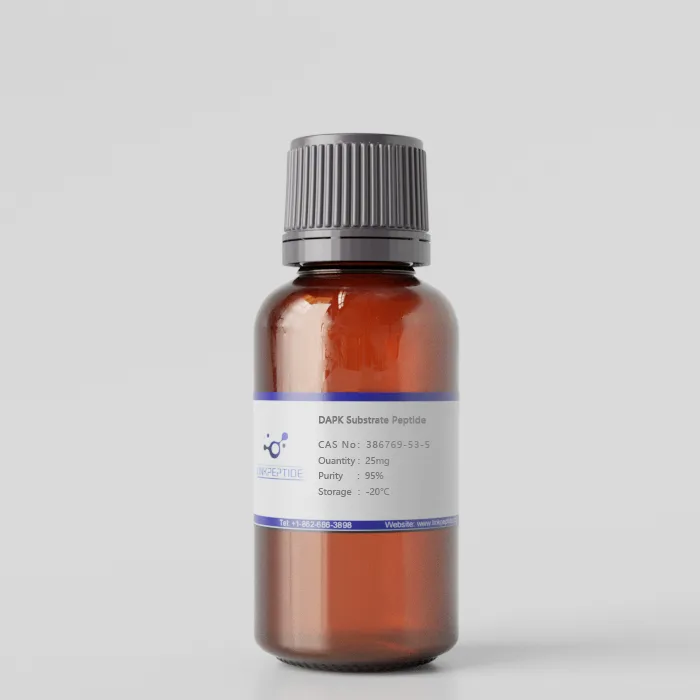
Product Name: Histone H4 (1-20), PRMT7 Substrate, M1
Sequence One Letter Code: SGRGKGGKGLGKGGAKRHRK-NH2
Sequence Three Letter Code: H-Ser-Gly-Arg-Gly-Lys-Gly-Gly-Lys-Gly-Leu-Gly-Lys-Gly-Gly-Ala-Lys-Arg-His-Arg-Lys-NH2
Chemical Formula:C82H151N37O21
Molecular Weight: 1991.5
Purity: 95%
Form: Lyophilized
Storage Conditions: - 20 °C
Research Area: epigenetics
Source / Species: human
Conjugation: Unconjugated
Code Nacres: NA.26
Application: Histone H4 (1–20), PRMT7 Substrate, M1, is a synthetic peptide corresponding to the N-terminal 20 amino acids of histone H4 and contains a glycine–arginine–glycine (GRG) motif targeted by protein arginine methyltransferase 7 (PRMT7). PRMT7 is a type II methyltransferase that catalyzes symmetric dimethylation of arginine residues, a modification involved in chromatin regulation and gene expression control. This peptide serves as a defined substrate in enzymatic assays to evaluate PRMT7 catalytic activity, substrate recognition, and methylation kinetics. It supports mechanistic studies of arginine methylation and facilitates inhibitor screening targeting PRMT7-mediated pathways. Histone H4 (1–20) is widely applied in epigenetics research, chromatin biology, and investigations of post-translational modifications that regulate transcriptional programs and cellular differentiation.
Current Research: Histone arginine methylation is a critical post-translational modification that regulates chromatin structure, transcriptional activity, and cellular differentiation. Protein arginine methyltransferase 7 (PRMT7) is a type II PRMT that catalyzes symmetric dimethylation of arginine residues (sDMA), contributing to epigenetic control of gene expression. Histone H4 (1–20), PRMT7 Substrate, M1 is a synthetic peptide corresponding to the N-terminal 20 amino acids of histone H4 and includes a glycine–arginine–glycine (GRG) motif recognized by PRMT7. As a defined enzymatic substrate, this peptide is widely used to characterize PRMT7 catalytic activity and substrate specificity in vitro. The N-terminal tail of histone H4 is a hotspot for regulatory modifications, including acetylation, methylation, and phosphorylation. Arginine residues within this region are accessible for enzymatic modification and serve as docking points for chromatin-associated proteins. PRMT7 preferentially targets arginine residues within glycine-rich motifs such as GRG, making the H4 (1–20) fragment an appropriate minimal substrate for studying methylation dynamics. By isolating the first 20 residues, the peptide preserves the local sequence context necessary for enzyme recognition while eliminating structural complexity associated with nucleosome assembly. In biochemical assays, recombinant PRMT7 is incubated with the H4 (1–20) peptide in the presence of S-adenosylmethionine (SAM), the universal methyl donor. Transfer of methyl groups to the target arginine can be detected using radiolabeled SAM incorporation, mass spectrometry, or modification-specific antibodies. These assays enable quantitative measurement of catalytic turnover and determination of kinetic parameters such as Km and Vmax. Because the substrate is well-defined and soluble, it provides reproducible assay conditions suitable for mechanistic enzymology. PRMT7-mediated symmetric dimethylation has been implicated in transcriptional regulation, DNA damage responses, and cellular stress adaptation. By using the H4 (1–20) substrate, researchers can investigate how PRMT7 activity is regulated by cofactors, interacting proteins, or post-translational modifications. Comparative assays with other PRMT family members further clarify enzyme selectivity and substrate discrimination within arginine methylation networks. The peptide is also valuable in inhibitor screening programs. Aberrant PRMT activity has been associated with cancer progression, stem cell regulation, and developmental disorders. Small-molecule inhibitors targeting PRMT7 are evaluated by monitoring reduction in methylation of the H4 (1–20) substrate. Determination of IC50 values and inhibition kinetics supports structure–activity relationship studies and optimization of candidate therapeutics. Because PRMT7 is structurally and functionally distinct from type I PRMTs, substrate-based assays are essential for assessing isoform selectivity. In epigenetics research, histone H4 (1–20) serves as a reference reagent for studying arginine methylation–dependent chromatin interactions. Methylated versus unmethylated peptide forms can be used in pull-down experiments to identify reader proteins that recognize symmetric dimethylarginine marks. These interactions contribute to chromatin compaction, transcriptional repression or activation, and recruitment of regulatory complexes. Furthermore, the H4 N-terminal region often carries multiple modifications that cooperate to define chromatin states. Although the synthetic peptide focuses on arginine methylation, it can be incorporated into combinatorial modification studies examining crosstalk between methylation and neighboring acetylation events. In summary, Histone H4 (1–20), PRMT7 Substrate, M1 is a synthetic peptide encompassing a GRG motif targeted by PRMT7 for symmetric arginine dimethylation. It provides a defined and reproducible substrate for enzymatic characterization, kinetic analysis, and inhibitor screening. Widely used in chromatin biology and epigenetics research, this peptide supports mechanistic investigation of arginine methylation pathways that regulate gene expression and cellular differentiation.
Get a Quote
 LinkPeptide

![Syntide-2 [PLARTLSVAGLPGKK]](https://www.linkpeptide.com/wp-content/uploads/2026/05/Syntide-2-PLARTLSVAGLPGKK.jpg "Syntide-2 [PLARTLSVAGLPGKK]")
![CDK1 Substrate [HATPPKKKRK]](https://www.linkpeptide.com/wp-content/uploads/2026/05/CDK1-Substrate-HATPPKKKRK.jpg "CDK1 Substrate [HATPPKKKRK]")