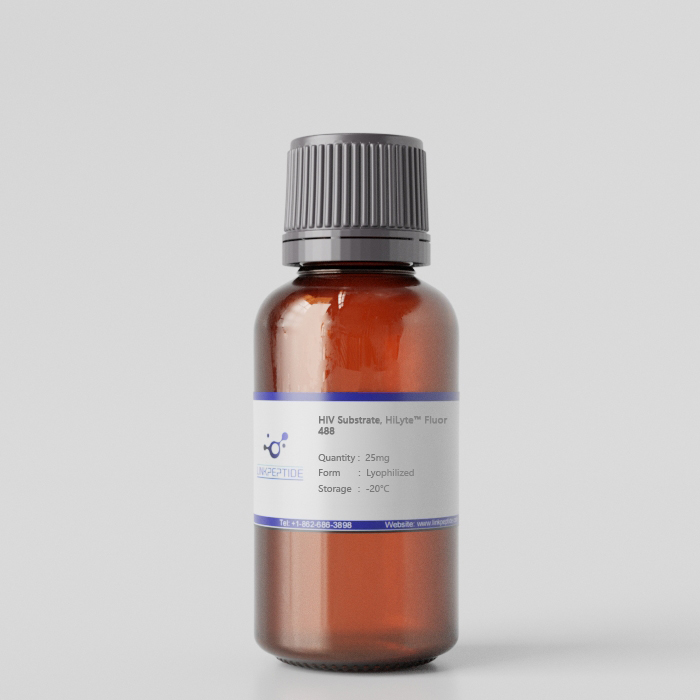
Product Name: HIV Substrate, HiLyte™ Fluor 488
Sequence One Letter Code: QXL®520-GABA-SQNYPIVQ-K(HiLyte™ Fluor 488)-NH2
Sequence Three Letter Code: QXL® 520-GABA-Ser-Gln-Asn-Tyr-Pro-Ile-Val-Gln-Lys(Hilyte™ Fluor 488)-NH2
Molecular Weight: 2008.2
Purity: 95%
Form: Lyophilized
Storage Conditions: - 20 °C Protected from light
Research Area: Antiviral
Source / Species: HIV
Conjugation: Conjugated
Conjugation Type: Double dyes
Code Nacres: NA.26
Application: HIV Protease Substrate, HiLyte™ Fluor 488 is a quenched fluorogenic peptide engineered from the native p17/p24 cleavage site within the HIV-1 Gag polyprotein. Upon specific cleavage by HIV-1 protease, separation of the HiLyte Fluor 488 donor from its QXL quencher generates a strong fluorescence signal (Ex/Em 490/520 nm). This design enables continuous, real-time monitoring of protease kinetics with high sensitivity and low background interference. HIV-1 protease is essential for viral maturation and infectivity, making it a primary antiviral drug target. This substrate is therefore widely used in enzyme characterization, inhibitor screening, and resistance profiling assays. Its compatibility with microplate-based formats supports high-throughput drug discovery applications and quantitative evaluation of protease inhibitors in biochemical research settings.
Current Research: HIV Protease Substrate, HiLyte™ Fluor 488 is a quenched fluorogenic peptide designed for sensitive and quantitative measurement of HIV-1 protease activity. The substrate sequence is derived from the native p17/p24 cleavage site within the HIV-1 Gag polyprotein, preserving the authentic recognition motif required for specific enzymatic processing. Upon cleavage by HIV-1 protease, the HiLyte Fluor 488 donor fluorophore is separated from its QXL quencher, resulting in a measurable fluorescence increase at Ex/Em 490/520 nm. This FRET-based design enables continuous, real-time monitoring of protease kinetics with high signal-to-background performance. Mechanistic Basis HIV-1 protease is an aspartyl protease that functions as a homodimer and is essential for viral maturation. During viral replication, it cleaves the Gag and Gag-Pol polyproteins into structural proteins and enzymes required for assembly of infectious virions. Inhibition of this protease prevents proper virion maturation, rendering viral particles noninfectious. Because of this critical role, HIV-1 protease has been a primary target of antiretroviral drug development. The HiLyte™ Fluor 488 substrate incorporates a donor–quencher pair positioned on opposite sides of the protease cleavage site. In the intact peptide, fluorescence emission is suppressed due to proximity-dependent quenching. Cleavage disrupts this interaction, producing a rapid and proportional fluorescence increase that directly reflects enzymatic turnover. This design minimizes background fluorescence and supports accurate kinetic measurements. Applications in Enzyme Kinetics The substrate enables detailed characterization of HIV-1 protease activity, including: Determination of kinetic parameters (K_m, V_max, k_cat) Evaluation of catalytic efficiency Comparative analysis of wild-type and mutant protease variants Real-time monitoring of cleavage rates Because fluorescence generation is continuous and quantitative, the assay allows precise time-course analysis under varying substrate and inhibitor concentrations. Inhibitor Screening and Drug Discovery HIV protease inhibitors remain a cornerstone of highly active antiretroviral therapy (HAART). The development of resistance-associated mutations has driven ongoing research into next-generation inhibitors with improved potency and resistance profiles. This fluorogenic substrate is widely used in: High-throughput screening (HTS) of small-molecule libraries Structure–activity relationship (SAR) studies Resistance profiling of protease mutants Comparative potency evaluation of candidate inhibitors Its compatibility with microplate-based fluorescence readers supports scalable screening workflows in pharmaceutical and academic research environments. Resistance and Mutational Analysis Mutations in HIV-1 protease can alter substrate recognition and inhibitor binding, contributing to therapeutic resistance. By using a substrate derived from a native cleavage site, researchers can assess how specific mutations impact catalytic activity and substrate affinity. This approach provides mechanistic insight into resistance pathways and informs rational drug design strategies. Experimental Advantages Authentic cleavage sequence derived from HIV-1 Gag High sensitivity and low background fluorescence Real-time, continuous kinetic measurement Compatibility with 96- and 384-well plate formats Suitable for biochemical and inhibitor profiling assays The spectral properties (Ex 490 nm / Em 520 nm) are well matched to standard fluorescence instrumentation, facilitating straightforward assay implementation without specialized equipment. Research Impact In virology and antiviral research, quantitative assessment of protease activity is fundamental to understanding viral maturation and therapeutic intervention. This substrate supports mechanistic studies of enzyme function, comparative analysis of drug-resistant variants, and validation of novel protease inhibitors. Its robust fluorescence response enables reproducible data acquisition across diverse experimental conditions. Overall, HIV Protease Substrate, HiLyte™ Fluor 488 provides a reliable and high-performance platform for investigating HIV-1 protease biology and advancing antiviral drug discovery efforts.
Get a Quote
 LinkPeptide

![Syntide-2 [PLARTLSVAGLPGKK]](https://www.linkpeptide.com/wp-content/uploads/2026/05/Syntide-2-PLARTLSVAGLPGKK.jpg "Syntide-2 [PLARTLSVAGLPGKK]")