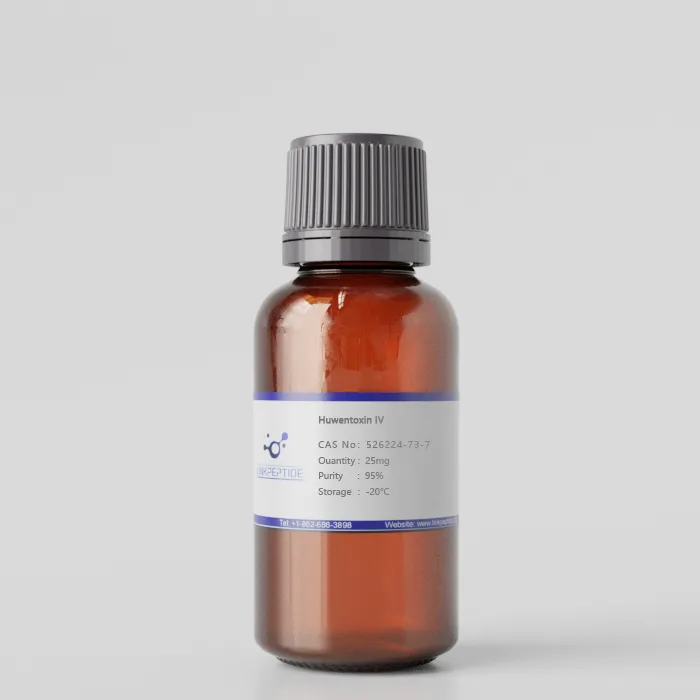
Product Name:Huwentoxin IV
CAS No:526224-73-7
Purity:95%
Molar Mass:4106.79
Chemical Formula:C174H278N52O51S6
Storage:Store at -20 degrees Celsius
Sequence:ECLEIFKACNPSNDQCCKSSKLVCSRKTRWCKYQI
Target:NaV1.7 channel blocker
Application:Huwentoxin IV is a peptide toxin derived from the venom of the Chinese bird spider (Ornithoctonus huwena). It is a potent and selective inhibitor of voltage-gated sodium channels (Nav1.7), which play a critical role in pain signal transmission. By binding to the voltage sensor domains of these sodium channels, Huwentoxin IV prevents their activation, thereby blocking the propagation of action potentials in neurons involved in nociception. This makes it a valuable tool in pain research, particularly in studies focused on chronic pain and the development of novel analgesics. Its high specificity for Nav1.7 channels has made it a promising candidate for exploring new pain therapies.
Current Research:
Huwentoxin-IV (HwTx-IV) is a 35-amino-acid neurotoxin isolated from the venom of the Chinese bird spider Selenocosmia huwena. It functions as a potent inhibitor of voltage-gated sodium channels (VGSCs), particularly targeting the tetrodotoxin-sensitive (TTX-S) subtypes.
Structural Characteristics
HwTx-IV belongs to the inhibitory cystine knot (ICK) structural family, characterized by a compact, stable configuration maintained by three disulfide bridges. This structure comprises a double-stranded antiparallel ??-sheet and multiple turns, contributing to its high stability and resistance to proteolytic degradation.
Mechanism of Action
HwTx-IV selectively inhibits TTX-S VGSCs by binding to neurotoxin receptor site 4 on the channel's ??-subunit. This interaction alters the voltage dependence of channel activation, effectively inhibiting neuronal Nav1.7, Nav1.2, Nav1.3, and Nav1.4 channels with IC?? values of 26 nM, 150 nM, 338 nM, and 400 nM, respectively.
Pharmacological Significance
The potent and selective inhibition of Nav1.7 by HwTx-IV has garnered interest for its potential analgesic applications, as Nav1.7 plays a crucial role in pain signaling pathways. Studies have demonstrated that HwTx-IV can attenuate pain responses in animal models of inflammatory and neuropathic pain, highlighting its therapeutic potential.
Research Applications
HwTx-IV serves as a valuable tool in neurophysiological research, aiding in the elucidation of VGSC function and the development of novel analgesics targeting specific sodium channel subtypes. Its high specificity and potency make it an essential molecule for studying the physiological and pathological roles of VGSCs.
Reference:
Get a Quote
 LinkPeptide